Fast, Reliable Attic Insulation Across Corona
Attic insulation in Corona usually costs between $1,800 and $5,200 depending on attic size, access clearance, and whether we’re topping up existing material or starting fresh. Most jobs wrap up in one day. Corona’s summer heat doesn’t joke around – attics here routinely hit 140°F and your ceiling is the only thing standing between that and your living room. We run crews into Corona every week from our base in Coto De Caza, and we know the difference between a downtown 1950s tract home with barely two feet of headroom and a 1990s hillside two-story with a wide-open attic. Call (855) 341-6045 for a free estimate, and we’ll tell you exactly what your attic needs – not what we happen to have loaded on the truck.
Why Maple Insulation Co Is Corona’s Preferred Attic Insulation Company
Noel Castaneda started Maple Insulation Co with a simple rule: match the material to the problem, not to the inventory. That matters in Corona more than most places, because the housing stock splits into two very different animals. Older homes near downtown have tight, low-pitch attics where full-size equipment simply won’t fit. The hillside subdivisions in 92883 and 92882 have sprawling attics that look fine from the hatch but hide compressed, settled fiberglass that’s lost half its R-value. Corona homeowners call us back because we send the right crew and the right equipment for the specific house – not a one-size-fits-all crew with a big truck and a prayer.
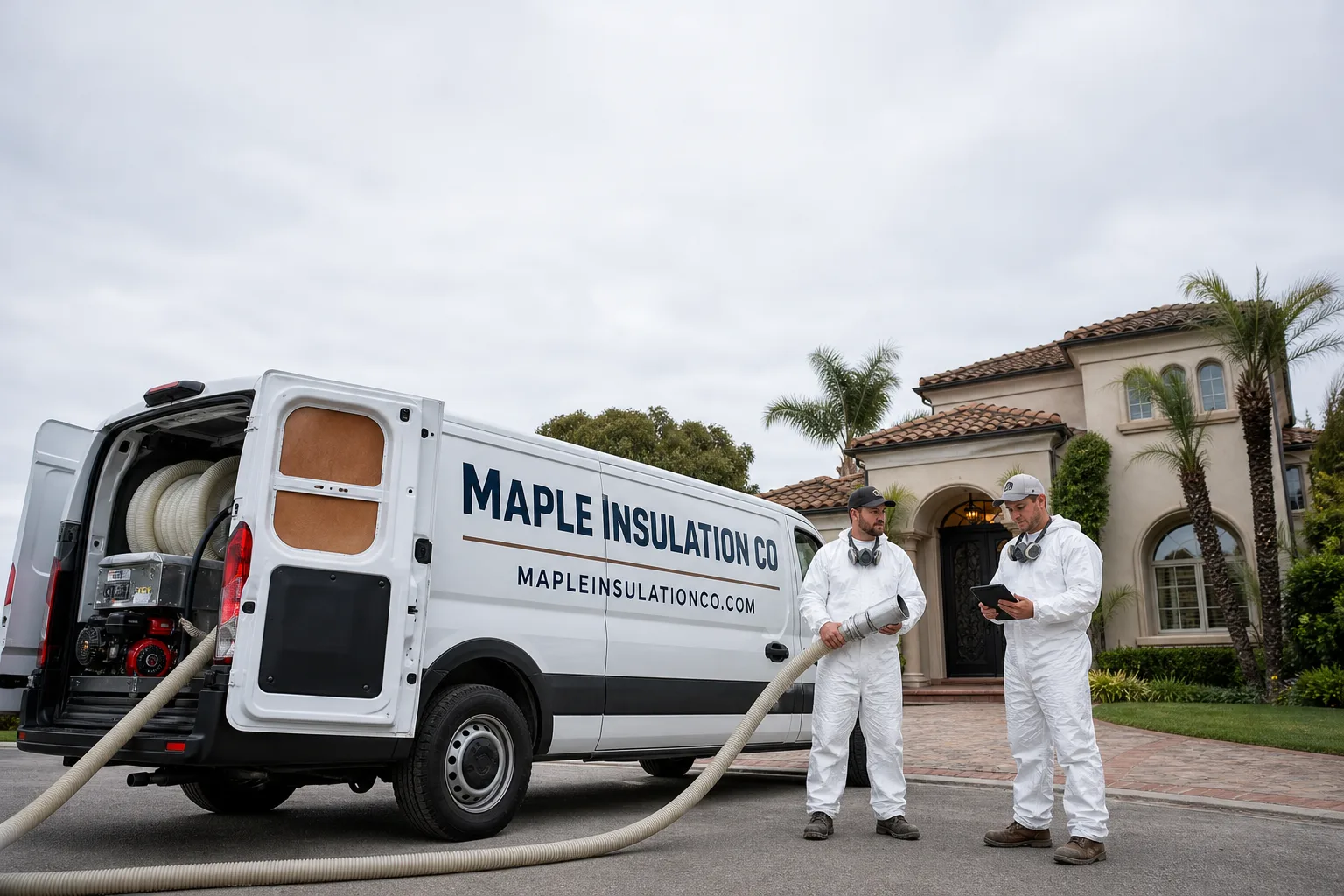
We stock eight brands across every major material category: Owens Corning and Johns Manville fiberglass, Rockwool mineral wool, GreenFiber cellulose, Icynene and Demilec spray foam. That’s not a brag – it’s leverage. It means when a Corona homeowner wants fire-resistant mineral wool for a west-facing tile roof over a bedroom, we can do that. When another wants open-cell spray foam to seal gaps in a 1970s tract home near the 91, we can do that too. Our Attic Insulation team handles all three primary methods – batt, blown-in, and spray foam – in-house. You don’t coordinate three contractors. You call one number and it’s handled.
Attic Ventilation in Corona
Attic Ventilation in Corona is what keeps your attic from turning into a kiln in August, and it’s the piece most insulation-only companies skip. Proper ventilation moves superheated air out through ridge vents, gable vents, or soffit vents while pulling cooler intake air in. If your attic doesn’t breathe, insulation becomes the ceiling on top of a hotbox – and in Corona, where July and August afternoons stretch past 100°F week after week, that hotbox radiates heat down through your ceiling long after the sun sets.
A typical ventilation upgrade on a Corona home runs $350 to $1,100, depending on whether we’re adding soffit vents, a ridge vent, or correcting an imbalance the original builder left behind. Older downtown homes in 92882 and 92878 often have almost no intake ventilation – just a couple of box vents that do nothing once the wind dies. Newer hillside homes in 92883 usually have decent ridge venting but undersized soffit intake, so air can’t move even though vents exist.
Low-Pitch Roof Ventilation Challenges
Downtown Corona’s low-pitch roofs have minimal attic volume, which means air stagnates fast. We often install low-profile soffit vents and dedicated gable-end vents to create actual cross-flow without cutting into roof structure that can’t afford it. This is one of the areas where a Corona-specific crew matters – the wrong vent setup on a low-pitch roof just moves hot air around, it doesn’t move it out.
Tile Roof Ridge Vent Integration
The concrete and clay tile roofs covering Corona’s southern and eastern hills need ridge vent integration done carefully to keep the tile profile intact and still exhaust heat. We cut and re-set tile properly, install the vent, and waterproof the transition. The point is doing it once, the right way, because on a 105° day in the Dos Lagos area you don’t want a roofer and an insulation guy pointing fingers at each other.
Radiant Barrier in Corona
Radiant Barrier in Corona is the single most effective upgrade for blocking radiant heat transfer through west-facing and south-facing roof decks in the Inland Empire sun. A radiant barrier is a reflective foil layer installed on the underside of the roof rafters. When the roof deck heats up to 150°F, the foil reflects that energy back out instead of letting the attic fill with heat that then soaks through your insulation into the home. In Corona’s semi-arid climate, with low humidity and relentlessly sunny summers, this matters more than in coastal ZIP codes.
Radiant barrier installation in Corona typically runs $900 to $2,400 for a full attic, depending on roof pitch, rafter spacing, and access. It’s a one-time upgrade that works immediately – and unlike insulation, it doesn’t degrade from heat exposure. The west-facing concrete tile roofs common in the southern hills near Eagle Glen and Dos Lagos take the worst beating, and we routinely see interior ceiling temps drop 10-15°F in those homes after a proper radiant barrier goes in.
Attic Insulation Top-Up Plus Radiant Barrier
Many Corona homeowners pair a radiant barrier with an insulation top-up, because they solve different problems. Insulation slows conductive and convective heat transfer; radiant barrier handles radiant heat. In an attic that already has R-19 batts but gets brutal in summer, a radiant barrier consistently cuts cooling load more than doubling the insulation would – and it costs less. We look at the actual attic, not a brochure, before recommending either.
Hillside Two-Story Radiant Barrier Needs
The 1980s-2000s two-story subdivisions in the south and east hills – places like Sierra Del Oro and the neighborhoods off Green River Road – have steep-pitch tile roofs and large south-facing roof planes. Those homes benefit most from radiant barrier installed on the underside of the rafters, especially where the roof deck faces west or southwest. The semi-arid inland heat means radiant barrier degrades more slowly than coastal fog would, but it also means the attic is hotter to begin with – making the barrier’s return timeline shorter.
Trusted Brands We Service in Corona
Maple Insulation Co installs and services material from Owens Corning, Johns Manville, Knauf, and Rockwool – and we carry those products specifically because Corona’s housing stock demands different solutions block to block. A downtown Corona 1950s home with a low attic needs a blown-in product that flows around framing without needing headroom to maneuver. A south Corona hillside two-story with a wide attic and a hot west roof needs mineral wool or high-density fiberglass with a radiant barrier above it. We keep local stock and can usually get Corona jobs on the calendar within a week, sometimes faster when the weather turns and the phone rings off the hook. Eight brands. Three methods. One contractor.
Common Attic Insulation Problems We See in Corona Homes
- Settled rock wool and vermiculite in downtown-era homes. The original insulation in many 1950s-1970s tract homes near downtown Corona has compressed to R-7 or less over the decades. It looks like dirt and does about as much good. The fix is a low-profile blown-in retrofit, not a bag-over-the-top that buries the old material without solving the clearance problem.
- Compressed blown-in fiberglass in hillside two-stories. Homes built 1985-2010 in the southern and eastern hills often have blown-in fiberglass that settles and compresses over time, especially under foot traffic from AC techs, cable installers, and the occasional overambitious homeowner. The R-value printed on the builder’s spec sheet is no longer the R-value in the attic. We measure, then we correct.
- Sun-degraded insulation along west-facing tile roof decks. The combination of intense Inland Empire sun and low humidity breaks down fiberglass and cellulose faster on west-facing slopes. Homeowners in Corona who live in homes with large western roof exposure often see uneven thermal performance from room to room – and the cause is invisible from the attic hatch.
- Missing or undersized attic baffles in ranch-style homes. Older single-story Corona homes with low-pitch roofs frequently have insulation jammed into the eave area with no baffles to preserve intake airflow. The attic can’t breathe, and adding more insulation without fixing the baffles makes the ventilation problem worse, not better.
Pricing for Attic Insulation in Corona, CA
A typical attic insulation project in Corona runs $1,800 to $5,200, with most single-story ranch homes landing in the $2,200 to $3,400 range and larger two-story hillside homes running $3,500 to $5,000+. The biggest cost driver is attic access – low-clearance downtown attics require specialized low-profile equipment and take more labor hours per square foot. Material choice matters too: blown-in GreenFiber cellulose tends to run slightly less than Rockwool mineral wool, while spray foam commands a premium for its air-sealing performance. We give you a written line-item estimate before any work starts, and the price is the price – no vague “depending” language that turns into a surprise change order. Call us at (855) 341-6045 for an exact quote. Estimates are free, and you’ll talk to a person, not a call center.
We Also Serve Cities Near Corona
Our crews run Attic Insulation in Corona and the surrounding Inland Empire communities every week. That includes Home Gardens, El Cerrito Corona, Eastvale, and Norco – all within a short drive, which means fast scheduling and no travel premiums. If you’re just over the city line, you’re still in our service area, and you’ll get the same Corona-caliber attention to your specific attic.
Serving Corona, CA — Our Local Coverage Area
We’re based in the Corona area and know this community well. Use the map below to see our service coverage — if you’re nearby, we can almost certainly help.
FAQs About Attic Insulation in Corona
Homes built in the 1950s through 1970s near downtown Corona were originally insulated to R-11 or R-19, but that material – often rock wool or vermiculite – settles and compresses over time, and the low-pitch roofs mean the attic was never re-insulated properly. The result is effective R-7 or less in many attics today. The fix is a low-profile blown-in retrofit that works around the tight clearance, which is a specialty we handle routinely for Corona homeowners. Call (855) 341-6045 and we’ll measure what you actually have, not what the original plans said.
For most homes in Corona’s southern and eastern hills – especially those with west-facing concrete tile roofs – a radiant barrier delivers measurable cooling load reduction and pays for itself over a few Inland Empire summers. It’s not a one-size answer; we evaluate roof orientation, attic ventilation, and existing insulation before recommending it. But if your home bakes on summer afternoons and the AC runs nonstop, a radiant barrier is usually the first upgrade we suggest. Estimates are free to Corona homeowners.
In many homes built between 1985 and 2010 in the south Corona hills, blown-in fiberglass has settled and compressed over the years, leaving uneven coverage and lower effective R-value than the original install. The only way to know is to measure actual depth and density in multiple attic locations, which we do as part of every free estimate. If it’s underperforming, a top-up or full replacement brings it back to where it should be for Corona’s summer heat.
Yes – we use low-profile blowing equipment designed specifically for attics with limited headroom, which is common in downtown Corona and the mid-century neighborhoods around it. The crew that runs full-size rigs into a low-pitch attic either can’t reach the far bays or ends up crushing the original insulation and making things worse. We match the equipment to the attic, not the other way around.
Insulation without proper ventilation turns your attic into a hotbox that radiates heat down into the home all night, which is the exact opposite of what a Corona homeowner wants from July through September. Proper ventilation exhausts superheated air, typically through ridge, gable, or soffit vents. We check ventilation before we add insulation, because the best insulation in the world can’t do its job if the attic can’t breathe.
Written by Noel Castaneda, Owner at Maple Insulation Co, serving Corona and the Inland Empire with attic insulation, spray foam, and blown-in insulation solutions since day one.