Fast, Reliable Attic Insulation Across Eastvale
Attic insulation in Eastvale is almost never about repairing old walls. It’s about upgrading builder-grade construction in homes that all went up within the same 15-year window. If your cooling bills climb every summer and your upstairs runs 8 to 10 degrees hotter than downstairs, the attic is usually the culprit. We work in Eastvale weekly, know the tract layouts off Limonite, Hamner, and Archibald, and can typically get a crew to your home within a few days. Call (855) 341-6045 for a free estimate.
Why Maple Insulation Co Is Eastvale’s Preferred Attic Insulation Company
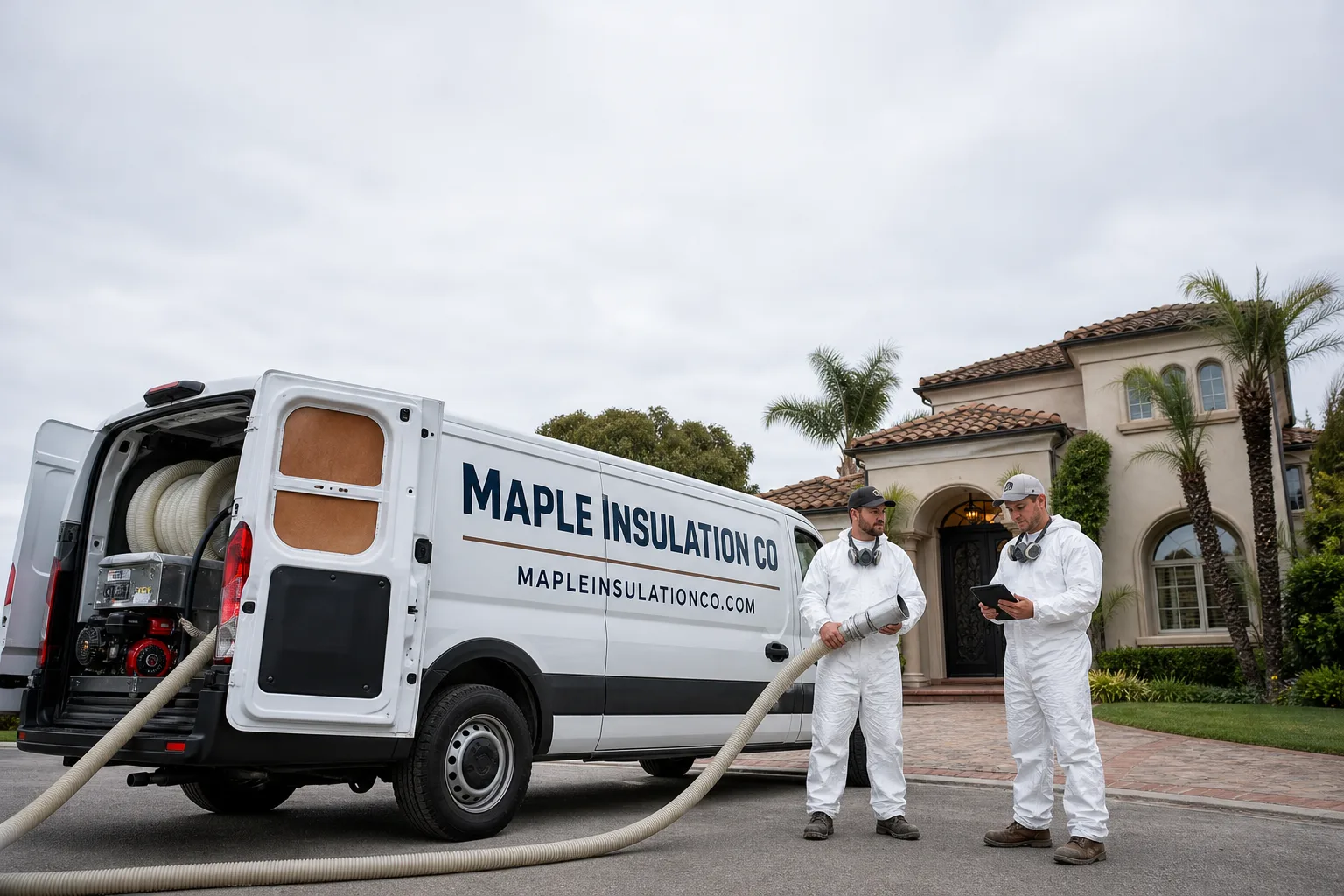
Most Eastvale homeowners call us because a neighbor already used us. The housing stock here is so uniform that when one house on a street gets fixed, three more calls come in the same month. Our crews know the standard Eastvale attic before stepping inside: high, hard-to-access spaces over attached garages, vaulted ceiling zones with thin coverage, and ductwork that bakes all summer.
Noel Castaneda runs our team with a simple rule: match the material to the problem, not to what we happen to stock most. That’s why Eastvale customers get real options from eight manufacturers, including Owens Corning, Johns Manville, and Rockwool. We carry fiberglass, mineral wool, cellulose, and both open-cell and closed-cell spray foam. The recommendation follows the attic, the climate, and your goals. Not our inventory sheet.
We’re licensed and insured, and estimates are always free. The phone number again: (855) 341-6045.
Attic Mold Removal in Eastvale
Attic mold removal in Eastvale is a common call in August and September, after months of heat push moisture into attic spaces where bathroom fans vent improperly. In 2000s-era tract homes, the vent ducts are often pointed at the roof sheathing instead of out a soffit. That warm, moist air hits a hot surface and condenses. Mold follows. Our crew in Eastvale removes the contaminated material, treats the affected framing, and checks the ventilation path so the problem doesn’t return in the next hot season.
Attic mold removal in Eastvale typically runs $1,200 to $3,800 depending on the square footage affected and how much insulation has to come out with it. We do this in-house, no subcontracted remediation crews.
Prevention After Remediation
The fix only holds if the ventilation gets corrected. After mold removal, we check soffit and ridge vent airflow and reposition bathroom fan ducts where the builder cut corners. In Eastvale’s low-slope attics, soffit vents are often partially blocked by insulation. That’s a repair we make before new insulation goes in.
When Mold Means Removal, Not Treatment
Surface treatment works when the mold is caught early and shallow. But when mold has embedded into fiberglass batts or blown-in cellulose, the material has to go. We see that more often in Eastvale homes where the original builder insulation was left untouched for 15-plus years. The cost to pull it and replace it is usually less than a second round of treatment a year later.
Attic Insulation Removal in Eastvale
Attic insulation removal in Eastvale happens for two reasons: contamination or a bad original install. In most Eastvale homes, the original blown-in fiberglass was installed thin, sometimes as low as R-11 to R-19 in low-slope sections. Over time it settles, compresses, and loses even that modest performance. When a homeowner wants to start fresh with a deeper, denser insulation, full removal is the cleanest path.
Attic insulation removal in Eastvale typically runs $900 to $2,500 depending on attic size and accessibility. That includes full vacuum extraction, bagging, and disposal. The high, hard-to-access attics over Eastvale’s two-story fronts add labor time, which is why our estimate always accounts for access points and ceiling height.
The Removal and Replacement Sequence
We remove first, then air-seal, then install. Air-sealing between removal and new insulation makes a measurable difference. In Eastvale’s summer conditions, top plates and recessed can lights leak hot attic air into living spaces. Sealing those before new insulation goes in is the highest-return hour of labor on the job, more effective than adding another few inches of insulation over a leaky ceiling.
Signs Removal Is the Right Call
If your Eastvale attic has visible rodent activity, roof leak staining, or insulation that’s been compressed by foot traffic from cable and HVAC work, removal beats layering over the top. Piling new insulation over damaged or contaminated material doesn’t fix the underlying problem. Removal costs more upfront but avoids a second project later.
Trusted Brands We Service in Eastvale
We install and service insulation from Owens Corning, Johns Manville, Knauf, and Rockwool, among others. For Eastvale homeowners, that matters because brand matching matters. If your 2012 tract home came with a specific batt product, we can match the type and density rather than mixing materials that behave differently. We stock common batt widths and blown-in fiberglass locally, which means most Eastvale jobs are completed in a single visit. No waiting on special-order material from out of state.
Common Attic Insulation Problems We See in Eastvale Homes
- Compressed builder-grade batts in low-slope sections. Eastvale’s original insulation was often R-19 at best, compressed down to R-11 where roof framing pinches. In the high, hard-to-access attics over the second story, that leaves vaulted ceiling zones with almost no effective coverage. We see the same pattern house after house.
- Duct runs baking at 140°F or higher in summer. Eastvale’s inland heat turns attic spaces into ovens. Ducts without adequate buried depth or radiant-barrier protection lose cooling capacity before the conditioned air even reaches the rooms. Attic insulation alone won’t fix this; the ducts and the attic floor both need attention.
- Air leaks at top plates and recessed can lights. These 2000s-era tract homes were built fast. The joint where interior walls meet the attic floor is rarely sealed. Hot attic air pours into living spaces through those gaps, so even after new insulation goes in, homeowners still feel warmth bleeding through if the sealing step is skipped.
- Settled blown-in fiberglass from the original build. Fiberglass settles over 15 to 20 years, especially in Eastvale’s dry heat. What started as R-30 can perform like R-22 or worse. A top-up is a straightforward fix, but only after checking the existing material’s condition and the air-sealing underneath.
Pricing for Attic Insulation in Eastvale, CA
A typical attic insulation top-up in Eastvale runs $1,100 to $2,300 for a standard two-story tract home. Full replacement with air-sealing ranges from $2,400 to $4,800 depending on attic size and access difficulty. Blown-in fiberglass (generally Owens Corning or Johns Manville) is the most common choice for Eastvale’s low-slope, hard-to-reach attics because it covers deep and settles predictably. Rockwool batts cost more, typically $3.00 to $3.80 per square foot installed, and get specified when fire resistance or sound attenuation matters. Spray foam runs higher, $3.50 to $6.00 per square foot, and we steer most Eastvale homeowners toward it only for specific cathedral ceiling or duct-encapsulation applications. The variables are attic square footage, access, existing insulation condition, and whether air-sealing is included. Call (855) 341-6045 for an exact quote; estimates are free.
We Also Serve Cities Near Eastvale
Beyond Eastvale, our crews cover Norco, Home Gardens, Corona, and Jurupa Valley. Each of those areas has its own housing patterns, from Norco’s larger lots to Corona’s hillside builds. If you’re a few miles from Eastvale, we can usually schedule without delay since we’re already in the area most weeks. Read more about our Attic Insulation work and see what applies to your home.
Serving Eastvale, CA — Our Local Coverage Area
We’re based in the Eastvale area and know this community well. Use the map below to see our service coverage — if you’re nearby, we can almost certainly help.
FAQs About Attic Insulation in Eastvale
Yes, in almost every case. The original insulation in a 2005 Eastvale home was builder-grade, usually R-19 batts or thin blown-in fiberglass that has since settled and compressed, performing closer to R-11 to R-19 in the critical low-slope sections. Upgrading to R-49 with air-sealing typically cuts attic-driven heat gain enough to drop upstairs temperatures by 6 to 10 degrees in the summer afternoons. That’s the single most effective energy upgrade for a home of that era. Call (855) 341-6045 and we’ll give you an honest read on what’s up there.
We use long-reach blowing hoses and plan access from the garage-side attic entry, which is standard in most Eastvale floor plans. Where access is too tight, we add temporary decking and work with low-profile equipment rather than forcing our way through. The difficulty is real and that’s exactly why we include access conditions in every estimate, so the price you get is the price you pay. No same-day upcharge because the attic was tighter than expected.
Most Eastvale homes benefit more from deeper insulation plus air-sealing than from a radiant barrier alone, but the two work together. In the inland summer, a radiant barrier can cut attic temperatures by 10 to 15 degrees, but it does nothing for conduction through the attic floor, which is where insulation depth matters. We usually recommend hitting R-49 on the attic floor and then considering a radiant barrier if the ductwork runs through the attic and the cooling bills are still high. Call (855) 341-6045 and we’ll talk through what your specific attic needs.
Removal takes everything out, down to the drywall; adding more insulation simply layers new material on top of what’s already there. Adding more is faster and cheaper, but only makes sense if the existing insulation is dry, uncontaminated, and not compressed beyond usefulness. In Eastvale homes where rodents, roof leaks, or mold have compromised the original fiberglass, removal is the correct call, followed by air-sealing and fresh insulation. We quote both paths so you can compare honestly.
Yes. Because Eastvale was built in concentrated bursts, most homes in a given tract share the same original insulation product, and we carry or can quickly source Owens Corning, Johns Manville, Knauf, and Rockwool products to match. Matching brand and type matters when you’re topping up rather than starting over, since mixed materials can behave differently under load and temperature. If a perfect match isn’t the right move, we’ll tell you that straight and recommend the better replacement. Call (855) 341-6045 and we’ll check what’s currently in your attic.
On a recent job in Eastvale’s Riverwalk neighborhood, our crew found the builder-grade fiberglass batts compressed to about R-11 and ductwork baking at 140°F in the attic. We air-sealed the top plates and recessed can lights, then blew in Owens Corning fiberglass to R-49, which dropped the upstairs afternoon temperature by 8°F and cut cooling runtime noticeably. The homeowner said the difference was obvious the first hot week. That’s the classic Eastvale job: same thin insulation, same hot ducts, same fix, block after block.
Written by Noel Castaneda, Owner at Maple Insulation Co, serving Eastvale and the surrounding Inland Empire.