

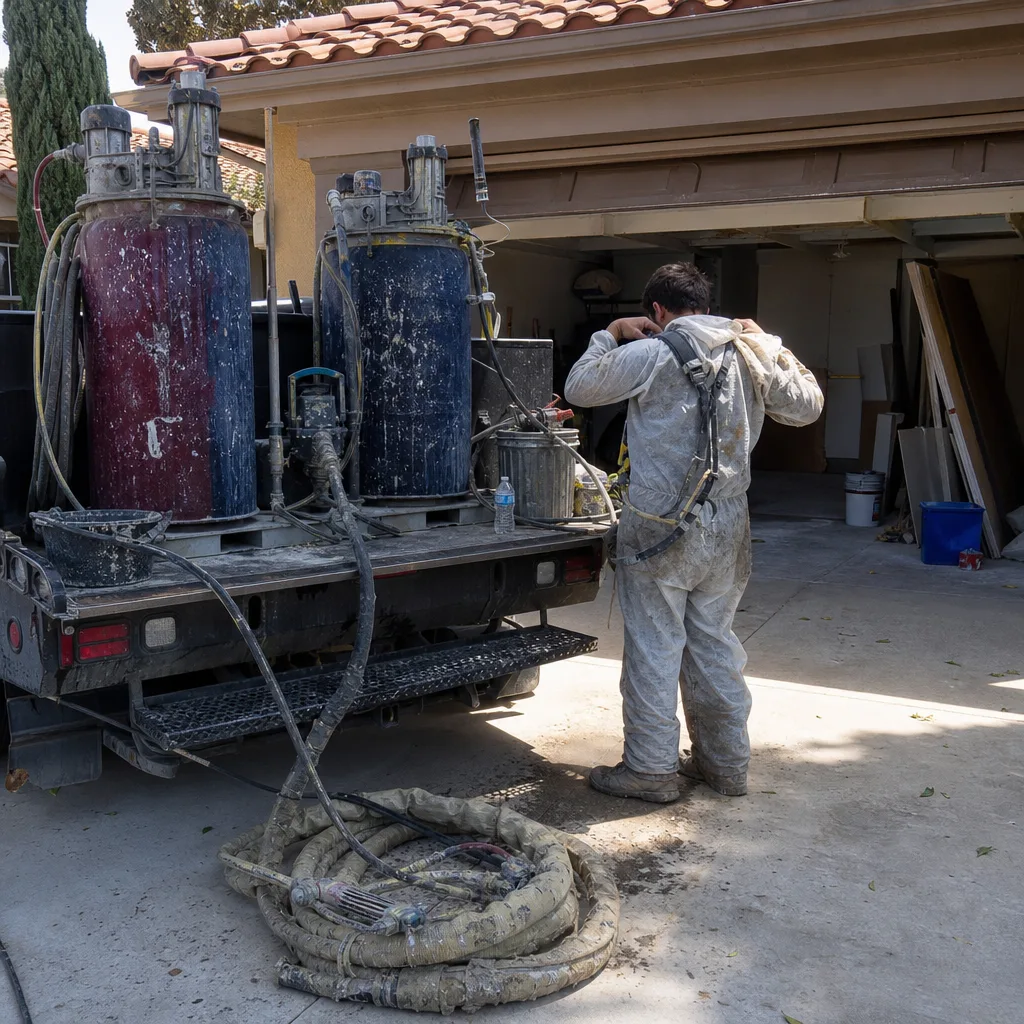
Trusted Spray Foam Insulation for Coto De Caza Homeowners
Spray foam insulation in Coto De Caza closes the gaps that fiberglass batts and blown-in cellulose leave behind, cutting air leakage by up to 30% in the homes we test. We’re Maple Insulation Co, led by Noel Castaneda, and we install open-cell and closed-cell foam from Icynene and Demilec, matching the product to your attic, walls, or crawl space rather than pushing whatever’s on the truck. Coto De Caza’s canyon winds and hot inland summers make a tight building envelope more than a luxury – it’s the difference between an HVAC system that cycles normally and one that runs constantly from May through October. Call (855) 341-6045 for a free estimate, and we’ll tell you honestly whether spray foam is the right fix for your house or if another material would serve you better.
Closed Cell Spray Foam Insulation
Closed Cell Spray Foam Insulation is a dense, vapor-impermeable foam that cures to roughly 2 pounds per cubic foot, adding structural rigidity and an R-value of about 6.5 per inch – the highest per-inch rating of any common insulation material. We recommend it for Coto De Caza homes where moisture control matters as much as temperature, like crawl spaces, rim joists, and exterior walls. Noel and our crew install closed-cell foam from Demilec and Icynene, applying it in continuous lifts so it bonds to sheathing, studs, and masonry without sagging. Closed-cell is the premium option; your actual cost depends on square footage and substrate condition, which we assess during the free estimate. See how much Spray Foam Insulation costs for typical project ranges.
Structural Strength and Water Resistance
Closed-cell foam adds shear strength to wall assemblies, which is why builders specify it in high-wind and seismic zones. Its closed polymer cells block bulk water and water vapor, meaning you won’t get the condensation problems that plague poorly detailed insulation in canyon humidity.
For a garage conversion or a room above an unconditioned space, this stiffness and moisture control often makes closed-cell the only foam that makes sense with our Spray Foam Insulation in Coto De Caza.
Where It Pays Off Fastest
Rim joists and crawl spaces are the two highest-return locations for closed-cell foam in our experience. A band of closed-cell at the rim cuts the stack effect that pulls hot outside air into your home all summer.
In walls, closed-cell delivers both insulation and an air barrier in a single pass, which simplifies detailing and removes the need for separate house wrap in many retrofit scenarios.
Open Cell Spray Foam
Open Cell Spray Foam is a lighter, vapor-permeable foam that cures at roughly 0.5 pounds per cubic foot, filling every cavity with a soft, air-sealing blanket rated around R-3.7 per inch. It’s the right call in Coto De Caza when you want maximum air sealing on a budget that stays below closed-cell pricing. We spray it overhead in attics and into stud bays where the home doesn’t face the moisture issues that demand closed-cell. Open-cell foam expands to roughly 100 times its liquid volume, so it reaches the awkward voids behind electrical boxes and around plumbing that batts always miss.
Attic Roof Decks and Sound Control
Applied to the underside of the roof deck, open-cell foam turns a vented attic into a conditioned space, which brings ductwork inside the thermal boundary. That matters in Coto De Caza because so many homes run HVAC ducts through attics that hit 140 degrees in August.
Open-cell also absorbs sound better than closed-cell, making it a smart choice for interior walls around bedrooms and home offices.
Budget-Conscious Air Sealing
Because it expands so aggressively, open-cell achieves complete cavity fill with less material than closed-cell, which keeps the installed cost lower per square foot. That’s why we often spec open-cell for large attic jobs where the priority is stopping air movement, not maximizing R-value per inch.
Noel can walk you through the trade-offs between the two foams so the choice comes down to your house, not guesswork.
Spray Foam Insulation Contractors
Spray Foam Insulation Contractors install the only insulation that functions as an air barrier, vapor retarder, and thermal insulator in one material, and Maple Insulation Co handles both open-cell and closed-cell applications in-house. Choosing a contractor for foam work matters more than for any other insulation type because foam performance depends on ambient temperature, substrate prep, and applicator technique. Our crew sprays Icynene and Demilec products under the leadership of Noel Castaneda, who has spent his career learning how foam behaves in the field, not just how it looks on a data sheet.
In-House Crew, Real Training
We don’t subcontract foam application. The same Maple Insulation Co team that measures your attic also runs the proportioner and the spray gun, so accountability doesn’t disappear between the estimate and the install.
Foam that’s sprayed off-ratio or onto a dusty substrate fails silently. A trained crew that does this every week is the difference between a job that performs for 30 years and one that delaminates in two.
Material Selection Without the Pitch
Our access to eight brands means we can spec open-cell, closed-cell, or a hybrid approach based on your home’s actual needs. We’d rather talk you out of foam entirely and into Rockwool batts than sell a product that isn’t the best fit for your Coto De Caza house.
That’s the practical difference of working with a contractor who isn’t married to a single product line.
Spray Foam Attic Insulation
Spray Foam Attic Insulation seals and insulates the attic – the single largest source of energy loss in most Coto De Caza homes – by applying foam to the roof deck, gable ends, or attic floor depending on whether the attic is vented or conditioned. We inspect your attic before recommending anything: how the ducts run, whether the HVAC equipment lives up there, and whether the soffit and ridge vents are working. If you’re converting the attic to a storage or living space, roof-deck foam is usually the right answer. If you just want to stop heat pouring through the ceiling, we may recommend sealing the attic floor and adding blown-in instead – even though foam is a bigger-ticket item, we won’t spec it where it doesn’t earn its cost.
Vented vs. Conditioned Attics
A vented attic with foam at the ceiling plane and blown-in insulation works well when ducts aren’t present, but most Coto De Caza homes have ductwork up top. Foam at the roof deck brings those ducts into the conditioned envelope and can cut duct-related energy loss dramatically.
We’ll explain the physics of each approach during your estimate so the decision is grounded in how your house actually works, not a generic recommendation.
Retrofit Ceilings and Existing Insulation
If old fiberglass already sits on the attic floor, we remove or level it before spraying, because foam over a dirty, dusty substrate won’t bond properly. This prep step is where shortcuts happen, and it’s one reason we never rush an attic job.
Our crew also seals attic bypasses – around chimneys, plumbing vents, and electrical penetrations – before applying foam, because air sealing means nothing if the gaps remain open.
Spray Foam Wall Insulation
Spray Foam Wall Insulation fills stud cavities completely and air-seals the wall assembly, which is why we recommend Spray Foam Insulation – Mission Viejo and Coto De Caza homes where rooms feel drafty or where exterior walls get blazing hot in the afternoon sun. Walls insulated with fiberglass batts still leak air around outlets, behind drywall seams, and where pipes penetrate the framing. Open-cell foam in a 2×4 wall delivers about R-13 and an air seal in one step; closed-cell in a 2×6 wall can exceed R-20 while acting as a vapor barrier – important for homes near the canyon’s morning fog line.
New Construction vs. Retrofit
For new builds or additions, we spray walls before drywall goes up, which is the cleanest and most cost-effective way to apply wall foam. For existing homes, we can inject foam through small access holes if the drywall is intact, or spray open cavities during a renovation.
Noel’s experience with both scenarios means he’ll tell you when wall foam is worth the disruption and when a dense-packed cellulose retrofit makes more sense.
Common Wall Leak Points
The worst air leaks in a wood-framed wall aren’t the insulation bays – they’re the rim joist, the band board, and the area where the wall meets the foundation. We treat those junctions before insulating the wall cavities themselves.
In older Coto De Caza homes, we also check for proper drainage plane details before spraying, because foam can trap moisture behind stucco if the wall wasn’t built to dry outward.
Rim Joist Spray Foam
Rim Joist Spray Foam seals the band of framing that sits on top of the foundation wall – the most overlooked air leak in any home – by spraying closed-cell foam across each joist bay from the crawl space or basement. In Coto De Caza homes, rim joists are often uninsulated or stuffed carelessly with fiberglass batts that do nothing to stop air. Closed-cell foam at the rim stops that air, handles the condensation risk from humid crawl spaces, and insulates simultaneously. Our crews spray the rim thoroughly in every job that involves the crawl space, often as a first step before tackling the larger attic project.
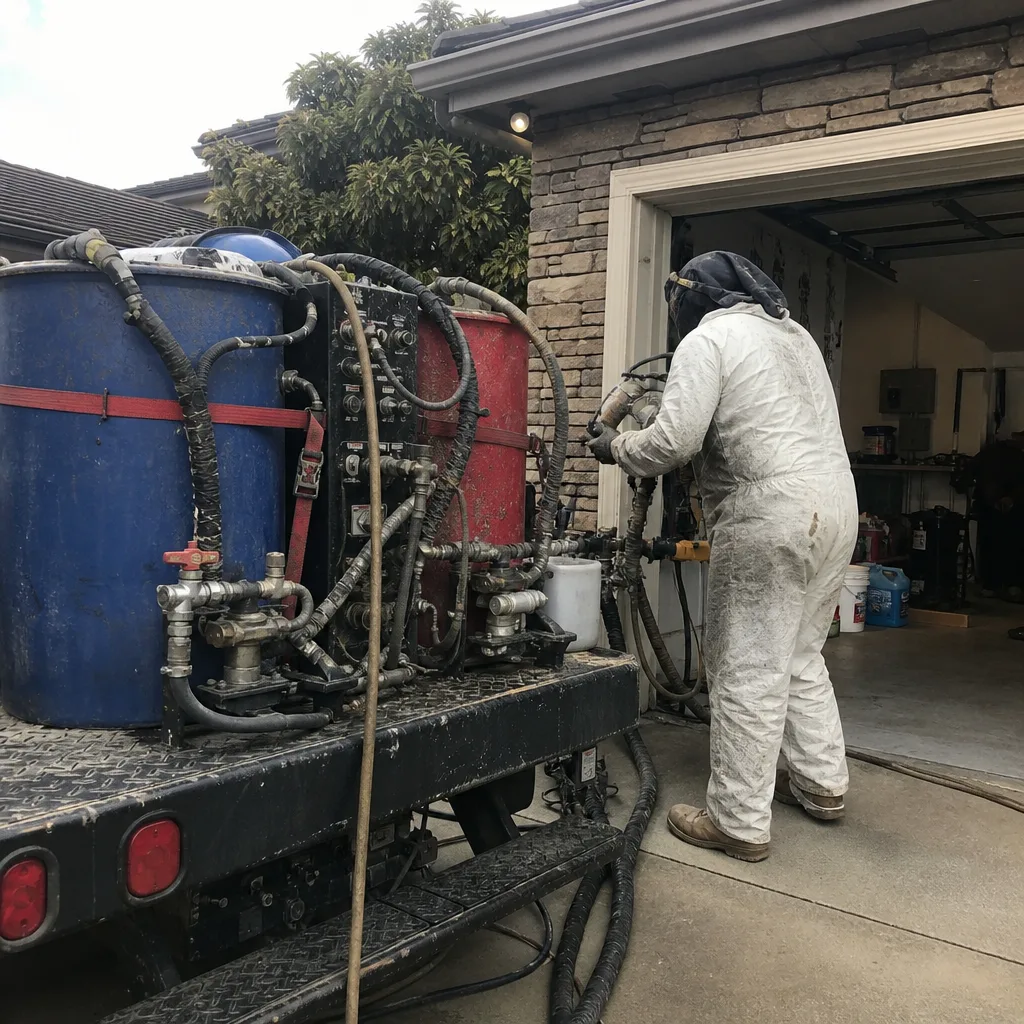
Stopping the Stack Effect
Hot outside air enters through the rim joist and rises through the house, pushing conditioned air out through the attic – a process called the stack effect. Sealing the rim joist is the single highest-value air sealing improvement we make in a typical Coto De Caza home.
Once the rim is tight, the rest of the building envelope works far more predictably.
Bond and Coverage Details
Closed-cell foam bonds to the sill plate, the subfloor above, and the foundation below, creating a continuous seal that block fills every seam and gap in one pass. We pull back any existing batts before spraying, because foam over old insulation is a waste of material.
Each bay gets a minimum of two inches of closed-cell foam, which provides both the air seal and a vapor retarder, ending the musty smell and rot risk at the source.
Crawl Space Spray Foam Insulation
Crawl Space Spray Foam Insulation seals and insulates the foundation walls or the floor above the crawl space, depending on whether you choose a conditioned or unconditioned crawl, and it’s one of the most frequently requested services we handle with Lake Forest Spray Foam Insulation and Coto De Caza. Homes with vented crawl spaces pull damp, cold, or hot outside air directly into the living space all year round. Closed-cell foam on the crawl space walls creates a conditioned space that keeps moisture and radon out, while foam on the floor above addresses comfort without changing the crawl space ventilation. Noel will help you choose the right approach by looking at your specific foundation type and drainage.
Conditioned Crawl Spaces
Spraying the crawl space walls moves the thermal boundary from the floor joists to the foundation, giving you a clean, dry space that can double as storage. We also seal the crawl space vents when conditioning, which is a step many contractors skip.
In Coto De Caza’s dry-summer climate, a properly conditioned crawl space often solves the mysterious cold floors in winter and the humid air that infiltrates older homes in winter storms.
Floor Deck Insulation for Vented Crawls
If a crawl space stays vented – cheap and common in older construction – spray foam on the underside of the floor joists is ideal, but closed-cell is usually required because open-cell against the subfloor can trap moisture. We check the joist spacing and subfloor condition before recommending either option.
This approach doesn’t give you the usable space of a conditioned crawl, but it dramatically improves floor temperature and reduces the drafts that creep up through floorboards.
Garage Spray Foam Insulation
Garage Spray Foam Insulation insulates the shared wall between the garage and the living space and can also be applied to the garage walls and ceiling for temperature control, which benefits homeowners who use the garage as a workshop, gym, or secondary living area. Too many Coto De Caza garages are built with zero insulation in that shared wall, which means the house leaks conditioned air into the garage and pulls hot or cold air back through. We spray closed-cell foam against the shared wall – it blocks air leakage and adds a fire-resistant barrier when required by code – and can extend the work around the garage’s exterior walls and ceiling for full comfort.
The Shared Wall Detail
The wall between your garage and your living room should be treated like an exterior wall when it comes to air sealing. We spray the stud cavities and the rim joist above the shared wall in one continuous pass, which is the only reliable way to stop garage air from entering your home.
This detail matters as much for indoor air quality as for energy loss – car exhaust and stored chemicals have no business in your living space.
Comfort in a Working Garage
Insulating garage walls and the garage ceiling with open-cell foam tames the extreme heat in summer and keeps a workable temperature in winter without taxing your home’s HVAC. If you’re parking cars in the garage and storing paint or tools, open-cell is usually the right call because it allows the assembly to dry.
We’ll walk the space with you and prioritize the areas that give the biggest comfort return for the cost.
Brands We Service
We stock and install spray foam from Icynene and Demilec, two of the most widely specified open-cell and closed-cell foam lines in residential construction. Icynene’s open-cell foam is known for its reliable expansion and consistent R-value, and we’ve applied it in attics and walls throughout Coto De Caza. Demilec’s closed-cell products are our go-to for rim joists and crawl spaces where moisture resistance is non-negotiable.
Beyond foam, our material roster includes Owens Corning and Johns Manville fiberglass, Rockwool mineral wool for fire resistance and sound control, and GreenFiber recycled cellulose for homeowners who want a sustainable option. That’s eight brands across five material categories, which means your insulation plan is built around your house, not our inventory. Whatever the right material turns out to be, we have it on the truck and the crew that knows how to install it correctly.
Signs You Need a Pro Right Now
- Upstairs rooms that never hold temperature. Heat rising through an under-insulated attic floor or poorly sealed ductwork makes second-story rooms run 8-10 degrees warmer than the rest of the house. Foam at the roof deck or duct sealing addresses this directly.
- Dust and musty smell in the crawl space. Musty crawl space air is a sign that the rim joist and foundation walls are leaking outdoor air and moisture into the home. Left alone, this leads to mold on the subfloor and musty air in every room.
- HVAC runs constantly from May to October. If your AC runs 12 or more hours a day in Coto De Caza’s hot season and never reaches the set point, the house is leaking conditioned air faster than the system can replace it. Air sealing with foam is the fix, not a bigger unit.
- Drafts around outlets and baseboards. Air moving through wall cavities and out of electrical penetrations means the wall assembly has no air barrier. Foam in the stud bays seals those pathways; no amount of caulk at the trim will.
- Condensation on garage walls or the shared wall with the house. Moisture collecting on the garage-side wall means warm house air is leaking into a cooler garage and hitting the dew point. That condensation rots framing and grows mold if it isn’t sealed at the source.
Our Process, Step by Step
- 1
Site walk and diagnostic conversation. Noel Castaneda walks your home inside and out, inspecting the attic, crawl space, walls, and rim joists with you. We ask about hot and cold rooms, humidity, and how you use the space, so the plan fits how you actually live.
- 2
Material recommendation and written estimate. We explain why closed-cell, open-cell, or a hybrid approach – or sometimes a different material entirely – fits your house. The estimate lists the scope, product, and material coverage clearly, with no vague line items.
- 3
Prep and protection. We mask floors, furniture, and fixtures, and we protect the work area from overspray before any foam leaves the gun. Existing damaged insulation is removed or leveled, and any substrate issues are corrected before we spray.
- 4
Application by trained crews. Our own team applies the foam using calibrated proportioners and heated hoses, maintaining the right substrate temperature and foam thickness throughout. We spray in lifts and check coverage continuously, because foam that’s applied too thick in one pass doesn’t cure correctly.
- 5
Post-install inspection and cleanup. We walk the finished work with you, confirm the foam depth and coverage, and clean the site to the condition we found it. You’ll know exactly what was done and where, and we’ll note any remaining opportunities for future work.
How Much Does Spray Foam Insulation Cost in Coto De Caza?
A typical spray foam insulation job in Coto De Caza runs between $2,500 and $12,000 depending on scope. Sealing and insulating a rim joist on the average 2,000-square-foot home usually costs $1,800 to $3,200. An open-cell attic roof deck installation runs $3.50 to $5.50 per board foot of coverage, while closed-cell runs $6.50 to $9.50 per board foot. Crawl space wall foam in a standard 1,200-square-foot crawl typically lands between $3,000 and $6,000, and a full-garage retrofit – shared wall, exterior walls, and ceiling – usually runs $4,000 to $9,000. The biggest cost drivers are total square footage, foam thickness required for your target R-value, substrate prep, and whether existing insulation needs removal.
The best way to avoid overpaying is to make sure you’re buying the right foam for the right location. Closed-cell foam costs more than open-cell, but it’s the correct product for rim joists and crawl space walls; open-cell is usually the better value for attic roof decks and interior walls. A free estimate from us includes the total coverage area in board feet, the foam type, and the thickness, so you can compare apples to apples without a fuzzy per-square-foot number. Call (855) 341-6045 and we’ll send Noel out to measure and price your job while you watch.
Our Service Area Near Coto De Caza
Maple Insulation Co serves Coto De Caza and the surrounding South Orange County communities, including Rancho Santa Margarita, Ladera Ranch, Trabuco Canyon, Mission Viejo, Portola Hills, Lake Forest, Foothill Ranch, Laguna Hills, Laguna Woods, Aliso Viejo, and Laguna Beach. We schedule most estimates within a few days of your call and can often fit emergency air sealing work in the same week. If you’re not sure whether we cover your address, call us – if we can’t help, we’ll say so plainly.
Serving Coto De Caza, CA — Our Local Coverage Area
We’re based in the Coto De Caza area and know this community well. Use the map below to see our service coverage — if you’re nearby, we can almost certainly help.
Frequently Asked Questions About Spray Foam Insulation in Coto De Caza
Spray foam insulation is a two-component polymer that expands on contact to fill cavities and seal air gaps, acting as insulation and air barrier in one. It’s applied as a liquid and cures into a solid foam within minutes, available in open-cell (softer, permeable) and closed-cell (denser, water-resistant) varieties. We install both types in Coto De Caza homes, selecting the right product for the location and moisture conditions.
Most residential spray foam jobs in Coto De Caza are completed in one day, though larger jobs that combine attic and crawl space work may take two. The foam itself cures within minutes, but prep work – masking, removing old insulation, and substrate repair – adds time. We’ll give you a clear timeline with your free estimate.
Spray foam work in Coto De Caza typically runs $2,500 to $12,000 depending on the area covered, foam type, and thickness. A rim joist seal runs $1,800 to $3,200, an open-cell attic roof deck runs $3.50 to $5.50 per board foot, and closed-cell runs $6.50 to $9.50 per board foot. Call (855) 341-6045 for an exact quote – estimates are free.
Yes, we install both Icynene and Demilec spray foam products, and we’ll select the specific formulation based on your project’s R-value goals, moisture exposure, and budget. Our crews are trained on both product lines and use calibrated equipment to ensure proper mix ratio and expansion. We also stock Owens Corning, Johns Manville, Rockwool, Knauf, and GreenFiber materials for non-foam applications.
We can often schedule emergency air sealing work – like exposed rim joists after foundation repair or immediate attic sealing before a heat wave – within the same week of your call. The work timeline depends on crew availability and the scope, but we prioritize urgent jobs for existing customers and new clients facing active comfort or moisture problems. Call us at (855) 341-6045 and we’ll tell you honestly when we can get there.
Spray foam insulation carries manufacturer warranties from Icynene and Demilec when installed by a trained contractor, and we stand behind our workmanship with our own service commitment. If a foam application fails due to adhesion, off-ratio mixing, or incomplete coverage, we’ll return and correct it. We document every install so warranty claims can be resolved without a fight.
Clear the area around the attic access, crawl space entry, or garage workspace so our crew can move freely, and move any stored items or vehicles that might be hit by overspray. We handle all masking and protection with plastic sheeting and tape before spraying. If you have questions about a specific room or item, call us ahead of time and we’ll walk you through it.
Schedule Your Spray Foam Insulation Service in Coto De Caza Today
If your Coto De Caza home runs hot upstairs, drafts through the walls, or pulls musty air from the crawl space, we’ll find the source and fix it with the right insulation material – foam, batts, or blown-in – not a canned solution. Call Noel Castaneda and the Maple Insulation Co team at (855) 341-6045 for a free, no-obligation estimate. We’ll measure, explain your options in plain language, and give you a number you can work with.
Written by Noel Castaneda, Owner at Maple Insulation Co, serving Coto De Caza and South Orange County.