
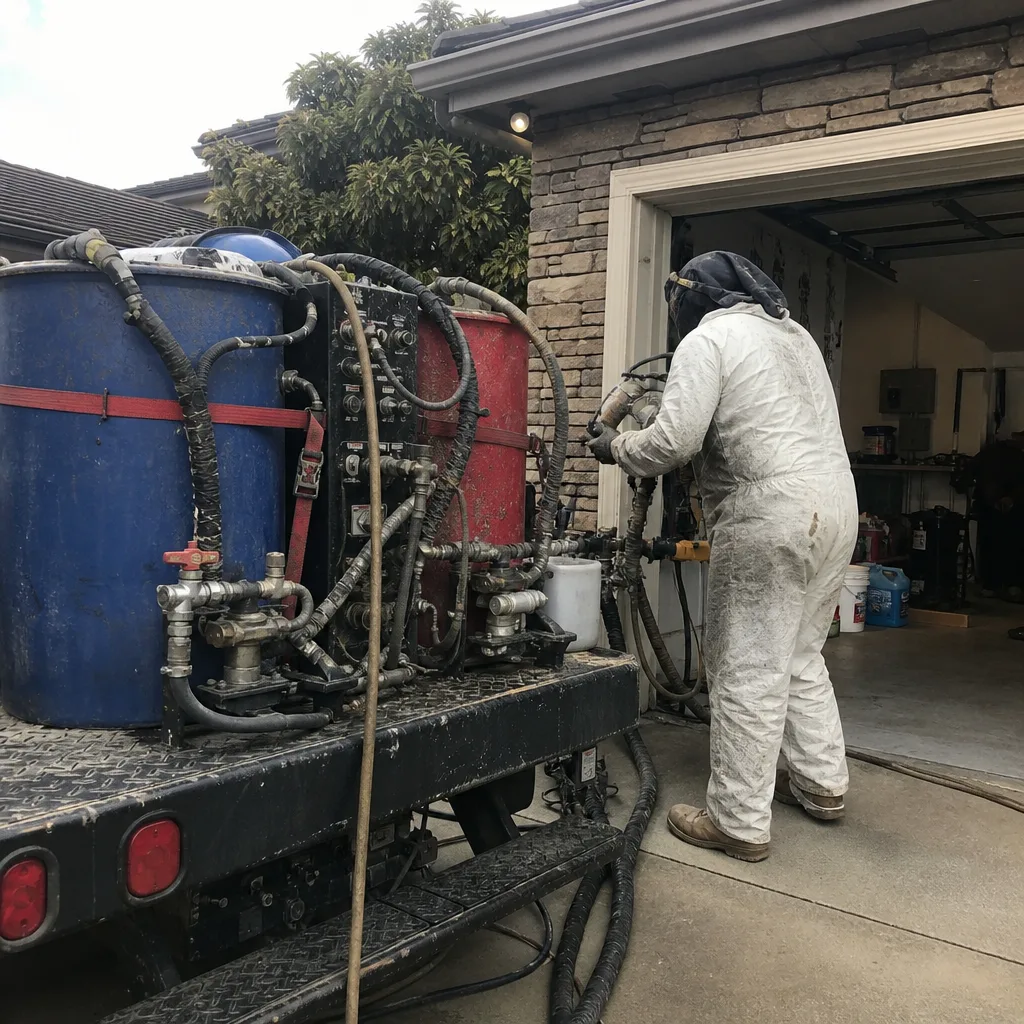
How Much Does Spray Foam Insulation Cost in Coto De Caza?
Spray foam insulation in Coto De Caza typically runs $1,600 to $3,200 for an attic, or roughly $1.50 to $3.50 per board foot installed, with most single-family homes landing near $2,400. Closed-cell foam sits at the high end because it delivers a higher R-value per inch and acts as its own vapor barrier; open-cell runs 30-40% less. A whole-home job on one of Coto’s larger custom lots can climb past $6,000 when you’re foaming a vaulted great room, a bonus room over the garage, and the rim joists in one visit.
We’re Maple Insulation Co, and we install our Spray Foam Insulation services alongside blown-in and attic batting, so we’re not going to tell you foam is the answer to every problem. Sometimes it is. This guide shows you what it costs here, what moves the number up or down, and how to decide whether foam is worth it for your house. If you’d rather just talk it through, call (855) 341-6045 and we’ll set up a free estimate.
Key Takeaways
- Attic-only spray foam in Coto De Caza: $1,600 to $3,200 for most homes.
- Open-cell is cheaper per board foot; closed-cell costs more but gives you more R-value per inch and moisture control.
- Foam beats fiberglass in Coto’s hot, dry inland climate because it seals the air leaks that let 100-degree air into the attic.
- Foam isn’t always the right call. In some attics, blown-in cellulose or mineral wool gets you the same energy result for less.
- Free estimates: (855) 341-6045.
Spray Foam Insulation Cost Breakdown (2026)
Here’s how the numbers break down for a typical Coto De Caza home, from a straightforward attic job to a full envelope build-out. These ranges reflect installed cost, materials and labor together, in the Coto market as of 2026.
| Scope of Work | Typical Price Range | Notes |
|---|---|---|
| Attic floor, open-cell, 1,200-1,800 sq ft | $1,600 – $2,400 | Most common job. Seals air gaps, boosts R-value over existing insulation. |
| Attic floor, closed-cell | $2,300 – $3,200 | Higher R-value per inch, vapor barrier included. |
| Attic roofline (underside of roof deck) | $3,000 – $5,500 | Used to condition the attic, common in Coto’s vaulted and cathedral ceilings. |
| Rim joists and band board | $600 – $1,200 | Small square footage, high payoff. Seals the biggest leak in many homes. |
| Crawlspace encapsulation (partial) | $2,500 – $4,500 | Closed-cell foam on walls and joists. |
| Whole-home envelope (attic + rim + bonus room) | $5,000 – $9,000+ | Larger Coto homes with multiple conditioned zones. |
| Per board foot (open-cell) | $1.50 – $2.25 | Board foot = 12″ x 12″ x 1″ thick. |
| Per board foot (closed-cell) | $2.50 – $3.50 | Denser foam, more R-value and moisture resistance per inch. |
What drives the number up or down? Three things matter most. Square footage and depth set the baseline: foam is priced by volume, so a thicker application costs more. Foam type moves you 30-40% in either direction. And access is the wildcard. A clean, walkable attic over a garage is quick work. A low-pitch, knee-wall attic with HVAC equipment in the way takes twice as long, and that labor shows up in the price.
If you want the full picture on what foam does for a house, our Spray Foam Insulation in Coto De Caza page walks through the material itself. For pricing, the table above is where most homeowners start. We match the material to the problem, and on a lot of Coto homes that conversation ends with a mix of foam and blown-in rather than foam everywhere.
What Affects Spray Foam Insulation Pricing in Coto De Caza
Two homes on the same street can get quotes a thousand dollars apart. Here’s what we look at when we walk a Coto property, and what you should expect to push your number up or down.
- Attic access and geometry. Coto De Caza has a lot of custom-built homes, and custom attics are rarely simple. Cathedral ceilings, bonus rooms over garages, and tight knee-wall spaces take more time than a standard truss attic. If our crew has to crawl through a 16-inch access or work around a furnace and ductwork, expect labor to climb.
- Existing insulation condition. Foam can go right over clean existing material, but if there’s old, compressed fiberglass or signs of pest activity, we need to address that first. Cleanup and removal add cost but protect the foam’s performance.
- Foam choice: open-cell vs. closed-cell. This is the single biggest lever. Open-cell is softer, less dense, and cheaper per board foot. Closed-cell is denser, gives you more R-value per inch, and handles moisture better. For Coto’s inland heat and the occasional Santa Ana wind event, closed-cell on rim joists and open-cell overhead is a common split.
- How much you’re conditioning. If your goal is to bring the attic inside the thermal envelope (a common move with vaulted ceilings here), that means roofline foam, which uses more material than floor foam.
- Season and scheduling. Foam needs specific temperatures to cure properly. Summer installs in a Coto attic that’s already 130 degrees take more planning and sometimes a cooler morning start. That can affect scheduling, not usually price.
- Permits and HERS testing. Some spray foam applications, especially in a conditioned attic, trigger Title 24 requirements for verification. We’ll tell you upfront if your job needs it so it’s in the quote, not added later.
We carry Icynene and Demilec spray foam lines because they let us dial in R-value, moisture resistance, and budget precisely rather than forcing one product. That matters in a market like Coto, where one house needs a budget-friendly attic top-off and the next needs a full closed-cell envelope.
How to Save on Spray Foam Insulation
Spray foam is not the cheapest insulation on the shelf, but there are real ways to keep the cost down without cutting corners on the install. Here’s what actually works.
- Start with the attic floor, not the roofline. Floor foam is the lowest-cost way to get the energy benefit. Roofline foam is worth it when you have vaulted ceilings or want the attic usable, but if you just want lower bills, floor foam gets you most of the way for a fraction of the price.
- Ask about a hybrid approach. Closed-cell on the rim joists and open-cell overhead is a common, cost-effective split. You get moisture control where it matters most and thermal performance where the square footage is. That mix usually runs 15-20% less than closed-cell everywhere.
- Bundle the work. If we’re already in your attic for foam, adding rim joist or knee-wall sealing in the same visit costs far less than a return trip. One mobilization, one cleanup.
- Compare materials honestly. Foam isn’t always the win. In some Coto attics, blown-in cellulose or Rockwool mineral wool gets you the same energy result for less money. We stock GreenFiber cellulose and Rockwool for exactly this reason, and we’ll tell you when foam is overkill.
- Address air sealing first. A lot of “insulation problems” are really air-leak problems. We check for that before quoting foam, because sealing a few gaps can cut the foam you need.
Every one of these decisions is easier with a walk-through. Call (855) 341-6045 for a free estimate and we’ll give you the honest version, including when a cheaper material does the job.
Is Spray Foam Worth It in Coto De Caza’s Climate?
Often, yes, but the reason is specific to this part of Orange County. Coto De Caza sits inland, tucked against the foothills, which means summer afternoons regularly run 10-15 degrees hotter than coastal towns like Laguna Beach or San Clemente. That heat load hits your attic first. Fiberglass batts and even blown-in insulation don’t stop hot air from moving through gaps and around penetrations. Spray foam does, because it expands into those gaps and seals them as it cures.
The result is measurable: fewer HVAC run hours, more consistent room temperatures upstairs in the afternoon, and less strain on the system during the July-to-September stretch. For a homeowner who’s watched the summer bill climb year after year, foam often pays back faster here than it would in a mild coastal climate. If you’re not sure which material fits your attic, we walk through the comparison house by house, and our home page gives you the full picture of what we install.
Open-Cell vs. Closed-Cell: Which Costs More and Why?
Closed-cell costs more, typically 30-40% per board foot, and it’s worth the difference in specific spots. Closed-cell foam is denser, gives you roughly double the R-value per inch, and resists moisture, which makes it the better pick for rim joists, crawlspaces, and any surface where you need a vapor barrier. Open-cell is lighter and cheaper, and it’s a good fit for attic floors where moisture isn’t a concern and you’re mainly chasing air sealing and thermal performance.
Our advice in Coto is usually a split: closed-cell where moisture and vapor matter, open-cell where it doesn’t. That’s the kind of call that comes from working with both Icynene and Demilec lines rather than pushing one product. Foam is also just one of the three methods we handle. Attic batting via Owens Corning, Johns Manville, Knauf, and CertainTeed, or blown-in with GreenFiber cellulose, are often part of the same conversation.
What Does a Typical Coto De Caza Spray Foam Job Involve?
A standard attic foam job is usually a single day for a crew of two. We mask and protect the space, seal the penetration points, apply the foam to the target depth, and clean up. You can be back in the house the same day in most cases, though closed-cell foam needs a short cure window before the space is fully reoccupied, and we’ll tell you exactly what that looks like for your job.
For larger Coto homes with vaulted ceilings or bonus rooms, we’ll sometimes split the work across two visits to keep each phase clean and properly cured. The install plan is part of the estimate, so you know the schedule before we start. Get a free estimate at (855) 341-6045.
FAQs – Spray Foam Insulation Cost
How much does spray foam insulation cost in Coto De Caza?
Most Coto De Caza attic jobs run $1,600 to $3,200, with a typical single-family home landing near $2,400. Closed-cell jobs and whole-home envelopes climb into the $5,000 to $9,000 range. Call (855) 341-6045 for an exact quote, because your attic’s layout drives the final number.
Is it cheaper to repair or replace insulation?
Repair is almost always cheaper when the existing insulation is intact but compressed or has small gaps. A partial foam top-off can run $600 to $1,200, versus $1,600 to $3,200 for a full attic job. We’ll tell you honestly which one your attic needs.
Can you come today for a spray foam estimate?
Same-day estimates are often possible, especially if you call in the morning. Call (855) 341-6045 and we’ll find the earliest slot. Installation itself is usually scheduled within a week or two depending on the season.
How long does spray foam last, and is it worth the price?
Properly installed spray foam lasts the life of the building, 30 years and often much longer. In Coto’s hot inland climate, the energy savings on HVAC run time typically make the payback shorter than in coastal markets. We’ll show you the estimated savings on your estimate.
Do I need a permit for spray foam in Coto De Caza?
Sometimes. Attic floor foam usually doesn’t; conditioned attic or roofline foam often triggers Title 24 verification. We’ll tell you upfront whether your job needs a permit or HERS testing so it’s in the quote, not a surprise later. Call (855) 341-6045 with your address and we’ll sort it out.
Pricing reflects the Coto De Caza market as of 2026. Maple Insulation Co offers free estimates – call (855) 341-6045.
Written by the team at Maple Insulation Co, serving Coto De Caza and greater Orange County. We install spray foam, blown-in, and attic insulation using products from Owens Corning, Johns Manville, Knauf, Rockwool, CertainTeed, Icynene, Demilec, and GreenFiber.
What Our Customers Say
"He did a blower door test before and after and gave me the numbers. I like being able to see the difference rather than being told about it."
— Ruben Guzman"Found and sealed a gap around the chimney chase that was basically an open chimney to the attic."
— Kevin Chen"Installed baffles at the soffits so the new insulation didn't block the ventilation, which the previous contractor apparently never considered."
— Eric Fletcher