
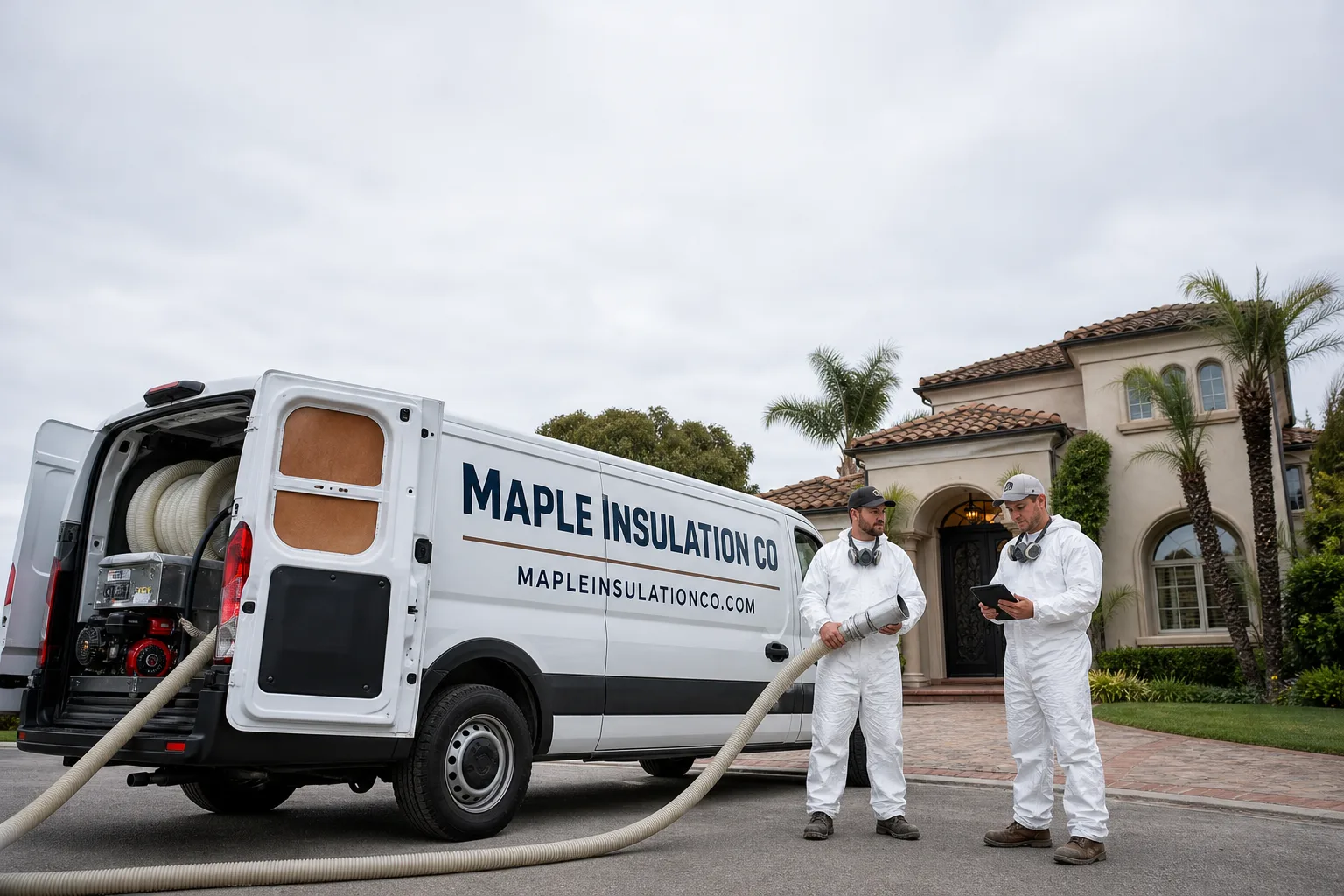
Fast, Reliable Spray Foam Insulation Across Grand Terrace
Spray foam insulation in Grand Terrace costs between $1.50 and $4.50 per board foot installed depending on whether you need open-cell or closed-cell, which translates to roughly $2,000 – $7,500 for a typical mid-century attic air-seal and roof-deck project in the 92313 zip code. Most Grand Terrace homes we assess were built between 1955 and 1975, and the original batts in those attics are long past their useful life, so foam is usually the fix that finally moves the needle on cooling bills here. We serve Grand Terrace from our Southern California operation and can typically reach a home off Barton Road or along Blue Mountain within a day or two of your call.
Call (855) 341-6045 for a free estimate, and we’ll walk your attic with you and tell you honestly whether spray foam is the right move or whether blown-in would do the job for less.
Key Takeaways:
- Closed-cell spray foam runs $2.50 – $4.50 per board foot; open-cell runs $1.50 – $2.50 per board foot in the Grand Terrace market.
- West-facing roof runs on canyon-edge and Blue Mountain streets take the worst wind and sun abuse, so we always inspect those slopes first.
- Most Grand Terrace homes are 1950s – 70s tract builds with shallow attics, meaning flash-and-batt or closed-cell flash coats often beat full-depth open-cell.
- We carry both Icynene and Demilec foam lines, so the recommendation fits your attic geometry, not some one-brand sales pitch.
Why Maple Insulation Co Is Grand Terrace’s Preferred Spray Foam Insulation Company
We’ve spent enough time inside 1950s and 1960s tract attics from Grand Terrace to Rubidoux to recognize the failure patterns before we even pull the ladder down. Homeowners along Barton, Preston, and Michigan know that when the inland heat stacks up in August, the difference between a sealed attic and a vented one is the difference between a $220 electric bill and a $410 one. Noel Castaneda built Maple Insulation Co around matching the material to the house rather than pushing whatever product is easiest to install. That’s why we carry eight brands across spray foam, blown-in, and batts, from Owens Corning to Icynene to Demilec.
We don’t quote Grand Terrace work sight unseen. An attic off Blue Mountain’s west slope behaves differently than one on a sheltered interior street, and the only way to spec the right foam depth and coverage is to get up there and look at the roof deck, the top plates, and the existing batt condition. That approach, plus the fact we handle all three primary insulation methods in-house, is why homeowners keep calling us back and referring neighbors.
Warranty coverage stays with your home, and all our Grand Terrace installs include a free follow-up thermal check so you can see the difference with a camera, not just feel it on the first hot day.
Crawl Space Spray Foam Insulation in Grand Terrace
Crawl Space Spray Foam Insulation is one of the highest-ROI upgrades for older Grand Terrace homes, particularly the 1950s and 1960s builds with floor joists that have never been sealed. On lots cut into the canyon slope, crawl spaces pull in hot, dust-laden air from the exposed hillside side of the grade, and that air leaks straight up into living rooms and kitchens through unsealed subfloor penetrations. Closed-cell foam applied to the crawl space walls and rim joist turns that cavity into a sealed, conditioned buffer zone instead of a hot-air intake.
We usually see crawl space foam jobs in Grand Terrace run $1,800 – $4,200 for a standard 900 to 1,400 square foot footprint, depending on access height and whether the rim joists need full encapsulation or just air sealing.
Hillside rim joist sealing
Homes on Blue Mountain canyon-edge lots have rim joists cut into sloping grade, which means one side of the crawl space sits against cool earth while the other bakes in afternoon sun. That temperature split pulls moisture and air through the rim joist on the exposed side. Closed-cell foam on the rim joist stops both air movement and the dust that blows in off the dry hillside during Santa Ana events.
Encapsulation for older piers
Many Grand Terrace crawl spaces are on original concrete piers with no vapor barrier worth the name. We can air-seal the perimeter with closed-cell foam and pair it with new ground cover so the air down there stops smelling like the canyon on a July afternoon.
Garage Spray Foam Insulation in Grand Terrace
Garage Spray Foam Insulation in Grand Terrace usually targets attached garages on the west or southwest side of the home, where a thin sheet of drywall and an uninsulated roof deck are all that stand between parked cars and 130-degree attic air. We foam the garage ceiling and the shared wall between garage and living space on homes along streets like De Berry and La Cadena, and the result is a garage that stays 15 to 25 degrees cooler in August and no longer radiates heat into the adjacent laundry room or hallway.
A typical Grand Terrace two-car garage ceiling foam project runs $1,200 – $2,800 depending on whether we’re foaming just the ceiling, the shared wall, or the entire garage envelope including the door header and rim areas.
Garage ceiling for attached living space
Attached garages in 1960s and 1970s Grand Terrace floor plans almost always share a wall or ceiling with a conditioned room. Foaming that interface cuts the heat transfer that forces your AC to fight the garage all afternoon.
Detached garage conversion prep
If you’re converting a detached Grand Terrace garage into a workshop, gym, or studio, open-cell foam on the roof deck and walls is the fastest way to get it comfortable without running a dedicated mini-split at full load. We’ll spec the foam thickness based on your planned use and the existing framing.
Trusted Brands We Service in Grand Terrace
We install and service spray foam from Icynene and Demilec, two of the most respected names in performance foam, alongside batt and blown-in work using Owens Corning, Johns Manville, and Knauf. For Grand Terrace homeowners, that matters because an attic on the Blue Mountain slope may call for a high-R closed-cell flash coat one week and a Rockwool mineral-wool batt upgrade the next, and we’re not going to try to sell you the same product for both. We carry the parts and materials to service existing foam installations too, so if you have an older foam job that’s delaminating or a rim joist that was never fully sealed, we can repair it without making you wait on special-order supplies. Eight brands, three methods, one contractor, Spray Foam Insulation expertise that fits the house.
Common Spray Foam Insulation Problems We See in Grand Terrace Homes
- West-side batt collapse from canyon wind. Original fiberglass batts on west-facing roof runs get compressed and blown into the eaves by the same late-afternoon wind that funnels down the Blue Mountain slopes. By the time we open the attic, the exposed deck is often bare right above the hottest wall of the house.
- Shallow mid-century rooflines limit foam depth. Grand Terrace tract homes from the 1950s and 60s rarely have more than 4 to 5 inches of rafter depth. Full-depth open-cell simply won’t fit, so we recommend closed-cell flash coats or a flash-and-batt hybrid for these attics.
- Uneven envelopes from old additions and sunrooms. Many homes have a 1970s or 80s addition that was framed and insulated differently from the original structure. The thermal break between old and new sections is a major source of air leakage, and spray foam is the only practical air barrier for those irregular top-plate gaps.
- Unsealed rim joists on hillside crawl spaces. The steeper lots off Blue Mountain and the canyon edge have crawl spaces with exposed rim joists that let hot hillside air pour into the floor system. Fiberglass stuffed into those cavities absorbs moisture and loses its R-value fast; closed-cell foam stays put.
Pricing for Spray Foam Insulation in Grand Terrace, CA
For Grand Terrace specifically, here are the honest numbers. Open-cell spray foam runs $1.50 – $2.50 per board foot, or about $1,800 – $3,500 for a standard attic roof deck. Closed-cell runs $2.50 – $4.50 per board foot, so an attic air-seal with a 2-inch closed-cell flash coat on the roof deck usually lands between $3,000 and $7,500 depending on square footage and access. Crawl space work falls between $1,800 and $4,200 for most hillside homes. Garage ceilings run $1,200 – $2,800. What moves the price is access, especially in low-clearance attics where the crew has to crawl, plus whether you’re doing open-cell or closed-cell and how much air sealing the top plates need. Call (855) 341-6045 and we’ll quote your attic based on measurements, not guesses. Estimates are free, and we’ll tell you if blown-in or batts make more sense for your budget. Our Grand Terrace customers get upfront line-item pricing, never a lump sum with no breakdown.
Keep in mind the hillside factor: homes on canyon-edge streets often need extra foam on the west-facing roof plane, which adds 10 to 18 percent to the bill compared to a sheltered interior lot. That’s not a surcharge; it’s just more square footage of deck that needs coverage.
We Also Serve Cities Near Grand Terrace
Beyond Grand Terrace, our crews cover Highgrove, Rubidoux, Bloomington, and Riverside on the same schedule, so if you’re just over the line on the 215 corridor you’ll get the same response time. Many of our Grand Terrace customers ask about service for rental properties or family homes in those neighboring cities, and the answer is yes, we run the same crew and the same pricing structure throughout the area.
Serving Grand Terrace, CA — Our Local Coverage Area
We’re based in the Grand Terrace area and know this community well. Use the map below to see our service coverage — if you’re nearby, we can almost certainly help.
FAQs About Spray Foam Insulation in Grand Terrace
Wind that funnels down the Blue Mountain canyon face hits west-facing roof runs harder than any other part of the house, and over 40 to 60 years it physically compresses fiberglass batts into the eaves, leaving the deck exposed exactly where the afternoon sun beats down hardest. That’s the first place we check on every Grand Terrace assessment. Spray foam bonds to the deck and won’t blow out, which is why we recommend it for exposed slopes even when batts make sense elsewhere. Call (855) 341-6045 and we’ll show you what’s happening up there.
Yes, and this is one of the most common applicator errors in Grand Terrace. A shallow 4- or 5-inch rafter bay won’t hold full-depth open-cell foam, so we spec a closed-cell flash coat at 1.5 to 2 inches to air-seal and insulate in one pass, then add batts below if more R-value fits your budget. That flash-and-batt approach solves the air-sealing problem without trying to cram foam where the geometry can’t hold it.
Yes, and the change is measurable. Foaming the garage ceiling and the shared wall between garage and living space drops garage temperatures by 15 to 25 degrees on a typical Grand Terrace August afternoon, which also removes the heat load bleeding into the rooms next to it. For attached garages on the west side of the home, it’s one of the quickest wins on the property.
For homes on canyon-edge lots, absolutely. The exposed rim joist on the hillside side of the crawl space pulls hot, dusty air into the floor system year-round, and closed-cell foam on the rim joist and crawl walls seals that entry point. On flatter interior streets it’s still useful, but hillside homes get the biggest return. We’ll tell you honestly if your crawl space needs it or if the money is better spent in the attic.
We install Icynene and Demilec spray foam lines, and for batts and blown-in we stock Owens Corning, Johns Manville, Knauf, and Rockwool. The brand selection is driven by your attic geometry, R-value needs, and budget, not by what we have sitting on the truck. If your project calls for mineral wool on the fire-rated wall and closed-cell foam on the roof deck, we can do both without subbing anything out.
What Grand Terrace Homeowners Should Know Before Foaming
On Grand Terrace’s canyon-edge and Blue Mountain-facing streets, driven afternoon wind and west-facing sun can compress or displace attic insulation on the exposed roof runs well before interior-street homes show the same wear. That means spray foam assessments here start at the ridge line and west-facing slopes, not the attic hatch. When we walk a home off Pico or De Berry, the first thing we do is pull the attic access and look for a pattern: is the west deck bare, are the batts stacked in the eaves, is there daylight at the top plate. If the damage is concentrated on the windward slope, foam goes on that deck first, because that’s the surface doing the most thermal work.
Blue Mountain’s terrain also means many Grand Terrace lots sit at a slight grade, with crawl spaces open to the hillside on one side and sheltered on the other. That asymmetry is exactly why a material-agnostic contractor matters here. A company that only sells batts will stuff the same material into every cavity regardless of wind exposure, grade, and sun angle. We don’t work that way. The right insulation depends on your attic, your climate zone, and your goals, and in Grand Terrace the answer is often mixed: closed-cell on the west deck, air seal at the top plates, and a batt upgrade or dense-pack in the interior cavities. We match the material to the problem, not to what we happen to stock most.
One last thing about the wind and sun here. If you live on a canyon-edge street off the Blue Mountain slope, watch your attic after a strong wind event. Batts that shift out of position in a 40-mile-per-hour gust don’t just lose a little R-value, they open a direct radiant-heat path from the deck to your ceilings. Foam doesn’t shift. That’s the whole argument.
Written by Noel Castaneda, Owner at Maple Insulation Co, serving Grand Terrace and the surrounding Inland Empire.