
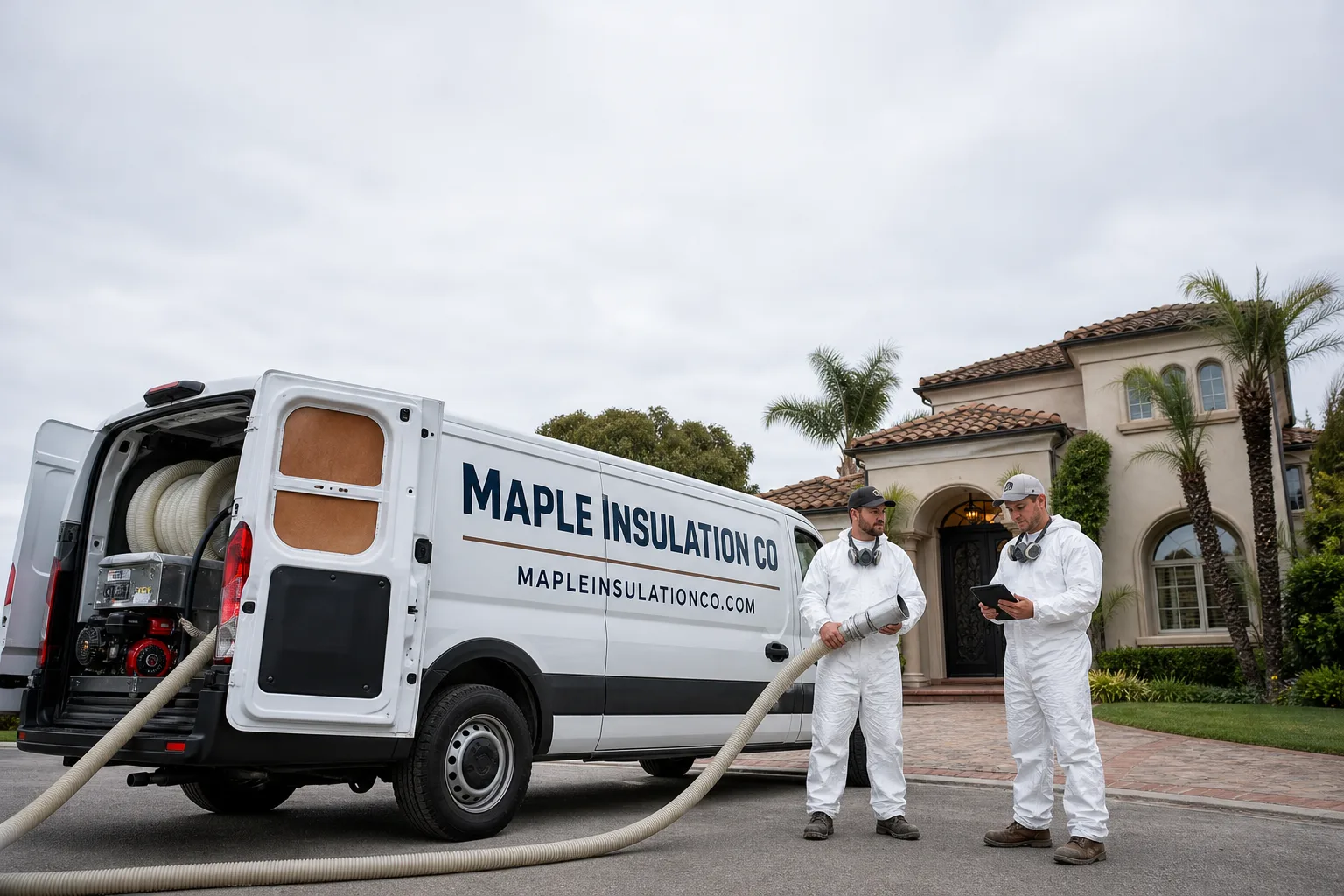
Fast, Reliable Spray Foam Insulation Across Eastvale
Spray foam insulation in Eastvale typically costs $2,800 to $7,500 depending on square footage and whether you’re foaming an attic, rim joists, or a garage ceiling. Most Eastvale jobs are completed in a single day, sometimes two for whole-attic open cell applications on larger two-story tract homes. If you’re reading this from a house off Hamner Avenue or near Roosevelt High School and your upstairs rooms spike every afternoon, you’re not imagining it. We work in Eastvale weekly, know the housing stock, and can usually have a crew out within a few days of your call. Reach us at (855) 341-6045 for a free estimate.
Why Maple Insulation Co Is Eastvale’s Preferred Spray Foam Insulation Company
Eastvale isn’t a city where every house is different. It’s the opposite. Whole neighborhoods went up in the same building wave on former dairy land, and that means our crews see the same attic layouts, the same vaulted-ceiling cavities, and the same builder-grade batts sagging off the rafters from Harada Heritage Park up to the Santa Ana River edge. Noel Castaneda built Maple Insulation Co around a simple idea: match the material to the problem, not to what we happen to stock most. When an Eastvale homeowner calls about a hot upstairs bonus room, we already know what we’re likely to find before we open the attic hatch.
We carry spray foam lines from Icynene and Demilec, both names architects and energy auditors spec for high-performance envelopes in this climate zone. We also install blown-in cellulose and batt insulation when foam isn’t the right answer for a given cavity or budget. That matters in Eastvale because some jobs genuinely don’t need foam, and we’d rather tell you that than sell you the wrong material.
Open Cell Spray Foam in Eastvale
Open cell spray foam is the most common foam we install in Eastvale attics, and for good reason. It expands into rafter bays, fills the irregular gaps around trusses and top plates, and air-seals while it insulates. In Eastvale’s tract housing stock, where vaulted ceilings over second-story bonus rooms and attached garages create awkward cavities, open cell does something batts can’t: it conforms to the space and stops air movement through the framing.
A typical open cell attic application in Eastvale runs $3,200 to $6,800 for a standard two-story tract home, depending on roof deck square footage and access. The material cost is part of the story. The labor is the other part. High, tight attics with shallow pitches take longer, especially when our crews are working around truss webs and can-lights that need boxing out first.
Whole-Attic Roof Deck Foam
Foaming the underside of the roof deck turns an Eastvale attic into semi-conditioned space, which matters when daytime attic temperatures push past 130°F in August. Instead of cooling a roasting attic cavity, you’re creating a thermal boundary at the deck itself. Ducts that used to bake in that heat end up inside the conditioned envelope, and that’s often the single biggest win in an Eastvale two-story.
Attic Floor Air-Sealing and Foam
When a customer doesn’t want to foam the roof deck, we often air-seal the attic floor with a flash of foam at the top plates, penetrations, and gaps, then add blown-in or batt depth above it. In Eastvale’s tract homes, the builder-grade fiberglass at the attic floor is frequently compressed under stored boxes or shifted away from the eaves, leaving thin spots over the hottest walls of the house. Sealing first, then insulating, is the sequence that actually moves the needle on cooling bills.
Spray Foam Insulation Contractors in Eastvale
Spray foam insulation contractors in Eastvale should know tract housing the way a mechanic knows a specific model year. When every house on a block shares the same floor plan and the same construction era, the failure points repeat predictably. Our crews know which Eastvale neighborhoods have the vaulted-ceiling cavities over the front garages, which ones run duct trunks through unconditioned attic spaces, and which ones need rim joist foam before any attic work makes sense.
A rim joist spray foam job in Eastvale typically runs $900 to $2,100 for the perimeter, and it’s one of the highest-return upgrades we do. The rim joist is where the floor framing meets the foundation wall, and in Eastvale’s wood-frame stucco construction, it’s a continuous gap around the whole first floor. Foam there stops conditioned air from leaking out and keeps hot outside air from pulling in at the band board.
Attic Duct Enclosure and Sealing
In Eastvale’s hot-dry climate, ductwork in unconditioned attics is often the biggest hidden energy drain. We’ve measured duct surface temperatures over 120°F in August attics. Foam doesn’t just insulate the house, it can enclose duct runs when the deck is foamed, bringing the HVAC distribution system inside the thermal boundary. That’s a material advantage spray foam has over fiberglass alone.
Rim Joist and Band Board Sealing
Eastvale’s foundations don’t move much seasonally, which makes closed-cell foam at the rim joist a stable, long-term air seal. The first-floor comfort difference is noticeable within a week. We frequently do this as a standalone job for customers who aren’t ready to tackle the attic yet.
Trusted Brands We Service in Eastvale
We service and install spray foam from Icynene and Demilec, two names Eastvale homeowners will see spec’d on energy audits and builder plans alike. For complementing materials, we carry Johns Manville and Knauf fiberglass batts, along with Rockwool mineral wool for fire-rated and sound-sensitive areas. When a customer wants to compare open cell foam against a Rockwool batt upgrade in a specific cavity, we can actually show them both options, cut sheets in hand, rather than defending one product line. That’s the whole point of our Spray Foam Insulation approach: eight brands, three methods, one contractor.
Common Spray Foam Insulation Problems We See in Eastvale Homes
- Foam applied over sagging builder-grade batts in vaulted ceilings. We see this in Eastvale’s two-story tracts where the original kraft-faced batts have separated from the roof deck, leaving an air gap between the batt and the plywood. Foam sprayed over that just seals in a void – you have to remove the failed batt first and foam directly to the deck.
- Attic hatches and garage-side penetrations left unsealed. Tight two-story tract layouts create stacked pressure zones, and a single unsealed attic hatch lets conditioned air pour past the new foam. On a Schleisman Road job, our crew found the upstairs bonus room heat gain came mostly from an unsealed attic access and electrical penetrations over the garage, not the main attic cavity itself.
- Duct runs roasting in unconditioned attics. Eastvale’s cooling-dominated climate means the ducts themselves leak heat into the air you’re paying to chill. Even a well-foamed roof deck won’t fix a disconnected duct boot under the insulation, so we check the full distribution path before and after spraying.
- Moisture against the deck in tight eaves. Eastvale’s shallow-pitch roof lines and stucco exteriors can trap humidity in enclosed rafter bays. Open cell foam is vapor-permeable and usually appropriate here, but we evaluate each attic’s ventilation profile before choosing between open and closed cell.
Pricing for Spray Foam Insulation in Eastvale, CA
Spray foam pricing in Eastvale runs on square footage and access more than anything else. Rim joist work lands between $900 and $2,100. Garage ceiling foam, common for the attached garages under Eastvale’s big second-story fronts, runs $1,400 to $2,800. Full attic roofline foam for a standard 2,400 to 3,200 square foot two-story tract home is typically $3,800 to $7,200. The variables are clear: rafter bay depth, vaulted ceiling count, number of can-lights to box out, and whether we’re removing old insulation first. Call (855) 341-6045 and we’ll walk the attic with you, then give you a written quote with material options side by side.
We Also Serve Cities Near Eastvale
Beyond Eastvale, our crews regularly work in Norco, Home Gardens, Corona, and Jurupa Valley. Much of that work is similar tract housing, though Norco’s larger lots and Corona’s mixed-era neighborhoods change the insulation approach. If you’re a few blocks outside the 92860 ZIP, call (855) 341-6045 and we’ll confirm service to your street.
Serving Eastvale, CA — Our Local Coverage Area
We’re based in the Eastvale area and know this community well. Use the map below to see our service coverage — if you’re nearby, we can almost certainly help.
FAQs About Spray Foam Insulation in Eastvale
Because the builder-grade batts in those vaulted cavities were never adequately secured to the roof deck, and once they sag an inch, the air gap defeats much of the insulating value. Eastvale’s summer attics push 130°F, so any gap becomes a radiant heat channel straight into the upstairs rooms. Foam applied directly to the deck closes that gap and air-seals the rafter bays. Call (855) 341-6045 for an assessment of your specific ceiling assembly.
Yes. Because Eastvale’s housing stock went up as large planned tracts in the 2000s and 2010s, the attics, vaulted ceilings, and garage layouts repeat almost identically from block to block. Our crews know which street clusters have the same roof truss designs and can often predict the failure points before we open the hatch. That repeatability means faster quotes and more precise material selection, not a one-size-fits-all spray approach.
For most Eastvale roof decks, open cell is the better fit and the better value. It’s vapor-permeable, fills irregular rafter bays in tight attic spaces, and carries an R-value around 3.5 to 3.8 per inch. Closed cell adds structural strength and a vapor barrier, and it shines in flood-prone or specialty areas, but Eastvale’s dry climate rarely requires it at the roof line. We’ll show you the cost and performance difference for your specific attic before you commit.
Yes, and this is often the single biggest comfort win in Eastvale’s two-story tract homes. When the roof deck is foamed, the duct runs stop sitting in a 130°F oven and start living inside the thermal boundary, so the air coming out of your registers arrives closer to what the HVAC unit produced. For attics where deck foam isn’t in scope, we can insulate and seal duct runs directly. Call (855) 341-6045 for an inspection of your current duct condition.
Yes, we’re set up for tight access. Our spray foam rig parks at the curb or in the alley, and hoses run to the attic through a window or hatch opening. Eastvale’s dense front-facing garages and narrow side yards don’t slow us down. We’ll tell you exactly where we’ll stage and how long we need before the crew arrives.
Written by Noel Castaneda, Owner at Maple Insulation Co, serving Eastvale and the surrounding Inland Empire.