
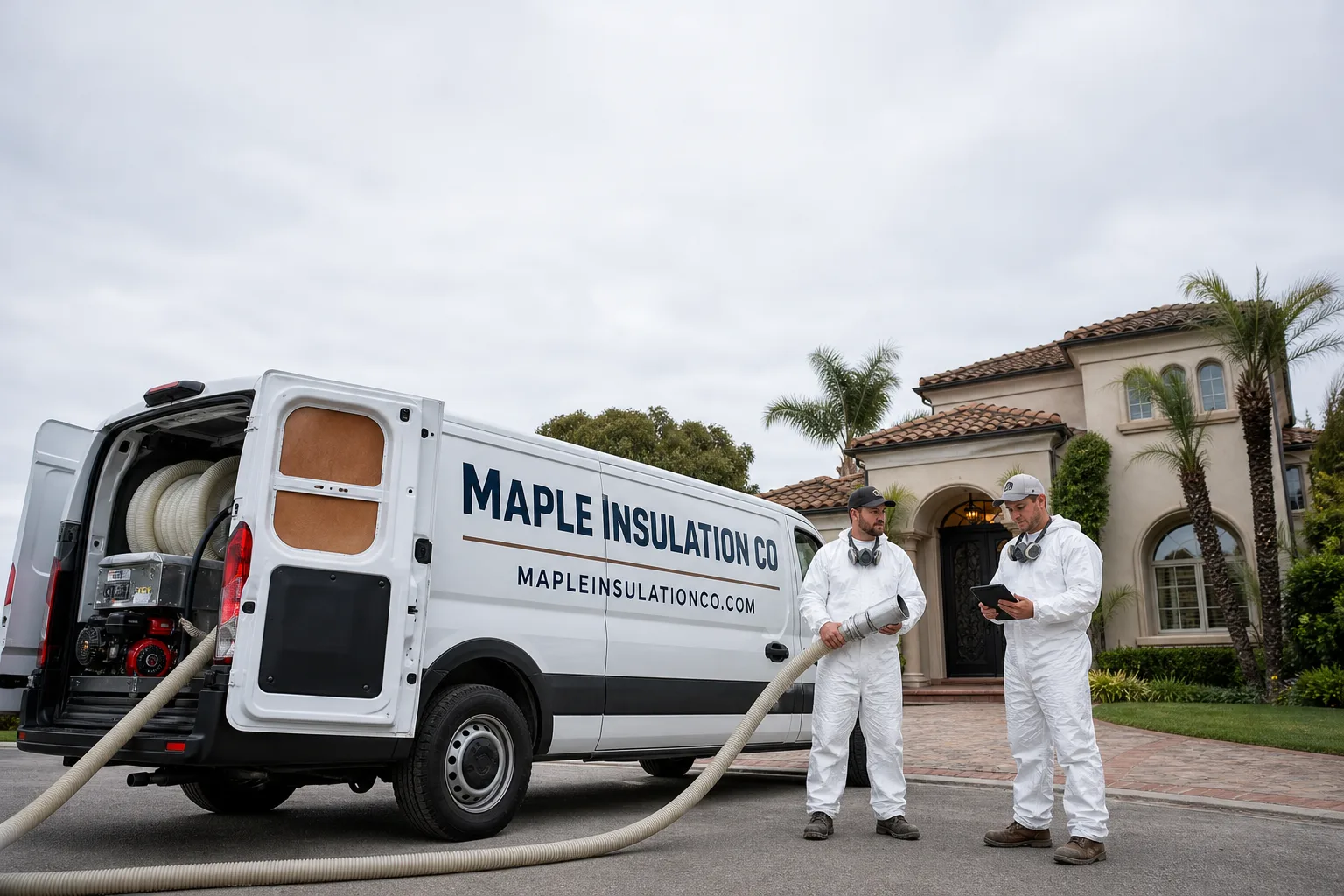
Fast, Reliable Spray Foam Insulation Across Jurupa Valley
Spray foam insulation in Jurupa Valley typically costs $2.50 to $6.50 per board foot installed, with most attic retrofits landing between $4,800 and $14,000 depending on foam type and square footage. Most Jurupa Valley jobs are completed in one to two days, and we schedule within the same week for most calls. If your home in Mira Loma, Pedley, or Sunnyslope was built before 2011, chances are the attic insulation is original, settled, and nowhere near what a triple-digit Inland Empire summer demands. We work throughout the 91752 zip code and know exactly what these older unincorporated-era homes need. Call us at (855) 341-6045 for a free estimate, and we’ll come out and measure what’s actually in your attic.
Why Maple Insulation Co Is Jurupa Valley’s Preferred Spray Foam Insulation Company
We’ve spent years working inside Jurupa Valley attics, and the pattern is consistent: homes built in the 1970s, 80s, and 90s in Mira Loma and Pedley were put up before the city incorporated, before energy codes got serious, and often without any insulation inspection at all. That means the problems we see here are different from what you’d find in newer Eastvale subdivisions or coastal cities. Homeowners call us when rooms won’t hold temperature, when the AC runs all afternoon in August, or when they open the attic hatch and feel heat pouring down. We answer those calls with a crew that’s familiar with the specific failure modes of Jurupa Valley’s older housing stock.
Noel Castaneda leads our team, and he’s built our approach around matching material to problem rather than pushing whatever’s on the truck. We carry open-cell and closed-cell spray foam from Icynene and Demilec, plus fiberglass and mineral wool options from Owens Corning, Johns Manville, and Rockwool. That matters in Jurupa Valley because a 1975 ranch house off Limonite Avenue needs a different solution than a 2018 tract home in Eastvale. We stock what’s needed to handle the older homes here, and we don’t make you wait on a specialty distributor.
Our response time to Jurupa Valley addresses is usually same-day for estimates and within three to five business days for installation, depending on attic prep work. Customers who call us from the Glen Avon or Pedley side of town get the same crew and same turnaround as anyone else in the Inland Empire. We know the neighborhood roads, the older home quirks, and the summer heat patterns that make insulation work here so urgent.
Closed Cell Spray Foam Insulation in Jurupa Valley
Closed cell spray foam insulation is the workhorse for Jurupa Valley attics because it delivers the highest R-value per inch of anything we install, around R-6.5 to R-7, and it seals air gaps while it insulates. In a 1970s Mira Loma ranch home where attic temperatures hit 140°F or more in July, closed cell applied to the roof deck or the attic floor can change how the whole house feels by mid-afternoon. We recommend it more often here than anywhere else we work. That’s because Jurupa Valley’s older housing stock typically has no radiant barrier, leaky soffit vents, and settled original fiberglass that’s doing almost nothing. Closed cell addresses all of that at once.
For Jurupa Valley homeowners, closed cell spray foam runs $3.50 to $6.50 per board foot installed. A typical 1,200-square-foot attic roof deck at 2 inches of closed cell lands between $7,500 and $12,500, depending on access, prep, and whether we need to remove old insulation first. It’s not the cheapest option, but it is the one most likely to solve the underlying problem permanently, which matters when you’re retrofitting a home that’s gone 40 years without a proper thermal boundary.
Roof Deck Sealing for Older Ranches
When we apply closed cell to an unvented roof deck, we’re doing more than adding insulation. We’re converting the attic from a superheated box into a conditioned space. That’s a bigger deal in Jurupa Valley than in coastal cities because the combination of triple-digit outdoor temps and dark shingle roofs pushes attic heat well past what any vented attic can shed. Sealing the roof deck means the attic stops working against your AC, and the rooms below finally hold a set temperature without the unit running nonstop.
When Closed Cell Beats Other Options
Closed cell is the right call when there are gaps to seal, when roof deck space is limited, or when the homeowner wants structural rigidity along with thermal performance. It’s also what we recommend when pests are a factor. In Pedley and Mira Loma, unscreened vents pull in dust and rodents from neighboring dairy and equestrian properties, and closed cell’s density makes it more resistant to nesting than fiberglass or open cell. If your attic has been a rodent highway, this is the product we’d walk you through first.
Open Cell Spray Foam in Jurupa Valley
Open cell spray foam costs less than closed cell, typically $2.50 to $4.00 per board foot installed, and it’s the better choice for Jurupa Valley homeowners whose priority is sound control and air sealing without the premium price tag of closed cell. It’s softer, expands more aggressively, and does an excellent job of filling odd-shaped cavities in older ranch-style homes where framing spacing isn’t uniform. For a 1978 Pedley home with settled batts and a noisy stretch of Limonite Avenue nearby, open cell on the attic floor can make a noticeable difference in both temperature consistency and how much road noise filters in.
Open cell is vapor-permeable, which means it lets moisture pass through rather than trapping it. In Jurupa Valley’s dry heat that’s rarely a liability; the bigger concern is that open cell alone won’t block radiant heat the way closed cell plus a radiant barrier will. We’re candid about that tradeoff because the wrong choice in an unvented attic can create problems. When we inspect a Jurupa Valley attic and see unscreened soffit vents or existing moisture issues, we address those before recommending open cell on a roof deck.
Interior Wall and Floor Cavity Filling
Open cell is also useful for filling wall cavities and floor joists in Jurupa Valley homes. If a mid-century ranch off Etiwanda Avenue has uninsulated walls, open cell can be injected or applied to stud bays to reduce heat transfer through the building envelope. It’s a job we handle in-house, and it’s one of the ways we address the uneven cooling that older homes here are known for. The air sealing effect alone cuts down on the hot dust that blows in from surrounding open land.
Budget-Conscious Attic Upgrades
For homeowners watching cost but still wanting a serious improvement over original R-11 batts, open cell on the attic floor is a solid middle path. A 1,200-square-foot attic at 6 inches of open cell typically runs $4,800 to $7,500 in Jurupa Valley. That’s less than closed cell on a roof deck, and it still transforms how the home performs in summer when paired with proper ventilation and sealed bypasses. We’ll give you real numbers for both options before you commit to anything.
Trusted Brands We Service in Jurupa Valley
We install Icynene and Demilec spray foam systems here, two names that builders and energy auditors specify for high-performance envelopes. We also carry fiberglass and mineral wool from Owens Corning, Johns Manville, Knauf, and Rockwool, so if spray foam isn’t the right fit for your attic, we’re not stuck steering you toward a product you don’t need. For Jurupa Valley customers, having those materials stocked nearby means shorter lead times on retrofit work. We’re not tied to a single manufacturer’s line, and that independence is what lets us recommend closed cell for a hot roof deck, open cell for a wall cavity, or Rockwool for a fire-rated separation without any conflict of interest.
Common Spray Foam Insulation Problems We See in Jurupa Valley Homes
- Settled or missing original R-11 batts. Homes built in the 1970s and 80s across Mira Loma and Pedley often have the same thin fiberglass they were built with, now compressed to half its original thickness. By July, those attics are radiating heat into the living space all afternoon.
- Unscreened vents pulling in dust and pests. With dairy and equestrian properties still operating throughout Jurupa Valley, open soffit vents become entry points for dust, rodent droppings, and nesting. Spray foam applied over active pest entry points traps the problem and smells it up; we screen and seal before we foam.
- Foam applied over unsealed attic bypasses. We’ve seen houses where a previous contractor sprayed foam but never sealed the plumbing chases, recessed lights, or flue gaps. The result is moisture trapping and uneven cooling even with new insulation, something that shows up during triple-digit weeks as one hot room or a musty attic smell.
- Open-cell foam without a thermal barrier in vented attics. Local code requires an ignition barrier when foam is left exposed in a vented attic, and some older Jurupa Valley homes never had that done. Under intense attic heat gain, exposed foam degrades faster and can fail resale inspection. We address the barrier as part of every open-cell install.
Pricing for Spray Foam Insulation in Jurupa Valley, CA
You should have real numbers before you decide anything. In Jurupa Valley, open-cell spray foam runs $2.50 to $4.00 per board foot installed, while closed-cell runs $3.50 to $6.50 per board foot. A typical 1,200-square-foot attic retrofit with open cell on the floor lands between $4,800 and $7,500. The same attic done as an unvented roof deck with 2 inches of closed cell typically runs $7,500 to $12,500, plus any prep work like removing old batts or screening vents. What moves the price: access to the attic, whether old insulation needs removal, the condition of the roof deck, and whether we’re adding a radiant barrier. Every estimate is free, and we’ll give you line-item pricing so you can see exactly what you’re paying for. Call (855) 341-6045 to schedule a walkthrough.
We Also Serve Cities Near Jurupa Valley
Our crews work throughout the Inland Empire heat corridor, including Glen Avon, Pedley, Sunnyslope, and Eastvale. If you’re in a neighboring community with the same unincorporated-era housing stock or newer tract construction, our Spray Foam Insulation team handles it all. We serve the full Jurupa Valley area and the surrounding cities with the same response times and material options.
Serving Jurupa Valley, CA — Our Local Coverage Area
We’re based in the Jurupa Valley area and know this community well. Use the map below to see our service coverage — if you’re nearby, we can almost certainly help.
FAQs About Spray Foam Insulation in Jurupa Valley
Because your problem isn’t just missing insulation, it’s air movement. Spray foam seals the gaps that blown-in fiberglass or cellulose just settles over. In 1970s Mira Loma ranch homes with original R-11 batts, the hot air leaking through bypasses, around flues, and through unscreened vents is often a bigger cooling loss than the thin insulation itself. Blown-in adds R-value but doesn’t stop air; closed-cell spray foam does both in one step. Call (855) 341-6045 for an exact recommendation after we see your attic.
No, we don’t spray foam over old batts. The old material has to be removed first. Spraying foam directly onto settled, dust-packed fiberglass means the foam can’t adhere to the roof deck or the drywall, and you end up with a sandwich of two materials that traps heat and moisture instead of blocking it. In Jurupa Valley attics where the original batts are 40-plus years old and contaminated with rodent droppings and dairy dust, removal is usually a necessity anyway. We’ll quote the removal and the foam as separate line items so you see exactly what you’re paying for.
Closed-cell is denser, costs more, and delivers about R-6.5 to R-7 per inch; open-cell is lighter, cheaper, and delivers about R-3.5 to R-4 per inch. In Jurupa Valley’s summer attic heat, closed-cell on a roof deck or attic floor makes a bigger difference because it also acts as an air and vapor barrier, which matters when the outdoor temp stays above 100°F for a week straight. Open-cell is still a solid air seal and a good option for wall cavities or budget-conscious attic floors. We’ll show you both options in your quote and explain which one fits your specific attic.
It depends on your roof pitch, attic ventilation, and which foam you choose. In an unvented attic with closed-cell on the roof deck, a radiant barrier is redundant because the foam is already stopping heat at the source. In a vented attic with open-cell on the floor, a radiant barrier on the rafters can drop attic air temperature significantly and make a real difference during triple-digit weeks. We don’t push radiant barriers as an add-on unless they’ll actually do something for your situation. Call (855) 341-6045 and we’ll measure your attic before recommending anything.
Closed-cell and open-cell spray foam are both rated to last 30-plus years when properly installed and protected from UV exposure. In Jurupa Valley’s attic heat, the failure point is usually not the foam itself but missing thermal or ignition barriers, moisture trapped by poor installation, or pests compromising the material. Properly applied closed-cell on a roof deck in a hot unvented attic should outlast the roof itself. We warranty our workmanship and stand behind the product, and we’ll tell you exactly what kind of longevity to expect before you commit.
If your Jurupa Valley home is still running on original insulation, summer is going to keep costing you money. Call (855) 341-6045 for a free attic inspection and a straight answer about what your house actually needs. Noel Castaneda and the Maple Insulation Co crew know these attics better than anyone.
Written by Noel Castaneda, Owner at Maple Insulation Co, serving Jurupa Valley and the Inland Empire.