
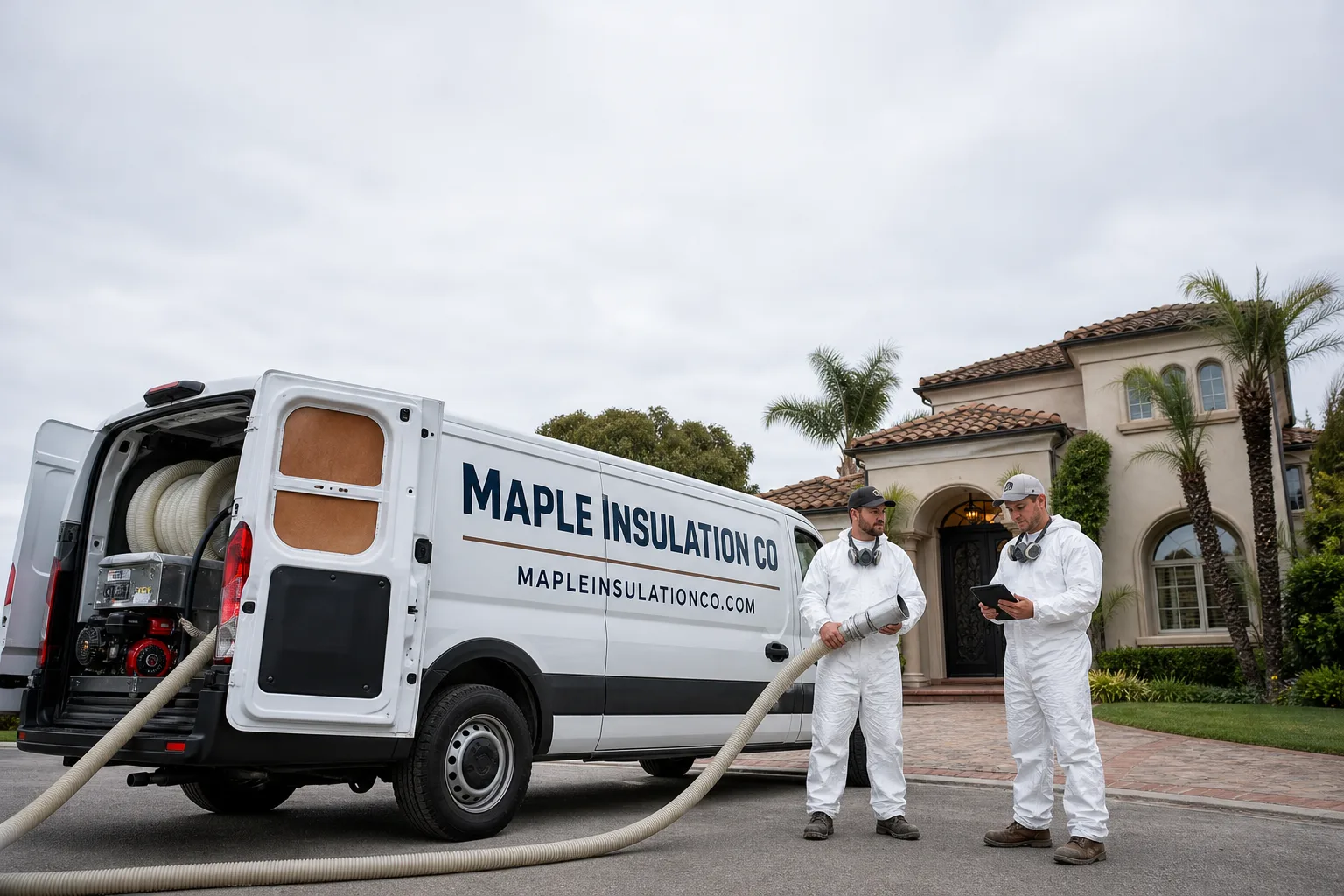
Fast, Reliable Spray Foam Insulation Across Corona
If your Corona home’s AC runs constantly through July and August, the problem is rarely the unit itself. It’s what’s happening above the ceiling and behind the walls. Spray foam insulation in Corona typically costs $2.50 to $5.50 per board foot installed, and on a standard 1,200-square-foot attic, a full roof deck application usually lands between $4,800 and $9,600. You can reach us at (855) 341-6045 for a free attic assessment, and in most Corona neighborhoods we can have a technician out within 48 hours.
We know the difference between a 1960s single-story off Sixth Street and a 2003 two-story in the hills above Sierra del Oro because we’ve foamed both. That local knowledge changes how we approach your project before we ever load the truck in Coto De Caza.
Why Maple Insulation Co Is Corona’s Preferred Spray Foam Insulation Company
Most insulation companies in the Inland Empire sell you whatever product line their distributor pushes hardest. We don’t have that problem. Noel Castaneda built Maple Insulation Co around a simple operating rule: match the material to the problem, not to what we happen to stock most. On a Corona job that might mean Icynene closed-cell for a west-facing tile roof, Demilec open-cell for an interior wall cavity, or Rockwool batts for a garage ceiling where fire separation matters.
Corona homeowners deal with a specific set of conditions: 100°F-plus afternoons, low humidity, intense sun exposure, and a housing stock that runs from postwar tract homes to 1990s hillside two-stories. We see the failures that come from treating all of those the same. Our crews have worked in 92882, 92883, 92877, and 92878 long enough to know which attics need ventilation fixes before foam goes in, and which ones just need the roof deck sealed. You can read what our Corona customers have said about that experience, but it’s easier to check your own attic temperature in August and imagine what it’s doing to your electric bill.
Crawl Space Spray Foam Insulation in Corona
Crawl Space Spray Foam Insulation in Corona is one of the highest-return projects we handle in the older single-story tracts near downtown, where floors sit over shallow crawl spaces that heat up like ovens by early afternoon. The job involves applying foam to the rim joists and subfloor from below, sealing the gaps where 100°F outside air seeps under your living space. Most Corona crawl spaces take one day, and a typical 1,000-square-foot area runs $2,800 to $5,200 depending on whether we’re sealing rim joists only or doing a full subfloor application.
Rim Joist Sealing for Older Floor Systems
The rim joist is where the floor framing meets the foundation wall, and in Corona homes built before 1980 it’s almost always unsealed. Air moves freely through those gaps. We use closed-cell foam here because it stops both air and moisture, which matters in a semi-arid climate where the temperature differential between crawl space and living room can hit 30 degrees in summer.
Subfloor Insulation for Tile and Hardwood Floors
If your Corona home has tile or hardwood over a vented crawl space, summer heat radiates upward through the flooring. Spray foam applied directly to the subfloor turns that radiant surface into a thermal break. It’s the fastest fix we know for homes where the thermostat reads 76 but your feet tell you otherwise.
Garage Spray Foam Insulation in Corona
Garage Spray Foam Insulation in Corona is a project we recommend before you buy a portable AC unit or resign yourself to not using the garage from June through September. An uninsulated garage in Corona regularly hits 120°F on a summer afternoon, and that heat transfers into any adjacent living space. We foam garage ceilings and shared walls, and for detached garages we can do the whole envelope. Expect $1,600 to $3,400 for a standard two-car garage ceiling in Corona.
Garage Ceiling Foam for Bedrooms Above
Many Corona homes built in the 1980s and 1990s have bonus rooms or bedrooms directly above the garage. If that room runs ten degrees warmer than the rest of the house, the garage ceiling is usually the culprit. Sealing it with closed-cell foam eliminates the heat stack effect in a single day.
Detached Garage Envelope Sealing
Detached garages in Corona’s newer subdivisions often have bare stud walls and no ceiling insulation at all. We spray the walls and roof deck as a complete envelope, which drops interior temperatures enough to make the space usable for storage, a workshop, or a home gym without running a dedicated AC unit all summer.
Trusted Brands We Service in Corona
We stock and install spray foam from Icynene and Demilec, two of the most widely specified brands in high-performance residential building envelopes, and we also handle Reflectix repair in Corona for jobs where that solution fits. You won’t get a generic “spray foam” pitch from us. We’ll show you the difference between Icynene’s open-cell line for sound control and Demilec’s closed-cell products for maximum R-value on a west-facing roof deck. For Corona customers, we also carry Owens Corning, Johns Manville, and Rockwool for hybrid jobs where spray foam isn’t the right call in every cavity. That range of options means your recommendation comes from the actual conditions of your Corona home, not from our warehouse.
Common Spray Foam Insulation Problems We See in Corona Homes
- Foam applied over settled rock wool in low-clearance attics. Many older downtown Corona homes have original rock wool or vermiculite that’s compressed to R-7 or less. If a contractor sprays thick foam directly over it without addressing the clearance issue, moisture gets trapped against the roof deck and rot follows.
- Delamination on dusty or oily sheathing. Corona’s semi-arid climate means roof decking accumulates a fine layer of dust and soot. South Corona’s steep tile roofs make proper substrate prep difficult, and foam that’s sprayed over that layer can peel away within a few years under intense sun.
- Missing radiant barrier on west-facing decks. We regularly see foam that’s degrading prematurely on the west-facing slopes in Corona’s hillside tracts. The ultraviolet exposure and sustained surface heat breaks down foam that isn’t paired with proper radiant control.
- Ignoring attic ventilation before foaming. Some Corona attics, especially in the 1950s and 1960s tracts, were built with minimal ridge and soffit vents. Sealing the attic without first fixing ventilation creates a different problem than the one you were trying to solve.
Pricing for Spray Foam Insulation in Corona, CA
Spray foam pricing in Corona runs slightly above the national average because of the extreme temperature swings and the need for careful substrate preparation. Open-cell foam in Corona typically costs $1.10 to $2.10 per board foot installed. Closed-cell runs $2.50 to $4.50 per board foot because it’s denser and delivers a higher R-value per inch. A full attic roof deck in a standard Corona ranch runs $4,800 to $9,600. Rim joist sealing in a crawl space runs $2,800 to $5,200. Garage ceiling foam runs $1,600 to $3,400. The variables are attic accessibility, roof pitch, and whether we need to remove settled legacy insulation first. Call (855) 341-6045 for a free estimate, and we’ll give you a firm number before any work begins.
We Also Serve Cities Near Corona
Our crews work throughout the surrounding area, including Spray Foam Insulation in Corona and neighboring communities like Home Gardens, El Cerrito Corona, Eastvale, and Norco. If you’re in one of those pockets and your attic has the same extreme heat problems we see across the Inland Empire, call us and we’ll schedule a visit the same way we do for our Corona customers. For more details on what we do, visit our Spray Foam Insulation service page.
Serving Corona, CA — Our Local Coverage Area
We’re based in the Corona area and know this community well. Use the map below to see our service coverage — if you’re nearby, we can almost certainly help.
FAQs About Spray Foam Insulation in Corona
Yes, but it has to be applied differently. In low-pitch roofs near downtown Corona, where there’s often less than two feet of attic clearance, our techs use low-profile spray rigs and apply foam directly to the roof deck rather than attempting to build up thickness on the attic floor. This seals the envelope without disturbing aged framing or trapping moisture. Corona homes with the tightest clearances are exactly where this matters most. Call (855) 341-6045 for an assessment of your specific roofline.
Closed-cell foam performs well on west-facing Corona roof decks when it’s paired with proper radiant barrier consideration. The intense afternoon sun on those steep-pitch tile roofs heats the decking to temperatures that degrade open-cell foam faster. We typically spec Demilec or Icynene closed-cell for those slopes, applied only after the sheathing has been cleaned and primed for adhesion. The radiant load in south Corona’s hills is the single biggest factor in material selection there.
Have it removed before any foam goes in. In older downtown Corona homes, we routinely find original rock wool that has settled to R-7 or less, and spraying foam directly over it traps moisture against the roof deck and accelerates rot. Removal is a one-day job for most attics, and once it’s out we can assess the sheathing condition and decide between closed-cell and open-cell for the new application. The fix starts with getting the old material out, not covering it up.
Yes, and it’s the single most effective change you can make to a garage you actually want to use in summer. An uninsulated Corona garage ceiling radiates heat downward all afternoon, and foam on that ceiling cuts the interior temperature gain dramatically. We’ve done enough garage ceilings in 92880, 92882, and the hillside tracts to tell you the difference is measurable the same day we finish.
Spray foam air-seals as it insulates, which matters more in Corona than raw R-value alone. Fiberglass batts leave air gaps, and in a climate where the outside air is 105°F while you’re paying to keep the inside at 76°F, air leakage through the attic is the dominant heat source. Closed-cell foam also handles Corona’s low humidity better, since it doesn’t hold moisture the way fiberglass can in older homes with original construction details.
Corona’s Two Roof Problems Demand Two Different Strategies
Here’s what we know from years of working in this city: you can’t treat a 1958 ranch off Sixth Street the same way you treat a 2001 stucco two-story off Cajalco Road. They have different roof pitches, different attic depths, different original insulation, and different failure modes.
In the older downtown tracts, the low-pitch roofs leave minimal attic clearance, and the insulation that went in sixty years ago was never adequate. We recently foamed the attic of a 1950s single-story home near downtown Corona where the original rock wool had compressed to R-7 and the low-pitch roof left barely 18 inches of clearance. Our tech used a low-profile spray rig to apply Icynene closed-cell foam to the roof deck, sealing the space without disturbing the aged framing. The homeowner immediately noticed fewer 100°F afternoon heat surges into the living space.
That’s the difference between understanding Corona and just showing up to spray foam. The low-profile equipment matters. The substrate prep on dusty, sun-baked sheathing matters. Knowing when a tile roof in the south hills needs a radiant barrier paired with the foam instead of foam alone matters. None of this is obvious from a Google search. It comes from years of fixing what other crews got wrong across 92882, 92883, 92877, and 92878.
Eight brands. Three methods. One contractor. That’s what we bring to every Corona job, whether you’re in a mid-century ranch near the 91 or a newer build up in the hills. And if you’re not sure what your attic actually needs, we’ll tell you honestly before we ever write an estimate. Call (855) 341-6045 and let’s talk about what’s above your ceiling.
Written by Noel Castaneda, Owner at Maple Insulation Co, serving Corona and the Inland Empire.