Fast, Reliable Attic Insulation Across March Air Force Base
Attic insulation in March Air Force Base usually costs between $1,800 and $4,200 for a full attic, depending on depth, access, and whether we’re removing old material or adding to it. Most jobs on base-adjacent homes are completed in one day, and our crews know the 92551 housing stock well enough to quote accurately before we arrive. If your utility bills spike every summer and your upstairs rooms feel ten degrees hotter than downstairs, the attic is usually the culprit. Call (855) 341-6045 and we’ll walk the attic with you, point out exactly what’s failing, and give you a number you can actually plan around.
We’re not a franchise crew that has to look up March Air Force Base on a map. Maple Insulation Co works in March Air Force Base regularly, and Noel Castaneda has spent enough time in 1950s base housing attics to know what’s up there before the ladder goes through the hatch. For a free estimate, call (855) 341-6045.
Why Maple Insulation Co Is March Air Force Base’s Preferred Attic Insulation Company
Reputation follows the work, and our work in 92551 keeps getting passed from one neighbor to the next. Rows of identical base houses mean word travels fast when someone’s attic finally stops roasting the bedrooms. Homeowners here call us after seeing the difference in a neighbor’s cooling bill, and we show up knowing the house plan before we step inside.
We keep response times to March Air Force Base tight because we schedule Riverside County jobs in clusters. When you call, we tell you the same week, not a six-week window. That matters in the Inland Empire, where a 100-degree week makes a failed attic hard to ignore.
Noel Castaneda built Maple Insulation Co around a simple position: we match the material to the problem, not to what we happen to stock most. That’s why we carry products from eight manufacturers across five material categories. When we tell a March ARB homeowner that blown-in cellulose is the right call, it’s because the attic told us so, not because that’s the only truck we own.
Radiant Barrier in March Air Force Base
Radiant Barrier work in March Air Force Base addresses a very specific Inland Empire problem: summer attic temps that climb past 140°F and bake the house from above. A radiant barrier is a reflective foil layer installed under the roof deck that reflects radiant heat back out before it ever reaches your insulation. In a semi-arid climate where cooling dominates the energy equation, this is often the single highest-return sheet of material you can add. Expect to pay $900 – $2,100 for a typical 92551 attic, depending on roof pitch, access, and square footage.
Where Radiant Heat Actually Comes From
The sun hitting your roof deck is a heat load, not an air-temperature problem. Shingles absorb it, the roof deck radiates it downward into the attic cavity, and your conventional insulation eventually gets saturated doing a job it wasn’t designed to do. A radiant barrier reflects that heat at the source, which keeps the insulation below it from becoming a slow-release radiator above your ceiling.
When It Makes Sense on Base Housing
Homes built in the 1950s through 1970s around March ARB typically have low-clearance attics with minimal venting. The physical space available for insulation is limited, so reducing heat at the roof deck gives you more effective cooling per dollar than trying to double stack batts in a cavity that won’t hold them. We’ve installed radiant barrier in dozens of base-plan homes where the difference shows up within the same billing cycle in summer.
Attic Cleaning Services in March Air Force Base
Attic Cleaning Services in March Air Force Base are part of the prep work before new insulation goes in, and in older base housing it’s usually non-negotiable. Most 92551 attics haven’t been disturbed in fifty years, meaning they’re holding dust, rodent droppings, degraded mineral wool fibers, and sometimes remnants of old wiring or building debris. A standard cleaning and debris removal for a base-plan home runs $450 – $1,100, with the high end covering full extraction of old insulation and surface sanitation of the attic floor.
Old Material Has to Go First
You can’t air-seal a dirty attic, and you can’t install insulation over degraded material without locking in the problems. On a row of mid-century base houses near the March ARB flight line, our crew opened an attic to find original mineral wool crushed to a fraction of its depth and radiant heat driving attic temps past 140°F. We removed the degraded material, air-sealed the shallow bays, and blew in GreenFiber to a uniform depth while leaving room for the acoustic batt spec the homeowners wanted against KC-135 engine noise. The attic held markedly cooler under 100°F+ afternoon sun.
What We Remove and What Stays
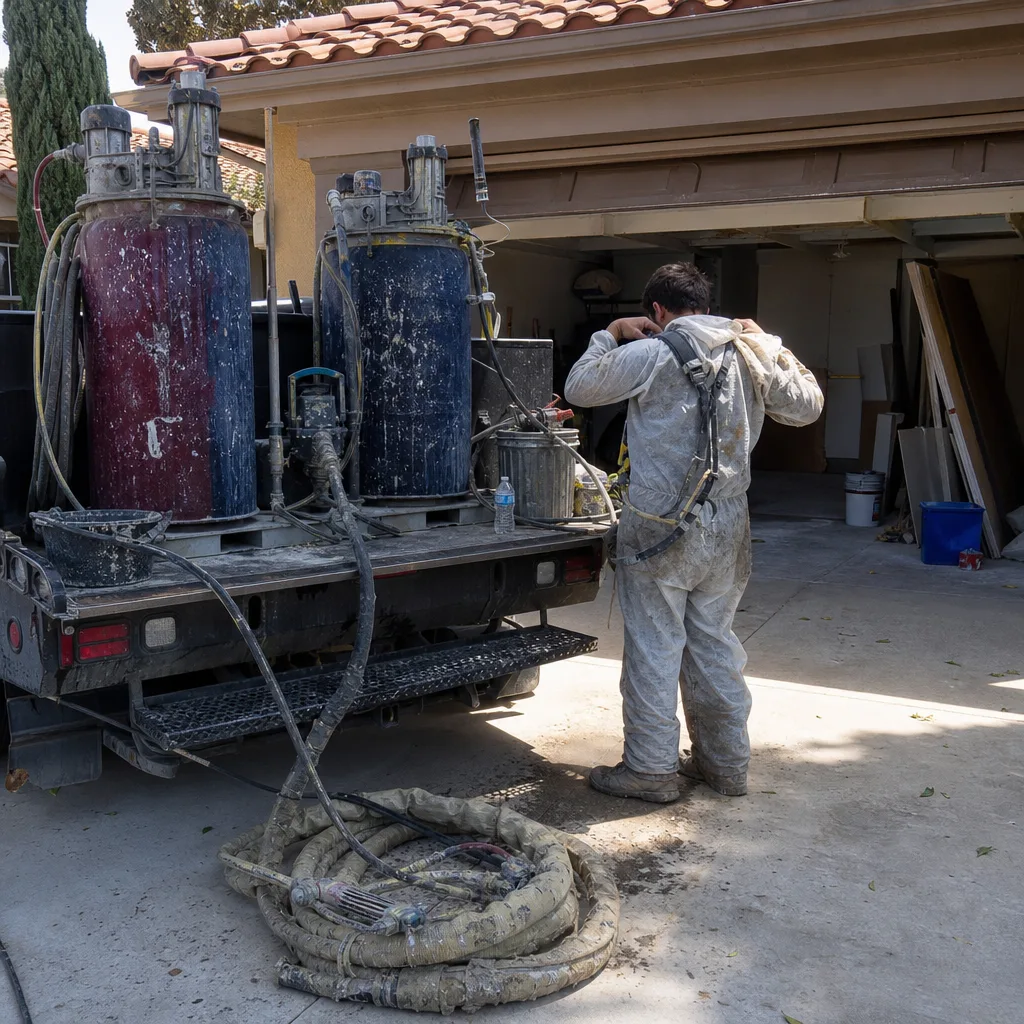
We extract loose-fill, damaged batts, vermiculite if encountered (with appropriate precautions), and contaminated material down to the attic floor sheathing. Then we do a debris pass and get the ceiling plane ready for air-sealing. What stays is whatever’s structurally sound. Most original base housing insulation isn’t.
What happens when you call
- 1
A real person answersNo phone trees — you reach a local pro.
- 2
You get an upfront price rangeHonest numbers before anyone is dispatched.
- 3
A background-checked tech heads outLicensed & insured, dispatched right away.
- 4
You approve before work beginsNothing starts until you say go.
Trusted Brands We Service in March Air Force Base
Maple Insulation Co doesn’t lock you into one product line. We install Owens Corning and Johns Manville fiberglass for standard budget-driven jobs, and we stock Rockwool for March Air Force Base homes where fire resistance and flight-line noise reduction sit at the top of the priority list. For deep-retrofit and air-sealing work, our blown-in GreenFiber cellulose gets into the shallow, irregular cavities these older base homes throw at us. Because we keep material inventory at our Southern California shop, turnaround on March ARB jobs doesn’t wait on a distributor’s delivery schedule.
Common Attic Insulation Problems We See in March Air Force Base Homes
- Settled original mineral wool. The 1950s – 70s base housing stock was insulated with loose mineral wool that compacts over decades. Most of these attics now measure two to three inches instead of the original six to eight, which means R-11 performance where R-30 should be. Removal and replacement beats topping it off every time.
- Compressed batts in shallow cavities. The repetitive base-plan homes have shallow rafter bays that a standard-thickness batt fills poorly. A contractor who stuffs R-30 batt into a 2×6 bay gets maybe R-18 out of it after compression. We cut and fit or switch methods entirely rather than pretend the label matches the performance.
- Flight-line noise through the attic. C-17 and KC-135 engine idle and takeoff cycles are part of life near the base perimeter. A proper acoustic batt installation behind the existing insulation layer helps, but not if air-sealing is skipped. Engine noise travels through the same gaps as hot air, so sealing comes first.
- Converted structures with oddball framing. Some March ARB houses are converted administrative or barracks buildings with no consistent rafter spacing, deep pockets, or access points that were never meant for insulation work at all. These need custom-cutting and often blown-in rather than rolled material, and we approach them as case-by-case retrofits, not standard installs.
Pricing for Attic Insulation in March Air Force Base, CA
For a standard 1,200 – 1,500 square foot base-plan house in 92551, a full attic insulation replacement typically runs $2,400 – $4,200 including removal of old material. A top-up over existing insulation runs $1,200 – $2,000, and attic cleaning alone lands between $450 and $1,100. Radiant barrier installation runs $900 – $2,100. What moves your number is access, depth of old material, and whether the attic has been updated at any point in the past. Every estimate is free, and we quote the job, not a vague range. Call (855) 341-6045 and we’ll give you exact numbers for your house, not a price sheet from another county.
We Also Serve Cities Near March Air Force Base
Our Attic Insulation crews cover the whole western Riverside County corridor. If you’re in Moreno Valley, Woodcrest, Perris, or Good Hope, you’ll get the same direct-schedule service and the same eight-brand material selection we bring to March Air Force Base. Sticking to this geography is what keeps our response times short and our crews familiar with the housing stock rather than guessing at it.
Serving March Air Force Base, CA — Our Local Coverage Area
We’re based in the March Air Force Base area and know this community well. Use the map below to see our service coverage — if you’re nearby, we can almost certainly help.
FAQs About Attic Insulation in March Air Force Base
Your March Air Force Base attic gets hot because the Inland Empire’s semi-arid climate drives 95 – 105°F temperatures for months at a time, and the sun hits your roof deck hard enough to push attic air past 140°F in older homes with minimal original insulation. A reflective radiant barrier helps, and so does adequate insulation depth, but the heat itself is a local reality, not a sign your AC is failing. Call (855) 341-6045 and we’ll measure your attic’s heat load directly and tell you what it would take to cut it.
Yes. Insulation, particularly dense mineral wool like Rockwool, can meaningfully reduce flight-line noise transfer through the ceiling plane, and it works best after air-sealing the attic floor so sound and heat stop sharing the same leak paths. We routinely spec acoustic batt behind the main insulation layer for March ARB homeowners near active taxiways. Call (855) 341-6045 and we’ll tell you whether your attic is even a significant noise pathway or if the windows are the bigger culprit.
Remove it. Original mineral wool from the 1950s – 70s in March Air Force Base housing is almost always compressed, dust-saturated, and performing at a fraction of its original R-value. Topping it off locks in the failed layer and limits how well air-sealing can work. Removal costs more upfront but gives you a clean, sealed cavity and a fresh material spec.
Yes, and these conversions often show some of the most dramatic temperature swings because they were never insulated for full-time living. The attics and roof assemblies in converted March ARB structures vary wildly, so we treat each as a retrofit rather than a standard install. Our blown-in cellulose handles the irregular cavities and shallow bays these buildings present.
Shallow cavities mean standard-thickness batts won’t fit without compression, and compressed batt loses so much R-value that the label becomes fiction. In these homes we either cut batt to the true cavity depth, switch to blown-in material that fills shallow and irregular spaces without gaps, or combine a thinner batt with a radiant barrier to hit the cooling performance the house needs. Call (855) 341-6045 for a free attic inspection and we’ll show you what’s actually possible in your specific bays.
Get Your March Air Force Base Attic Fixed This Week
If you live in 92551 and you’re tired of the upstairs being unusable from June through September, call Maple Insulation Co at (855) 341-6045 today. We’ll schedule a free attic inspection, give you a printed quote with line items you can check, and get the work done without turning your house into a construction zone. March Air Force Base homes have specific insulation problems, and we know them by name.
Written by Noel Castaneda, Owner at Maple Insulation Co, serving March Air Force Base and the surrounding Riverside County area.