Fast, Reliable Attic Insulation Across Good Hope
Attic insulation in Good Hope is a cooling problem first, not a heating one. The inland Riverside County sun bakes roofs from June through October, and if your attic can’t block that heat, your air conditioner never stops running. Maple Insulation Co installs and services Attic Insulation systems built for exactly this climate, with crews that route through Good Hope weekly. Call (855) 341-6045 for a free attic inspection and estimate.
Why Maple Insulation Co Is Good Hope’s Preferred Attic Insulation Company
Most Good Hope homes we walk into have insulation that was barely adequate when it was installed, let alone after ten summers of inland heat. We work across fiberglass, mineral wool, cellulose, and both open- and closed-cell spray foam, so the recommendation you get matches your attic’s actual condition rather than whichever product we have sitting in the warehouse. Eight brands. Three methods. One contractor.
Noel Castaneda leads our insulation team, and his approach is straightforward: diagnose the problem, show you what we found, and fix it correctly so you’re not paying to redo the work in five years. We carry Owens Corning, Johns Manville, Knauf, Rockwool, Icynene, Demilec, CertainTeed, and GreenFiber, which means we can match the material to the problem, not to what happens to be on the truck. Our crews know Good Hope’s housing stock, and we’re familiar with the specific ways these homes leak conditioned air and trap heat.
Attic Mold Removal in Good Hope
Attic mold removal in Good Hope usually follows the same pattern: insulation or stored boxes block the soffit vents, attic temperatures swing 40 to 50 degrees between day and night, and condensation forms on the underside of the roof sheathing. Mold follows. The first sentence of any honest conversation about Good Hope attic mold is that removing surface mold without fixing the airflow problem is a temporary patch, not a repair.
When we remove mold from a Good Hope attic, we’re also checking vent pathways, baffles, and insulation placement so the conditions that caused the growth don’t return. In homes near the 92572 ZIP code, we typically see mold concentrated near the eaves where soffit vents have been blocked by blown-in insulation or batts shoved too tight. The work includes treating affected framing and sheathing, then correcting the ventilation and insulation layout. Removing mold alone from a typical Good Hope attic typically runs $1,200 to $2,800 depending on affected square footage, with the insulation correction priced separately.
What Good Hope Homeowners Should Know About Attic Mold
Mold in a Good Hope attic is almost always a ventilation problem wearing a mold disguise. The same day-night swing that makes your upstairs hot also drives moisture into the attic cavity when warm, humid air meets cooling roof sheathing after sunset.
If you smell mustiness near attic access or see dark staining on the underside of the roof deck, don’t wait. The fix gets more expensive as mold spreads, and the underlying ventilation problem keeps getting worse.
Attic Insulation Removal in Good Hope
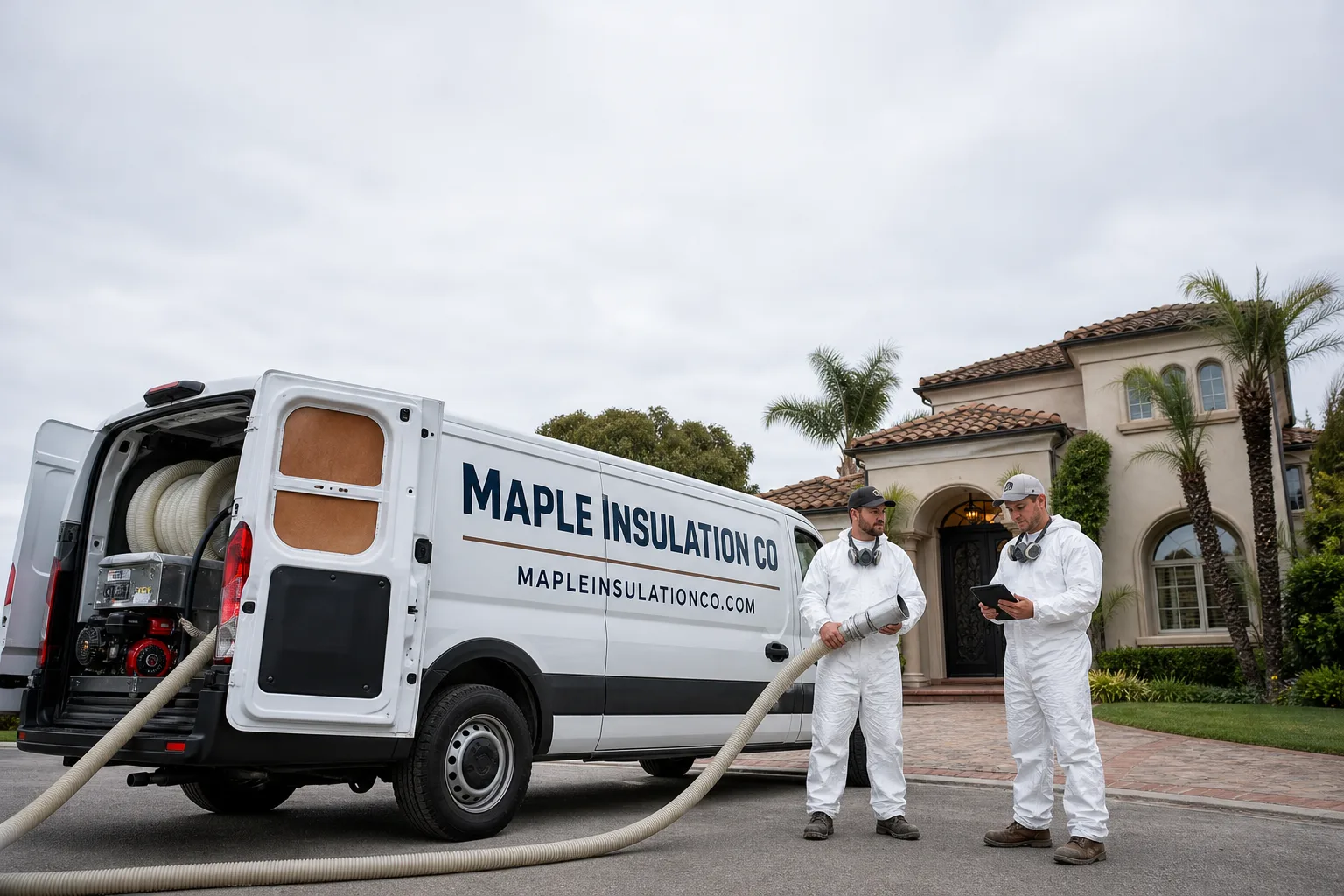
Attic insulation removal in Good Hope is frequently the right move for homes with original builder-grade batts that have been compressed, saturated by a past roof leak, or contaminated by rodent activity. Topping off bad insulation with new material doesn’t recover lost performance; the damaged layer has to come out first. Our crews handle full removal with commercial vacuums and careful disposal, then prep the attic floor for whatever material we’re installing next.
For most Good Hope homes, full removal plus air sealing plus new blown-in insulation ranges from $2,000 to $5,500 for a typical 1,200 to 2,000 square foot attic. The spread depends on access, how much old material is up there, and whether we’re also addressing mold or vent corrections. If the existing insulation is dry, uncompressed, and free of contamination, a top-up may be sufficient, and we’ll tell you that rather than sell you a removal you don’t need.
Signs Removal Is the Right Call
Compressed fiberglass batts that have been walked on, stacked under boxes, or squeezed around HVAC equipment lose most of their R-value. We see this constantly in Good Hope homes where the attic doubles as storage.
Rodent droppings, old water stains on insulation, or material that’s crumbled into dust all point toward removal rather than top-up. Removing the old layer gives us a clean surface to air-seal penetrations before new material goes in.
Trusted Brands We Service in Good Hope
We’re material-agnostic, and the brands we stock reflect that. For Good Hope attics we regularly install GreenFiber blown-in cellulose because it covers uneven attic floors well and performs consistently in high heat. Owens Corning and Johns Manville fiberglass both handle the basic batt and blow-in work at a budget-friendly price point. Rockwool mineral wool goes into attics where fire resistance and sound control matter, and we carry Icynene and Demilec spray foam for homes where air-sealing and maximum R-value per inch are the priority. Because we stock local inventory for Good Hope jobs, we can usually start within days, not weeks.
Common Attic Insulation Problems We See in Good Hope Homes
- Compressed fiberglass batts over living spaces. Stored boxes, old HVAC equipment, and even past contractors crawling through the attic crush batts down to a fraction of their rated R-value. The result is hot spots directly under the compressed areas, which Good Hope homeowners notice as temperature differences room to room.
- Radiant heat gain through unsealed penetrations. Can lights, wiring holes, and top plates let superheated attic air leak into rooms below. In Good Hope’s summer, attic air can hit 140 degrees, and even small gaps act like open windows.
- Attic mold on roof sheathing. Poor ventilation combined with Good Hope’s day-night temperature swings creates condensation on the underside of the roof deck. We see it most often in homes where soffit vents are blocked by insulation or where bathroom fans vent into the attic instead of outside.
- Inadequate insulation depth, especially in older homes. Many Good Hope attics built before modern energy codes have R-19 or less. Current recommendations for this climate are R-38 to R-49, and the gap shows up as a second floor that never cools down.
Pricing for Attic Insulation in Good Hope, CA
Blown-in attic insulation for a typical Good Hope home runs $1,800 to $4,200, depending on square footage and target R-value. Attic batt insulation for a fresh install lands between $1,500 and $3,800. If you’re topping up an existing attic, expect $1,200 to $2,500 for most Good Hope homes. Full insulation removal with air sealing and new blown-in material runs $2,000 to $5,500. Spray foam is priced per board foot, so it costs more upfront but delivers the highest R-value per inch and air-seals in one step. These are real ranges for the 92572 market, not national averages. For an exact quote on your attic, call (855) 341-6045; estimates are free, and we’ll show you what’s actually up there before we recommend spending anything.
We Also Serve Cities Near Good Hope
Maple Insulation Co runs crews out of Coto De Caza and covers the surrounding Inland Empire communities, including Good Hope and the nearby cities of Perris, Romoland, Sun City, and Mead Valley. If you’re just outside the 92572 ZIP, give us a call and we’ll confirm our next available routing date for your area.
Serving Good Hope, CA — Our Local Coverage Area
We’re based in the Good Hope area and know this community well. Use the map below to see our service coverage — if you’re nearby, we can almost certainly help.
FAQs About Attic Insulation in Good Hope
Because R-value alone doesn’t stop Good Hope heat. Unsealed attic penetrations, under-vented attics, and compressed or uneven insulation all let radiant heat reach the second floor even when the attic has enough material on paper. Air-sealing the attic floor before adding insulation is the step most homes miss, and it’s the step that makes the biggest difference in upstairs comfort. Call (855) 341-6045 and we’ll show you where your attic is leaking heat.
If the existing material is dry, uncompressed, and free of mold or rodent contamination, a top-up is usually sufficient. If batts are flattened from storage, water-stained from an old leak, or filled with droppings, removal is the right call because new insulation won’t fix the underlying problem. We’ll inspect and tell you which path makes sense for your Good Hope attic.
For inland Riverside County, we recommend R-38 to R-49 in the attic. The higher end of that range makes sense if you run air conditioning heavily or have a two-story home where the upstairs struggles to keep up. We can assess what’s currently installed and calculate the exact depth of new material needed to hit your target.
Yes. Our crews are equipped to remove mold-affected insulation, treat the sheathing, correct the ventilation problem, and install new insulation in a single project. Most Good Hope mold and insulation jobs are completed in one to two days, depending on attic size and the extent of the mold. Call (855) 341-6045 for a free assessment.
We install GreenFiber blown-in cellulose, Owens Corning and Johns Manville fiberglass, Rockwool mineral wool, and Icynene and Demilec spray foam. The brand we recommend depends on your attic, your climate zone, and your goals; since we stock all of them, the recommendation is driven by your house rather than our inventory.
Written by Noel Castaneda, Owner at Maple Insulation Co, serving Good Hope and the surrounding Inland Empire communities.