
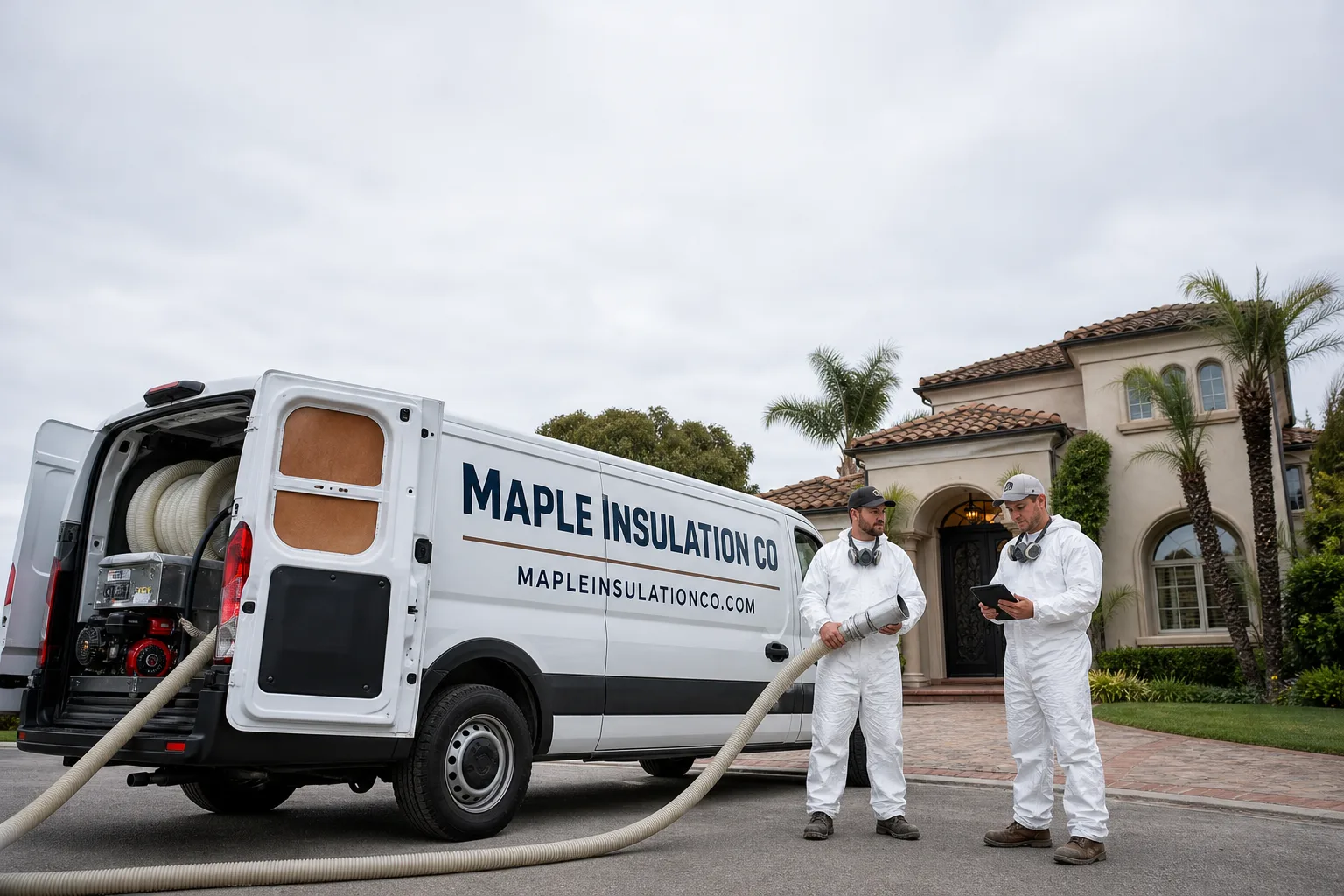
Fast, Reliable Spray Foam Insulation Across Wildomar
Spray foam insulation in Wildomar typically costs $2.50 – $6.50 per board foot installed, with attic jobs on 2000s-era tract homes running $4,200 – $8,900 and detached workshops on rural parcels falling between $2,100 and $5,400 depending on square footage and foam type. Most Wildomar jobs are completed in one to two days, including prep, application, and ember-resistant vent detailing. We serve the entire 92595 ZIP code and respond to most service calls within 24 – 48 hours. Call (855) 341-6045 for a free estimate tailored to your specific roofline and existing insulation condition.
Our crews work the full stretch of Wildomar, from the ranch parcels off Grand Avenue and Bundy Canyon Road down through the Windsor Avenue corridor and into the tract subdivisions around Clinton Keith Road. The mix of housing stock here means we shift constantly between retrofitting aging ranch-style homes with original compressed insulation and upgrading thin builder-grade batt in newer stucco-over-wood-frame construction. Homes near The Farm and along Gruwell Street tend to be among the newer builds, while the acreage off Palomar Street and further east toward the hills carries the older, larger-lot character. We know these streets because spray foam performance in wildomar hinges on how the roof assembly interacts with triple-digit heat and Santa Ana wind events.
Why Maple Insulation Co Is Wildomar’s Preferred Spray Foam Insulation Company
Wildomar homeowners call us because we treat every job as a roofing and air-sealing project, not just an insulation install. In this town especially, the venting system is the weak link. We’re the contractor who will tell you that your soffit vents are ember entry points before we quote a foam thickness. That level of local detail comes from walking dozens of Wildomar attics, from the 2000s-era tracts around Oak Creek Drive to the older ranch spreads southeast of Grand Avenue.
Led by Noel Castaneda, our team carries both Icynene and Demilec spray foam lines, so we can recommend open-cell or closed-cell based on your roofline pitch, existing vapor profile, and whether the structure is attached to living space or detached. We don’t push one product. We match foam chemistry to the specific heat load, venting configuration, and ember risk on your Wildomar parcel. Eight material brands across three insulation methods means the recommendation fits your home, not our inventory.
Spray Foam Attic Insulation in Wildomar
Spray Foam Attic Insulation in Wildomar is about controlling radiant heat gain and sealing the ceiling plane against the triple-digit summer stretches that bake roofs from June through September. We spray open-cell or closed-cell directly onto the underside of the roof deck, converting the attic from a vented, superheated chamber into a semi-conditioned space or a sealed assembly. For a typical Wildomar tract home with a 1,400 – 2,200 sq ft attic floor, expect $4,200 – $8,900 for closed-cell or $3,300 – $6,200 for open-cell, depending on deck exposure and access.
The wildomar-specific step most contractors skip is the soffit treatment. In the 2000s-era subdivisions throughout 92595, the open eave vents that satisfy building code for ventilation double as ember entry points during Santa Ana events. Before spraying, we line those vents with ember-resistant mesh and sometimes an intumescent coating, then foam against the sealed assembly. Without this, wind-driven embers can lodge at the foam edges and compromise both the insulation and the structure.
Roof Deck Foam for Radiant Heat
The dominant comfort problem in Wildomar attics is radiant heat transfer. Roof deck temperatures here routinely exceed 150°F in summer. Spray foam applied to the underside of the deck interrupts that radiant load before it can radiate down through the ceiling, which is why spray foam outperforms blown-in or batt insulation in this specific climate when the attic contains ductwork or air handlers. Sheetrock temperatures in the living space stay far closer to the thermostat setpoint.
Older Ranch Attic Retrofit
On ranch parcels with original compressed batt or loose-fill insulation, we often find the existing material has pancaked to near-zero R-value. Our approach there is to remove and dispose of the failed material, then spray the roofline or ceiling plane directly. For detached buildings with unvented roof assemblies, we pair the foam with a code-required ignition barrier so the assembly meets the same fire-safety standards as the main home.
Spray Foam Wall Insulation in Wildomar
Spray Foam Wall Insulation in Wildomar addresses the stucco-over-wood-frame construction that dominates the 2000s-era tracts. These walls often have fiberglass batt between studs with gaps around wiring penetrations, plumbing chases, and electrical boxes, all of which leak conditioned air. Spraying open-cell foam into framed wall cavities from the interior or during renovation fills those voids and creates an air seal that batt simply cannot match. Wall cavity foam jobs in Wildomar typically run $2.50 – $4.50 per board foot for open-cell and $4.00 – $6.50 for closed-cell, plus drywall and prep work.
The wall story in Wildomar is also an ember story. During Santa Ana events, wind-driven pressure differentials pull air through any unsealed wall penetration. We air-seal door frames, window rough openings, and wiring chases before foaming so the assembly works as a system. A wall that is insulated but not air-sealed still loses conditioned air through bypasses.
Garage and Workshop Walls
Detached workshops and garages on rural Wildomar parcels are prime candidates for wall foam. These outbuildings often have uninsulated or poorly insulated walls, and many lack any air barrier at all. Heavy-duty roll-up doors on oversized openings create negative pressure when raised, pulling hot attic air and dust through every unsealed penetration. We foam the wall cavities and then seal the door framing, the header gap, and any exposed wiring chases so the building holds temperature instead of leaking it.
Interior Wall Retrofits
If you’re renovating a Wildomar home down to studs, that’s the moment for spray foam. We spray open-cell into the exposed cavities before drywall goes back up. This is also when we address rim joist areas, which are a major air leakage point in slab-on-grade construction common throughout 92595. The material bonds to the substrate, eliminating the gaps and compression failures that plague batt insulation over time.
Trusted Brands We Service in Wildomar
We’re material-agnostic, which means every Wildomar job gets matched to the product that solves the actual problem. For spray foam, we stock both Icynene and Demilec product lines, two of the most recognized names in performance foam. Icynene open-cell works well for interior wall cavities and sound dampening between rooms. Demilec closed-cell brings higher R-value per inch plus moisture resistance, which matters on unvented roof decks over detached workshops. We also carry Owens Corning, Johns Manville, and Rockwool for hybrid assemblies where foam isn’t the right fit for every layer. Wildomar customers never wait on a special order because we keep local stock for this market’s common configurations.
Common Spray Foam Insulation Problems We See in Wildomar Homes
- Compressed builder-grade batt in 2000s tract attics. Triple-digit summer heat flattens fiberglass, leaving gaps and thin spots. If we spray over compressed batt without removing it, the assembly never reaches its target R-value, so we pull it first.
- Open soffit vents acting as ember entry points. Santa Ana winds drive embers into eave vents that were never designed for fire. We seal those vents with ember-resistant mesh and intumescent coating before foam application, a detail most contractors skip.
- Detached workshops on ranch parcels with unvented attics. Foam applied without a proper ignition barrier can fail inspection and increase fire risk. We always verify ignition barrier requirements on unvented assemblies before spraying.
- Oversized roll-up doors creating negative pressure. Heavy doors on workshops and garages pull hot attic air through door frames and wiring chases when opened. Foam alone won’t fix this; the door frame and penetrations must be air-sealed as part of the job.
Pricing for Spray Foam Insulation in Wildomar, CA
Open-cell spray foam in Wildomar runs $2.50 – $4.50 per board foot. Closed-cell runs $4.00 – $6.50 per board foot. A full attic spray on a 1,500 sq ft ranch home lands between $3,900 and $8,200. Detached workshop roof decks usually fall between $2,100 and $5,400. Wall cavity retrofits range from $2.50 – $4.50 per board foot for open-cell plus necessary drywall patching. The factors that move your quote: total board footage, open-cell vs. closed-cell, existing insulation removal, ember-resistant vent sealing, and access difficulty on steep or low-slope roofs. Every Wildomar estimate is free, and we provide a written line-item breakdown before any work begins. Call (855) 341-6045 and we’ll schedule a walkthrough within 24 – 48 hours.
We Also Serve Cities Near Wildomar
Our crews cover the full southwest Riverside County corridor. If you’re in Wildomar or the surrounding communities, we handle spray foam jobs in Murrieta, Murrieta Hot Springs, Sedco Hills, and Lakeland Village. The drive from Coto De Caza puts us at most Wildomar properties in under an hour, so same-week scheduling is standard across this service area.
Serving Wildomar, CA — Our Local Coverage Area
We’re based in the Wildomar area and know this community well. Use the map below to see our service coverage — if you’re nearby, we can almost certainly help.
FAQs About Spray Foam Insulation in Wildomar
Yes, absolutely. In Wildomar’s 2000s-era tract subdivisions, open soffit and eave vents that meet code for ventilation double as ember entry points during Santa Ana wind events. We seal those vents with ember-resistant mesh and intumescent coating before applying spray foam so the foam edges don’t become ember traps. This step is commonly skipped by contractors unfamiliar with the wildfire corridor in southwest Riverside County. Call (855) 341-6045 for a free inspection of your venting system.
Yes, and this is some of our most common work on the ranch parcels off Grand Avenue and Bundy Canyon Road. We spray closed-cell foam on the roof deck to handle radiant heat, then air-seal the heavy-duty roll-up door framing and wiring chases to stop negative pressure from pulling hot air through the envelope. We also verify ignition barrier requirements on unvented assemblies so the building passes inspection.
Spray foam outperforms batt in Wildomar summers because it creates an air seal that fiberglass cannot. Attic temperatures here routinely exceed 150°F, and compressed builder-grade batt loses most of its effective R-value under those conditions. Open-cell foam holds its shape and seals against convective heat gain, while closed-cell adds roughly R-6.5 per inch. Many Wildomar homeowners see their second-floor bedroom temperature differentials narrow noticeably after a roof deck foam retrofit.
Yes, once the failed insulation is removed and the roof assembly is properly prepared. On older ranch-style homes, we remove the original compressed batt or loose-fill, repair any roof leaks or damaged decking, then spray directly onto the prepared surface. For unvented assemblies, we install a code-required ignition barrier if one is needed. The result is a cleaner, more effective thermal envelope than layering new material over old.
We install Icynene and Demilec spray foam lines, selected by assembly type and moisture resistance needs. Icynene open-cell is our standard for interior wall cavities and sound control. Demilec closed-cell is the choice for roof decks and unvented assemblies where higher R-value per inch and moisture resistance matter. Both are applied by our own crews, led by Noel Castaneda, with no subcontracting on spray foam work.
For a free spray foam insulation estimate in Wildomar, call (855) 341-6045. We’ll walk your attic, check your venting, and give you a written quote with line-item pricing before any work begins. If you’re ready to replace compressed insulation or upgrade an underperforming roof deck before the next Santa Ana season, now is the right time to schedule.
Written by Noel Castaneda, Owner at Maple Insulation Co, serving Wildomar and southwest Riverside County with material-agnostic insulation expertise.