
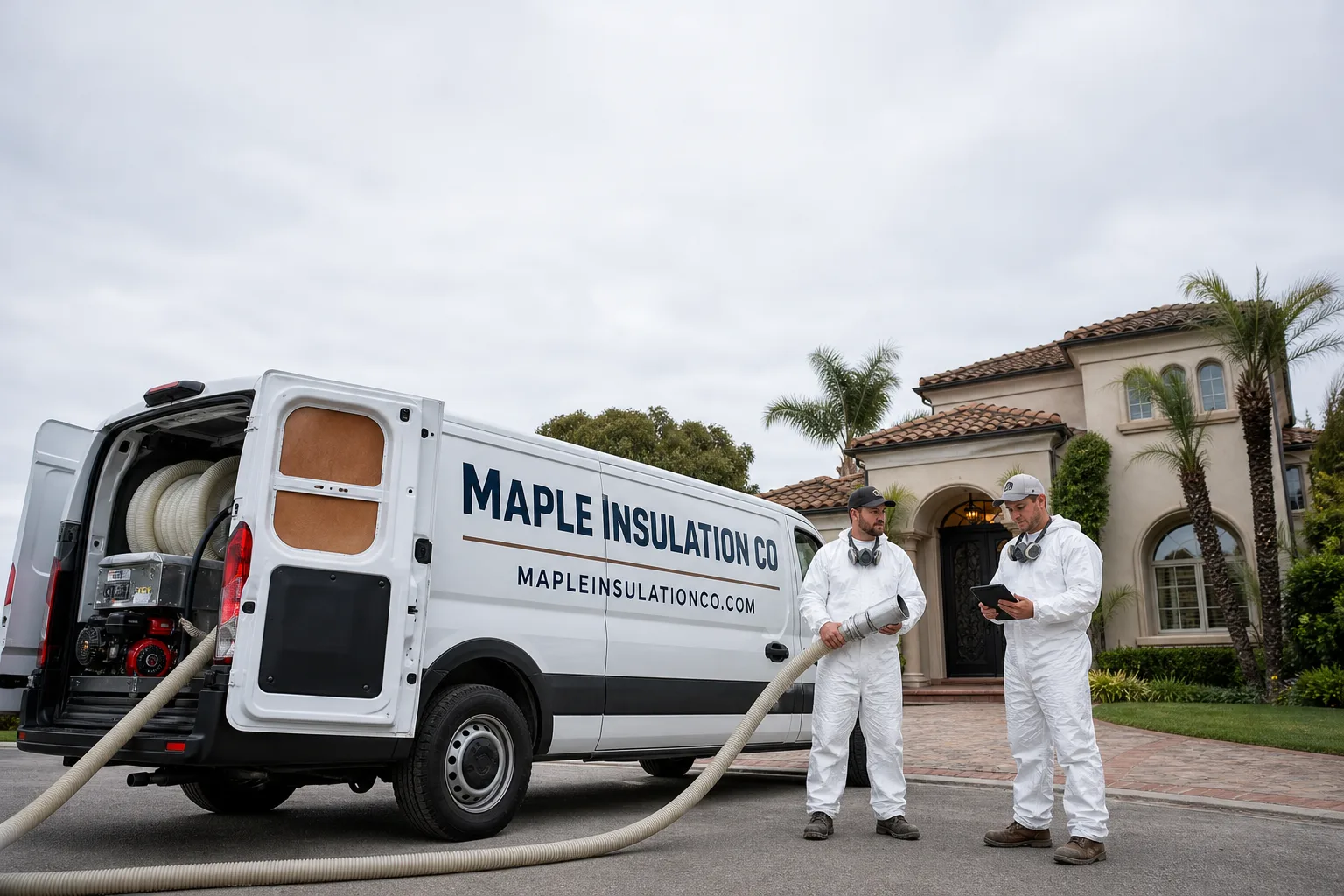
Fast, Reliable Spray Foam Insulation Across Tustin
Spray foam insulation in Tustin typically costs $2,800 to $7,200 for a full attic application, with most homes in the 92780 and 92781 ZIP codes falling between $3,100 and $5,400 depending on square footage and whether we’re removing old batt first. We reach most Tustin neighborhoods within 30 to 45 minutes of your call, and same-day estimates are standard for homes near the 5 freeway corridor. If you’re tired of rooms that bake in the afternoon or AC bills that climb every August, call (855) 341-6045 and we’ll walk through what’s actually going on in your attic before you spend a dollar.
Noel Castaneda built Maple Insulation Co to solve one recurring problem: Tustin homeowners getting pitched a single product instead of a real answer. Spray foam is sometimes the right call. Sometimes it’s blown-in cellulose or Rockwool batts. We stock all of it, so the recommendation comes from your house, not our inventory.
Why Maple Insulation Co Is Tustin’s Preferred Spray Foam Insulation Company
Tustin’s housing stock splits in two directions, and most insulation companies treat both sides the same. That’s a mistake. The mid-century tracts around downtown 92780 have attics that ratchet past 140°F by mid-afternoon, cooking original fiberglass batts until they’re flat and useless. The newer planned communities in 92782 have tighter envelopes but still lose cooled air through rim joists, garage ceilings, and unsealed top plates. We’ve worked both sides of that split long enough to know what each home actually needs.
Our crews carry open-cell Icynene, closed-cell Demilec, and Rockwool mineral wool on the same truck. That matters when a Tustin homeowner calls expecting a foam pitch and instead gets a straight answer: open-cell for a vented attic, closed-cell for a rim joist, mineral wool for a wall cavity where fire rating and sound matter more than R-value per inch. Noel Castaneda trains every estimator to explain the trade-offs in plain language, because a wrong foam choice in the wrong attic is an expensive problem, not a minor detail.
Homeowners around North Tustin, the Tustin Ranch area, and the Columbus Square development call us because we show up when we say we will, and we quote the job after looking at the actual space, not a satellite image. That’s not a sales tactic. It’s the only way to spot the old 92780 batt that’s compressed to half its nameplate R-value before you seal over it.
Spray Foam Attic Insulation in Tustin
Spray foam attic insulation in Tustin usually means air-sealing the ceiling plane and bringing the attic to R-21 or R-22 with open-cell foam, and it typically runs $3,400 to $6,800 in this market depending on attic access, existing insulation removal, and square footage. The heat in a Tustin attic isn’t a winter problem. It’s a July-through-October problem, when the Santa Ana corridor pushes roof deck temperatures high enough to bake old insulation and radiate heat down into living space all evening. Foam stops that radiant transfer by sealing every gap, crack, and penetration where superheated attic air pushes through.
We recently sprayed open-cell foam in a 1950s ranch home near downtown Tustin in 92780 where the attic regularly hit 150°F and the original batt had collapsed to less than R-7. Using Icynene, we air-sealed the ceiling plane and brought the attic to R-22, dropping the afternoon living-room temperature by 8°F even during a Santa Ana wind event. The homeowner also noticed less dust coming in from the alley-facing garage. That job taught us again why removal before foam matters: sealing over dead batt traps heat and moisture, and the foam blisters and loses adhesion within a season.
Old Batt Removal Before Foam
In Tustin’s older 92780 tracts, the question isn’t whether the original insulation has compacted. It’s how much. Decades of sun-baked attic heat compress fiberglass batts until they’re doing almost nothing, and spray foam applied directly over that layer will trap the heat and moisture that the dead batt still holds. We pull the old material, inspect the drywall for staining, and only then spray to the full specified depth.
Attics With Vented Roof Decks
Most Tustin homes have vented attics with ridge and soffit vents, which means open-cell foam on the ceiling plane is usually the right call. It air-seals while still allowing the roof deck to breathe. Closed-cell foam on the underside of roof decking creates a hot-roof assembly that changes how the attic operates, and in a vented attic, it requires ignition and thermal barriers to meet code for occupied space. We won’t recommend that unless the attic is unvented and conditioned already.
Spray Foam Wall Insulation in Tustin
Spray foam wall insulation in Tustin typically costs $2.50 to $4.50 per square foot of wall area when done during a remodel or from the interior after drywall removal, with whole-wall retrofits in older 92780 homes landing between $4,800 and $9,600. Walls in mid-century Tustin homes often have nothing more than thin fiberglass batts, if that, and the gaps around electrical boxes, plumbing penetrations, and top plates leak conditioned air all year. Closed-cell foam seals those leaks and adds structural rigidity, which is a real benefit in older stick-framed homes that have settled.
The 92782 side of Tustin is different. Newer construction has building wrap and modern sheathing, but rim joists and band boards still leak unless the builder paid extra for sealing, which most don’t. That’s where a targeted wall application, usually closed-cell foam on rim joists and exposed foundation walls, pays for itself in reduced air infiltration. We handle that separately from full wall retrofits, because the scope and the foam type are different.
Interior Retrofit During Remodel
Tustin homeowners remodeling a kitchen or bath have a narrow window to insulate exterior walls while the drywall is down. That’s the cheapest time to do it, and open-cell foam works well in 2×4 cavities. We coordinate with your contractor so the foam is sprayed before closing up, and we sign off on the depth before inspection.
Rim Joist and Band Board Sealing
Air leaks in older Tustin homes don’t happen at the walls as much as at the rim joist, the band board above the foundation, and the top plate under the attic. Closed-cell foam in those spots stops the stack effect that pulls hot attic air down in summer and heated air out in winter, and it’s often a half-day job for a single-story tract home. It’s also one of the highest-ROI foam applications we do.
Trusted Brands We Service in Tustin
We install Icynene and Demilec spray foam lines, two names that energy auditors and builders specify when performance matters more than price. For Tustin homeowners weighing foam against blown-in or batt options, we also carry Owens Corning fiberglass, Rockwool mineral wool, and Spray Foam Insulation accessories for every job we touch. When you call us about a Tustin property, you’re not getting a single-product pitch. You’re getting a material choice informed by your attic, your walls, and your actual utility bills.
Common Spray Foam Insulation Problems We See in Tustin Homes
- Foam sprayed over collapsed batt in 92780 attics. The original fiberglass has lost most of its R-value, but it’s still holding heat and moisture. Sealing over it traps that moisture against the ceiling drywall, and the foam eventually blisters and pulls away.
- Closed-cell foam in vented attics without the required thermal barrier. Tustin code requires an ignition barrier or thermal barrier on closed-cell foam in occupied spaces, and older remodels often skipped that step. We correct it when we find it before it becomes a fire inspection failure.
- Leaky ductwork sealed in without repair. Homes near downtown Tustin and the 92780 corridor often have original metal ducts with open seams. Tightening the envelope with foam without sealing ducts first causes condensation inside the ducts and, eventually, mold in the attic.
- Inconsistent application depth from previous installers. We see attics in Tustin where foam was sprayed thin in corners and around baffles to save material. That’s a performance killer, because air leaks concentrate exactly where the foam is thinnest. We measure and document depth on every job.
Pricing for Spray Foam Insulation in Tustin, CA
Here’s what spray foam actually costs in Tustin, based on the jobs we’ve quoted in the past year. A full attic air-seal and open-cell application runs $3,400 to $6,800 for most homes under 2,000 square feet. Rim joist and band board sealing is usually $1,800 to $3,200. Wall retrofits during a remodel land between $4,800 and $9,600 depending on the number of exterior walls. Closed-cell foam costs more per board foot but delivers a higher R-value per inch, and the total job price comes down to the area sprayed, not the brand name on the truck. Call (855) 341-6045 for an exact quote. Estimates are free, and Noel Castaneda reviews every one before you see it.
We Also Serve Cities Near Tustin
While this page covers spray foam work in Tustin, our crews also reach North Tustin, Santa Ana, Irvine, and Orange on the same schedule. If you’re on the edge of a ZIP code or just outside city limits, call us and we’ll confirm whether today’s route includes your street.
Serving Tustin, CA — Our Local Coverage Area
We’re based in the Tustin area and know this community well. Use the map below to see our service coverage — if you’re nearby, we can almost certainly help.
FAQs About Spray Foam Insulation in Tustin
Yes, spray foam directly addresses Tustin’s summer heat problem by air-sealing the ceiling plane so that superheated attic air can’t press down into living spaces, and by stopping the wind-driven air exchange that Santa Ana events push through every gap and crack in an older home. The result is a cooler upstairs in the afternoon and less dust infiltration during wind events. Call (855) 341-6045 for an attic assessment before the next heat wave.
In Tustin’s 92780 homes, spray foam works by first removing the dead batt insulation that’s compressed to a fraction of its original performance, then sealing the entire ceiling plane so the attic stops radiating heat downward. We’ve measured original batts at less than R-7 in attics that hit 150°F, and bringing that attic to R-22 with open-cell foam drops the room below it by 6 to 8 degrees on hot afternoons. The key is removal before spraying. Call (855) 341-6045 and we’ll inspect your attic for free.
Yes, spray foam fits 92782 homes, but typically as a targeted application rather than a whole-attic job. Newer construction has modern insulation in the attic and walls, but the rim joists, band boards, and garage ceilings still leak conditioned air, and closed-cell foam there delivers the biggest efficiency gain per dollar. We also see 92782 homeowners using foam on garage ceilings to stop heat migration into bonus rooms above. Call (855) 341-6045 and we’ll tell you which areas actually need it.
For most Tustin attics, especially vented attics on older 92780 homes, we recommend open-cell foam like Icynene applied to the ceiling plane at R-21 or R-22. It air-seals while letting the roof deck breathe, and it doesn’t trap the moisture that Tustin’s mild winters and warm nights can create. Closed-cell foam has its place, but in a vented attic it requires thermal barriers and changes the moisture dynamics. We’ll recommend the specific product after looking at your attic, not before.
Spray foam handles Tustin’s mild winters well, though the bigger payoff here is summer and wind-season performance. Cold-season temperatures rarely stress heating demand, but the same air-sealing that keeps heat out in August also keeps heated air in on the thirty or forty chilliest nights a year, which makes rooms more consistent without running the furnace longer. For Tustin, foam is primarily a heat-blocking and air-sealing upgrade, not a winter one. Call (855) 341-6045 to talk through what your home actually needs.
Written by Noel Castaneda, Owner at Maple Insulation Co, serving Tustin since inception.