
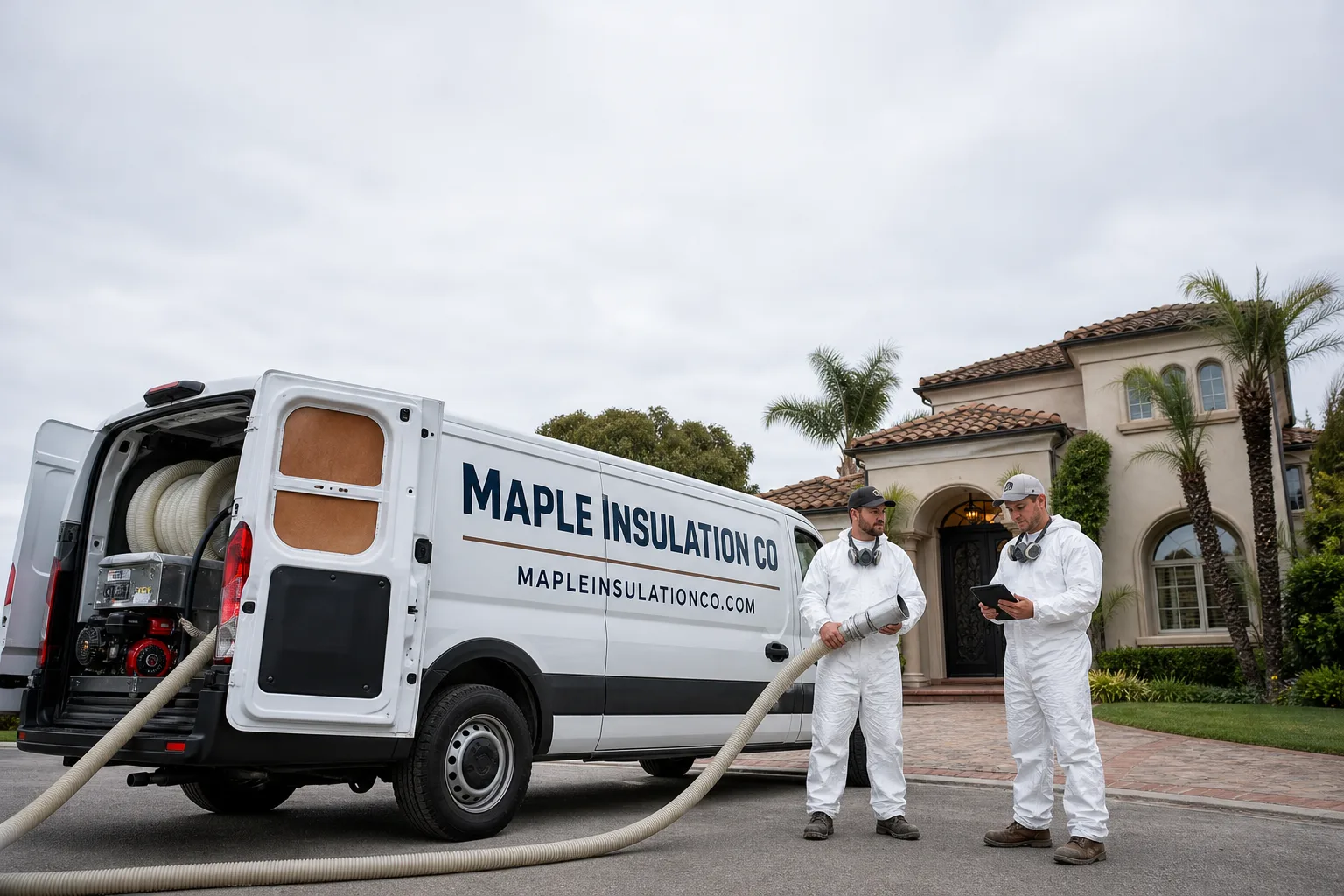
Fast, Reliable Spray Foam Insulation Across March Air Force Base
Spray foam insulation in March Air Force Base typically costs $2.50 to $6.50 per board foot installed, with most rim joist jobs landing between $1,400 and $2,800 and full attic applications running $4,000 to $9,500 depending on square footage and foam type. We service the entire 92551 ZIP, usually within one to two business days of your call. If you’re dealing with flight-line noise bleeding through your walls or cooling bills that spike every summer, we can help you sort out whether open-cell, closed-cell, or a hybrid approach makes sense for your specific structure. Reach Noel Castaneda and the crew at (855) 341-6045 for a free on-site estimate.
The homes around March Air Force Base aren’t like what you’ll find in Moreno Valley or Perris. This is base housing, converted barracks, and a handful of newer infill builds, each with their own insulation headaches. We know the difference between a 1958 wood-frame officer’s house and a converted admin building with concrete-block walls, and we spec foam accordingly.
Why Maple Insulation Co Is March Air Force Base’s Preferred Spray Foam Insulation Company
March Air Force Base homeowners call us because we don’t push one product. We stock Icynene and Demilec spray foam lines alongside Owens Corning, Johns Manville, and Rockwool products, which means the recommendation you get matches your wall cavity, your noise exposure, and your budget. Not our inventory.
Our team has sprayed foam in nearly every corner of the 92551 ZIP, from the older housing clusters near the main gate to the infill construction along the base perimeter. We understand the permitting considerations for work on former military structures, and we know which areas of the base require coordination with housing management before any insulation goes in. That local knowledge saves you time and prevents rework.
Every job starts with Noel walking the property himself. He measures existing insulation depth, checks for settled fiberglass and unsealed top plates, and identifies where air is actually moving through your envelope. Then we give you a straight answer on what needs to happen.
Rim Joist Spray Foam in March Air Force Base
Rim joist spray foam in March Air Force Base is the single highest-return insulation upgrade for the 1950s – 70s wood-frame homes that dominate this ZIP, because those rim joists were almost never sealed when the houses went up, leaving a continuous gap where hot attic air pours in and flight-line noise follows. In a 1962 home near the base perimeter, the original fiberglass had settled away from the top plate entirely. We filled the shallow cavity with 2 lb closed-cell Icynene, which sealed the air movement and cut both the heat gain and the C-17 rumble the homeowner had been living with for years.
Expect to pay between $1,400 and $2,800 for a full rim joist application in a standard March Air Force Base ranch, depending on linear footage and access. Most jobs wrap in one day.
How Rim Joist Sealing Works Here
Closed-cell foam goes in at 2 to 3 inches, which in these older homes is often enough to hit code-minimum R-value without overstuffing the cavity. The foam bonds to both the sill plate and the subfloor, creating an air barrier that fiberglass batts simply cannot achieve.
Signs You Need Rim Joist Work
You’ll notice drafts at the base of exterior walls, cold floors near the perimeter in winter, and a persistent smell of crawl space or garage air inside the living space. If you hear aircraft noise more clearly on the first floor than upstairs, your rim joists are likely the culprit.
Crawl Space Spray Foam Insulation in March Air Force Base
Crawl space spray foam insulation in March Air Force Base homes usually involves sealing the subfloor or the crawl space walls, and in this semi-arid climate the bigger concern is dust, rodent access, and radiated heat from the soil rather than standing water. Homes in March ARB’s historic housing stock typically sit on short crawl spaces with vented foundations, which means during a 100°F week the air under your floor is closer to 120°F. Encapsulating and insulating that space changes how the whole house feels.
Costs for crawl space spray foam in March Air Force Base run $1,800 to $5,200 depending on whether we’re insulating the walls, the subfloor, or doing a full encapsulation with vapor barrier. We’ll give you a line-item breakdown before any foam gets sprayed.
Subfloor Spray Foam vs. Crawl Space Wall Foam
For vented crawls with no moisture issues, spraying the subfloor underside with closed-cell foam creates a thermal break between hot crawl air and your living space. For crawls you want to fully seal, we spray the perimeter walls and rim joists, then add a vapor barrier on the ground. Both approaches work; the right one depends on your foundation and how you use the space.
What Crawl Space Work Unlocks
Sealing a crawl in March Air Force Base cuts dust infiltration, keeps pests from finding their way into wall cavities, and makes floors noticeably warmer in winter and cooler in summer. The energy savings compound when paired with attic work.
Trusted Brands We Service in March Air Force Base
We install and service Icynene and Demilec spray foam products, which are the two names most often spec’d for high-performance building envelopes. For jobs where acoustic performance matters more than raw R-value, we bring Rockwool mineral wool into the assembly, and for standard batt replacements we carry Owens Corning and Johns Manville. Because we stock parts and materials for all these brands locally, we don’t lose days waiting on shipments when a March Air Force Base job needs to move. Eight brands, three methods, one contractor: we match the material to the problem, not to what we happen to stock most.
Common Spray Foam Insulation Problems We See in March Air Force Base Homes
- Shallow cavity overfilling. The 1950s wood-frame housing near the flight line has stud bays shallower than modern 2×6 construction, and spraying foam too thick distorts framing or leaves voids. We apply thin lifts and let each pass cure before the next.
- Concrete-block bonding failure. Converted administrative buildings and some barracks structures have painted or sealed block walls that foam won’t adhere to without proper prep. We grind, clean, and sometimes prime those surfaces before spraying.
- Unsealed garage openings in newer infill. Newer homes around the base perimeter often have builder-grade doors with zero insulation around the rough opening, creating a giant hole in the envelope. Spraying that perimeter ties the garage into the conditioned space and cuts noise transfer.
- Noise paths through shared walls. In townhouse-style military housing, party walls transmit aircraft engine noise even when exterior walls are insulated. We combine closed-cell foam with Rockwool acoustic batt in those assemblies to hit both thermal and sound targets.
Pricing for Spray Foam Insulation in March Air Force Base, CA
Here’s what we’re seeing across the 92551 ZIP right now. Open-cell spray foam runs $2.50 to $3.75 per board foot installed. Closed-cell runs $4.00 to $6.50 per board foot. A typical rim joist job in a March Air Force Base rancher lands between $1,400 and $2,800. Crawl space sealing runs $1,800 to $5,200 depending on scope. Full attic spray foam in a 1,200-square-foot base home runs $4,000 to $6,500. What moves the needle: access difficulty, whether old insulation needs removal, and whether we’re doing multiple areas in one trip. Estimates are free, and the number we quote is the number you pay.
| Service | Typical Cost in March Air Force Base |
|---|---|
| Rim joist spray foam | $1,400 – $2,800 |
| Crawl space subfloor spray foam | $1,800 – $4,200 |
| Full crawl space encapsulation | $3,500 – $5,200 |
| Attic spray foam (1,200 sq ft) | $4,000 – $6,500 |
| Open-cell foam (per board foot) | $2.50 – $3.75 |
| Closed-cell foam (per board foot) | $4.00 – $6.50 |
We Also Serve Cities Near March Air Force Base
Beyond Spray Foam Insulation in March Air Force Base, our crews cover Moreno Valley, Woodcrest, Perris, and Good Hope. If you’re on the edge of the base or just outside the ZIP boundary, call us anyway and we’ll let you know if you’re in our service area. The same Spray Foam Insulation expertise applies across the whole Inland Empire corridor.
Serving March Air Force Base, CA — Our Local Coverage Area
We’re based in the March Air Force Base area and know this community well. Use the map below to see our service coverage — if you’re nearby, we can almost certainly help.
FAQs About Spray Foam Insulation in March Air Force Base
Yes, closed-cell spray foam is one of the most effective insulation types for reducing low-frequency aircraft noise, especially when combined with Rockwool acoustic batts in wall assemblies. C-17 and KC-135 engine noise transmits through air gaps and unsealed framing, which foam seals directly. Call (855) 341-6045 for a noise assessment of your specific home.
Open-cell foam applied in thin lifts works best in shallow 2×4 wall cavities because it expands less aggressively and won’t distort the framing. For rim joists and areas where air sealing matters more than full cavity fill, 2 lb closed-cell in a 2 to 3 inch application is the standard choice. We’ll spec the foam type based on your actual framing depth.
Closed-cell spray foam creates an air barrier alongside its thermal resistance, which means it blocks radiant heat transfer and stops hot attic air from pressurizing your living space. In March ARB’s semi-arid climate, where summer highs regularly exceed 100°F, this reduces cooling load and keeps upstairs rooms noticeably cooler. Get a free estimate at (855) 341-6045.
Yes, converted administrative and barracks buildings with painted or sealed concrete-block walls require surface prep before foam will bond correctly. We clean, etch, and sometimes prime block surfaces to prevent voids and delamination. Skipping this step is the most common cause of failed foam installations in converted buildings.
Yes, crawl space spray foam is a standard application for March ARB base housing, either on the subfloor underside or the crawl space perimeter walls. Most 1950s and 1960s base homes have vented crawls that pull in hot, dusty air, and sealing them works well in this climate. Call (855) 341-6045 for a specific recommendation.
Written by Noel Castaneda, Owner at Maple Insulation Co, serving March Air Force Base and the surrounding Inland Empire communities.