
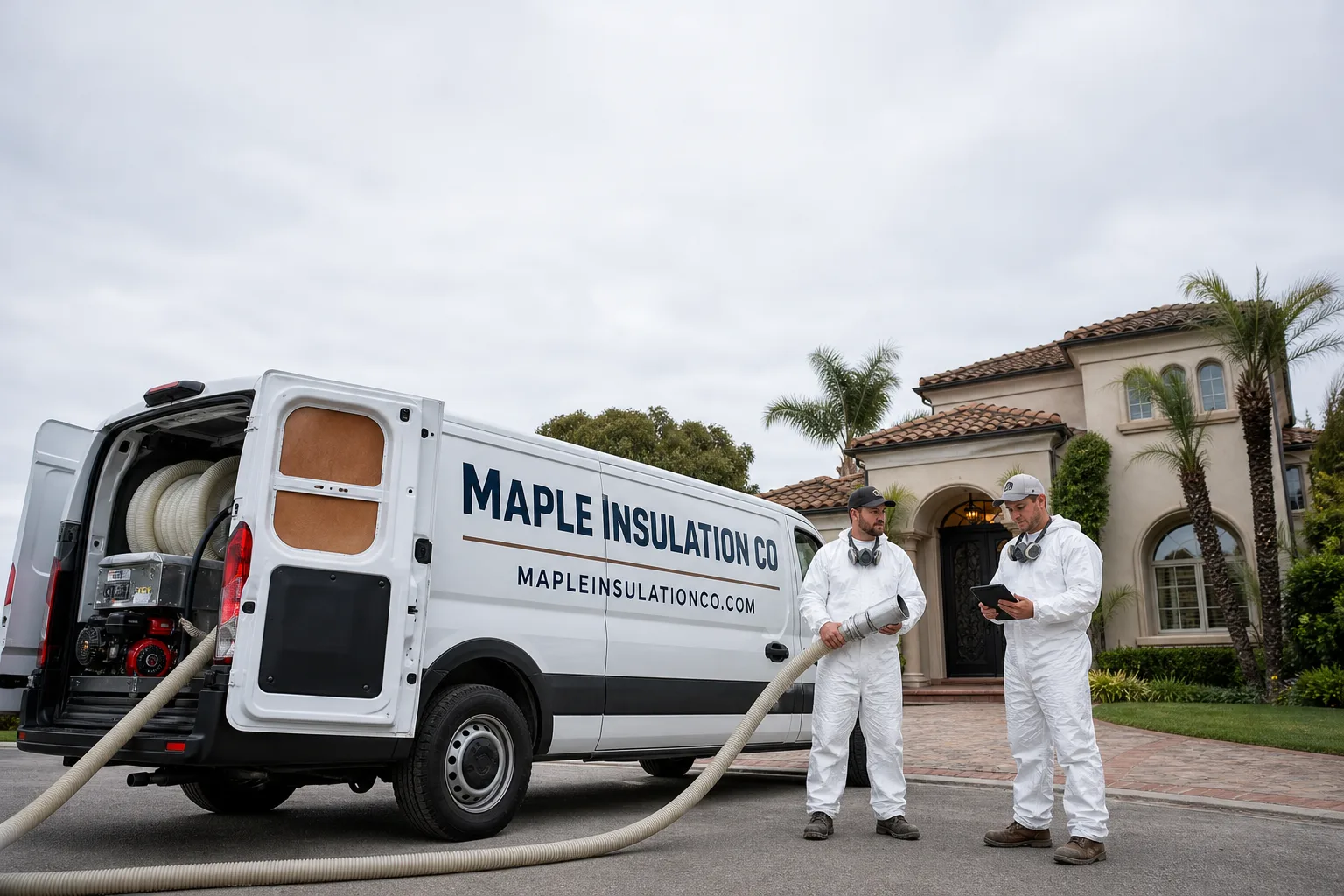
Fast, Reliable Attic Insulation Across Mission Viejo
If you live in Mission Viejo and your upstairs rooms feel ten degrees hotter than downstairs every summer, the problem is almost certainly your attic. Most homes here were built between 1966 and 1980 with original R-11 fiberglass batts that have spent 40-plus years baking under inland Orange County sun. Maple Insulation Co fixes this daily. We’re based in Coto De Caza, ten minutes from most Mission Viejo neighborhoods, and we know exactly what these tract homes need. Call (855) 341-6045 and we’ll give you a straight answer on what’s going on up there.
Why Maple Insulation Co Is Mission Viejo’s Preferred Attic Insulation Company
Mission Viejo homeowners call us because we understand the specific problem their houses have. This isn’t a market of custom builds where every attic is different. It’s a master-planned community where nearly every home is a wood-framed, stucco-clad tract build from the same few decades, and that means the insulation failures follow predictable patterns. We’ve worked in Madrid, Pacific Hills, Stoneridge, and dozens of other Mission Viejo neighborhoods. Homeowners here tell us the same thing: their AC never shuts off in August, their second floor never cools down, and nobody has looked in their attic since they bought the place.
Noel Castaneda built this company around a simple idea: match the material to the problem, not to whatever we happen to stock most. That’s why we carry products from eight manufacturers across fiberglass, mineral wool, spray foam, and cellulose. When a Mission Viejo homeowner needs an HOA-compliant attic retrofit, we’re not forcing a single product line on them. We’re choosing what actually works for their roofline, their budget, and their community’s architectural standards.
We respond to Mission Viejo calls same-day for estimates, and most retrofit jobs start within a week. That matters when your attic is hitting 135°F and your cooling bill is climbing.
Insulation Contractors in Mission Viejo
Insulation contractors in Mission Viejo do something very different from their counterparts in newer cities like Rancho Santa Margarita or Lake Forest. Here, the dominant job is a retrofit on a 40- to 50-year-old attic, not a fresh install on new construction. That means our crews spend most of their time removing or topping up degraded fiberglass, sealing air leaks around recessed lights and HVAC chases, and working around limitations that tract-home construction creates.
Retrofit-First Approach
In Mission Viejo, original R-11 batts have typically sagged, compressed, or settled to the point where they’re doing almost nothing. The fix is usually blown-in insulation installed right over the old material, or a full removal and replacement when moisture or rodent damage is present. We handle both, and we’ll tell you which one actually makes sense versus which one just costs more.
Working Around Architectural Controls
Many Mission Viejo neighborhoods have active HOA architectural review boards that restrict exterior changes. That includes roof vents, soffit modifications, and anything visible from the street. We plan insulation jobs with those constraints in mind from the first visit. No surprises, no violation notices arriving two months after the work is done.
Attic Ventilation in Mission Viejo
Attic ventilation in Mission Viejo gets overlooked constantly, and it’s the quiet reason many insulation upgrades don’t deliver the savings they should. A properly insulated attic with no airflow still turns into an oven. Mission Viejo’s summer heat pushes attic temperatures past 130°F before noon, and without working intake and exhaust ventilation, even fresh R-38 insulation sits in a superheated box.
HOA-Compliant Vent Upgrades
This is where Mission Viejo gets tricky. Standard off-the-shelf ridge vents or box vents often get rejected by architectural review boards because they alter the uniform roofline or color profile that the original 1970s tract design established. We stock low-profile vent options that blend with existing stucco and roofing colors, and we’ve handled enough ARB submittals in Mission Viejo to know what gets approved and what gets sent back.
Combining Insulation and Airflow
The right attic system combines sealed air leaks, code-level insulation, and balanced ventilation. Skip any one of those three and you’re leaving measurable energy savings on the table. In Mission Viejo’s climate, we typically recommend R-38 or better in the attic floor and a ventilation setup sized for the attic’s cubic footage, not a guess.
Trusted Brands We Service in Mission Viejo
Mission Viejo customers rarely ask us to service a specific brand. They ask us to solve a problem. But when we make a material recommendation, we’re pulling from a shelf that includes Owens Corning, Johns Manville, Knauf, and Rockwool, plus spray foam lines from Icynene and Demilec. We stock the common materials locally for Mission Viejo jobs, which means faster turnaround and no waiting on a freight shipment from a distributor. For a 1972 tract home in Madrid, we might recommend Owens Corning ProPink blown-in fiberglass. For a homeowner in Pacific Hills who wants fire resistance and sound dampening between a bonus room and the garage, Rockwool mineral wool is the better call. The brand follows the problem, not the other way around.
Common Attic Insulation Problems We See in Mission Viejo Homes
- Sagging and compressed batts. Four decades of heat cycling in a Mission Viejo attic compresses R-11 fiberglass down to an inch or two in places. That leaves huge gaps in coverage, especially around recessed lights and duct chases.
- Inadequate ventilation that cooks the insulation. When static vents crack or get painted over during a reroof, attic temperatures climb past 140°F. Insulation degrades faster, and the second floor never cools down.
- HOA restrictions blocking proper fixes. Several Mission Viejo communities require architectural review for any vent change visible from the street. Homeowners who skip the submittal end up with stop-work orders or fines, so the insulation job stalls halfway.
- Limited attic access in post-tension slab homes. Most Mission Viejo tract homes sit on post-tension slabs with small scuttle holes and tight attic cavities. That rules out exterior rigid foam and makes blown-in or dense-pack the only realistic options for walls and attic floors.
Pricing for Attic Insulation in Mission Viejo, CA
A typical attic insulation top-up in Mission Viejo runs $1,800 to $3,400 for a 1,200 to 2,000 square foot home, depending on existing conditions and target R-value. Full attic insulation replacement, where we remove old material and start fresh, typically lands between $2,800 and $5,500. Adding ventilation upgrades like HOA-approved soffit or ridge vents adds $300 to $900 depending on how many vents and what style your community requires. Attic baffles and vent prep run $150 to $450 per section. These are real numbers from Mission Viejo jobs, not national averages adjusted for the area. The fastest way to get an exact number for your home is to call (855) 341-6045. Estimates are free, and we’ll tell you honestly whether a top-up or a full replacement is the right spend.
We Also Serve Cities Near Mission Viejo
Maple Insulation Co works throughout south Orange County. If you’re in Coto De Caza, Lake Forest, Laguna Hills, or Rancho Santa Margarita, check our Mission Viejo service area page to confirm coverage and response times for your neighborhood. Same material expertise, same brands, same crew, different street address.
Serving Mission Viejo, CA — Our Local Coverage Area
We’re based in the Mission Viejo area and know this community well. Use the map below to see our service coverage — if you’re nearby, we can almost certainly help.
FAQs About Attic Insulation in Mission Viejo
In many Mission Viejo communities, yes. If the vent is visible from the street or changes the roofline profile, the architectural review board typically requires a submittal before work begins. We can prep the paperwork and specify low-profile vents that match your tract’s original design, which dramatically improves approval odds. Call (855) 341-6045 if you’re not sure whether your community requires review.
We can match or improve it. Original R-11 batts from the 1970s are obsolete by current code, so we typically recommend blowing in R-38 or R-44 on top of what’s there, or doing a full removal and replacement if the old material is compressed or contaminated. The goal is better performance, not a cosmetic match. We’ll show you what’s in your attic before we quote anything.
For most Mission Viejo homes, blown-in fiberglass at R-38 or higher is the practical answer. It covers uneven attic floors completely, resists the heat-related compression that kills batts over time, and installs without disturbing HOA-controlled exterior surfaces. Spray foam is a strong choice for homes with ductwork in the attic, and we’ll explain when that upgrade justifies the higher cost. Call (855) 341-6045 for a recommendation specific to your house.
Most Mission Viejo homes have small scuttle holes and tight attic cavities, which is exactly why blown-in insulation works so well here. We run a 3-inch hose through the existing access point and fill the attic floor evenly without cutting new openings. For wall insulation, dense-pack cellulose or fiberglass goes in through small drilled holes that get patched and painted to match, so nothing changes on the exterior.
No. Attic insulation goes inside the attic, under the roofline, so there’s no change to your roof or anything visible from the street. The only exception is if you’re also adding ventilation, but we specify low-profile, color-matched vents that keep your HOA’s architectural review board happy. No exterior work means no submittal for the insulation itself.
Written by Noel Castaneda, Owner at Maple Insulation Co, serving Mission Viejo from our Coto De Caza headquarters. Our Attic Insulation team handles every job with the material matched to the home, not the inventory.
Ready to solve your attic heat problem? Call (855) 341-6045 for a free estimate. We’ll walk your attic, show you what’s there, and give you a number that covers materials and labor. No pressure, no upsell.