
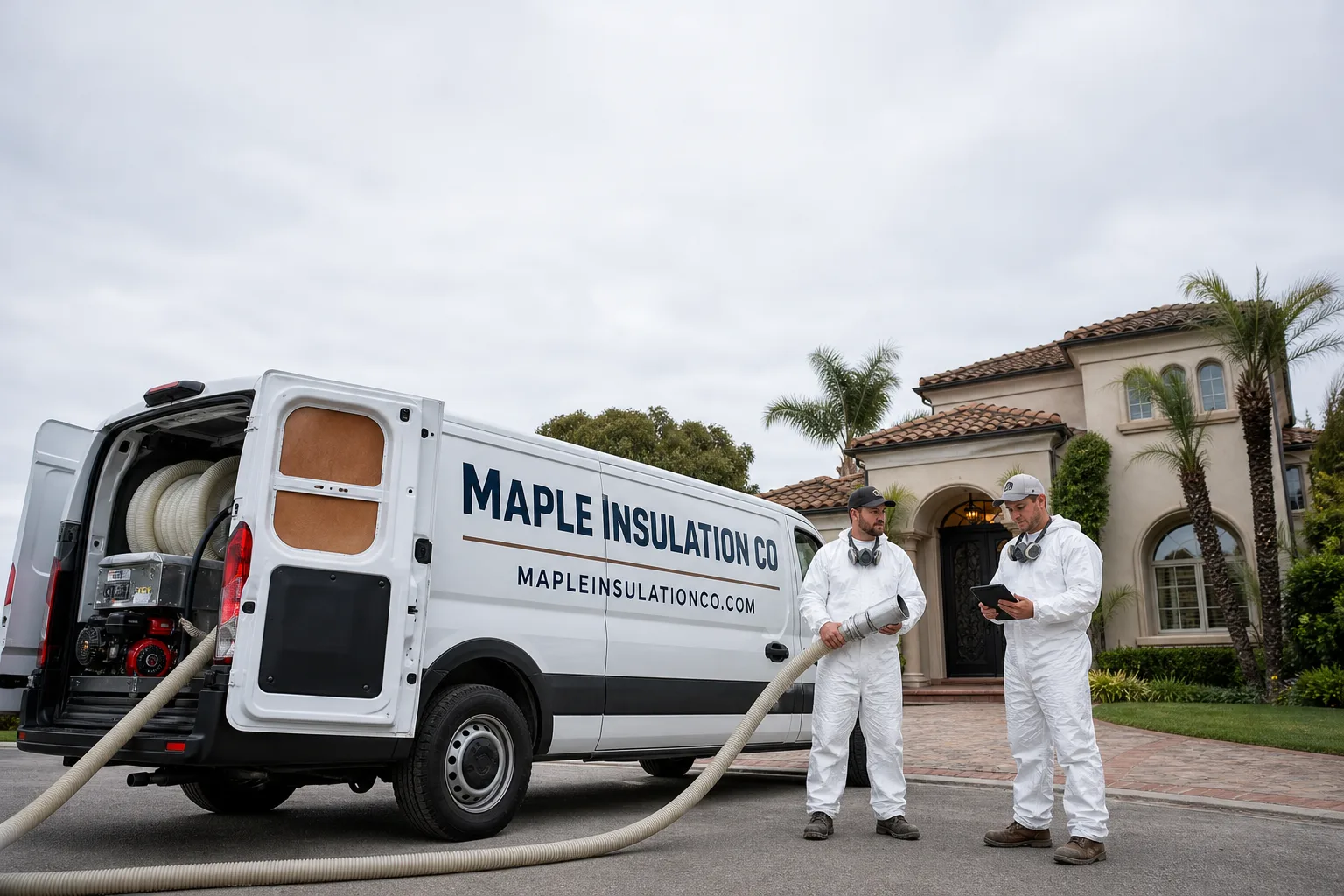
Fast, Reliable Spray Foam Insulation Across San Joaquin Hills
Spray foam insulation in San Joaquin Hills typically costs $2,800 to $7,500 for a standard attic application, with open-cell foam running $1.50 to $2.80 per board foot and closed-cell at $2.50 to $4.75. We complete most residential jobs in one to two days. Maple Insulation Co reaches every corner of the 92657 zip code, from the canyon-rim streets above Crystal Cove to the ridgeline homes off Newport Coast Drive. Call (855) 341-6045 and we’ll schedule a walkthrough within 48 hours.
Why Maple Insulation Co Is San Joaquin Hills’s Preferred Spray Foam Insulation Company
We earned our reputation in San Joaquin Hills the slow way: showing up on time, reading the attic before recommending anything, and standing behind the work after the truck leaves. Homeowners on streets like Ridge Park Road and Summit Drive have called us back for second properties and referred us to neighbors. That’s the only review that matters to us.
Our crews know what a 1990s stucco-and-tile home in Newport Ridge needs that a 1980s custom in Crystal Cove might not. The rooflines differ. The ventilation differs. And the marine-layer moisture that rolls up the canyons in summer treats each attic a little differently. We’ve been inside enough of them to know where the problem spots hide.
When you call, you reach Noel Castaneda’s team directly. No call center. No dispatch through three states. We schedule San Joaquin Hills jobs quickly because our primary operation sits just over the hills in Coto De Caza, which puts us about 20 minutes from most streets in the community.
We’re licensed and insured, product-certified on both Icynene and Demilec spray foam lines, and we carry our own blower door for post-install verification. Not every insulation crew in Orange County does that.
Open Cell Spray Foam in San Joaquin Hills
Open Cell Spray Foam is the workhorse for San Joaquin Hills attics because it excels at air sealing, which matters more here than most homeowners realize. The marine layer pushes moisture against ceiling planes, and open-cell foam’s air-sealing capability stops that moisture from reaching your insulation. It expands up to 100 times its liquid volume, filling every odd-shaped cavity in those steep-pitch custom roofs without leaving gaps.
Where It Performs Best
Open-cell makes the most sense on attic ceilings and interior walls. In San Joaquin Hills homes with vaulted ceilings over great rooms, we spray directly against the roof deck, turning the attic into conditioned space. That’s particularly useful on canyon-rim lots where roof geometry leaves awkward, hard-to-ventilate spaces. The foam conforms to every angle and irregular rafter bay without the cutting and fitting that batt insulation demands.
What It Costs Here
Open-cell spray foam in San Joaquin Hills runs $1.50 to $2.80 per board foot installed. On a typical 2,000 square foot attic ceiling, expect $3,000 to $5,600. Jobs with steep roofline complexity or difficult access at the rear of canyon-lot homes trend toward the upper end. We quote each job after seeing the actual attic, not before.
Spray Foam Insulation Contractors in San Joaquin Hills
Spray Foam Insulation Contractors who work in San Joaquin Hills consistently need to understand one thing that separates this community from flatland Orange County: the wildfire construction codes. Steep roof pitches, ember-resistant vent requirements, and defensible-space ordinances mean the insulation work can’t be treated as generic. A contractor who sprays foam without addressing ember-rated ventilation creates a problem the homeowner may not discover until fire season.
What We Check Before Foaming
On every San Joaquin Hills project, we inspect existing attic vents, recessed light housings, and any penetration through the ceiling plane. Homes here built before the 2010 code updates often have non-combustible mesh vents that weren’t designed for ember exposure. We replace or retrofit those before applying foam. It adds a step, but skipping it is how you end up with a foam-insulated attic that still fails the fire inspector’s checklist.
Material Selection
We specify between Icynene and Demilec open-cell and closed-cell products depending on the attic configuration. At a Crystal Cove home where the attic hits 140°F in August, we often recommend Demilec’s closed-cell line because it doubles as a vapor barrier and holds up better under sustained heat. But at a Newport Ridge property with standard pitch and good cross-ventilation, Icynene open-cell delivers the air-sealing performance at a friendlier square-foot cost. We don’t push one foam; we match the spec to the house.
Trusted Brands We Service in San Joaquin Hills
We carry Icynene and Demilec spray foam products, two manufacturers whose names show up on high-performance building specs nationwide. For San Joaquin Hills customers considering alternatives to spray foam, we also stock Owens Corning fiberglass batts, Johns Manville products, and Rockwool mineral wool. Having eight brands across all three major insulation methods means we can give you an honest comparison between spray foam and blown-in or batt options without steering you toward whatever we happen to have in the warehouse. The recommendation comes from your attic, your roofline, and your goals.
Common Spray Foam Insulation Problems We See in San Joaquin Hills Homes
- Ember vents ignored during foam application. On canyon-rim streets like those above Crystal Cove, steep pitch roofs with standard vents create an ember entry point that foam alone doesn’t solve. We retrofit ember-resistant vents before insulating, which generic installers routinely skip.
- Marine-layer moisture bypassing unsealed recessed lights. Fog that rolls up the hills in May and June finds every unsealed can light in the ceiling. Without meticulous air sealing around those penetrations, the moisture reaches the insulation cavity and compromises performance within a few seasons.
- Open-cell foam on radiant barriers in superheated attics. Summer attic temperatures in San Joaquin Hills frequently exceed 140°F. Foam applied directly over a radiant barrier without proper adhesion testing can delaminate, leaving gaps that defeat the air seal.
- Foam thickness inconsistent on steep vaulted ceilings. 1980s and 1990s custom homes with dramatic vaulted ceilings create difficult spray angles. Inexperienced crews leave thin spots at the ridge line, and those thin spots become thermal bypasses the homeowner feels as drafts in winter and heat in summer.
Pricing for Spray Foam Insulation in San Joaquin Hills, CA
Here’s what you can expect to pay in the 92657 zip code as of this year. Attic ceiling spray foam, covering a standard 1,500 to 2,000 square foot attic, ranges from $2,800 to $7,500 depending on whether you choose open-cell or closed-cell. Rim joist sealing in raised-foundation canyon lots runs $900 to $2,200. Garage ceiling spray foam falls between $1,200 and $3,000. Roof deck applications on vaulted ceilings start around $4,500 and climb with square footage and pitch complexity. Closed-cell always costs more per board foot than open-cell because of its density and vapor-barrier properties. Call (855) 341-6045 for a free estimate based on your specific attic, not a phone-based square footage guess.
We Also Serve Cities Near San Joaquin Hills
Beyond San Joaquin Hills, our crews work regularly in Aliso Viejo, Newport Beach, Laguna Beach, and Irvine. If you own rental property across multiple south Orange County communities, one call handles all of it. Our Spray Foam Insulation division coordinates multi-property scheduling so you’re not juggling three different insulation calendars.
Serving San Joaquin Hills, CA — Our Local Coverage Area
We’re based in the San Joaquin Hills area and know this community well. Use the map below to see our service coverage — if you’re nearby, we can almost certainly help.
FAQs About Spray Foam Insulation in San Joaquin Hills
Spray foam addresses both conditions by creating a continuous air seal. The marine layer that pushes moisture against your ceiling in May and June can’t get past properly installed open-cell or closed-cell foam the way it can with fiberglass batts. And during July through September, when attic temperatures climb past 140°F, the foam’s air-sealing properties stop superheated attic air from radiating into your living space. You need both: the air seal for moisture, and the thermal break for heat. Call (855) 341-6045 if your energy bills spike in both winter and summer; that’s the telltale sign of a bidirectional problem.
Because Crystal Cove homes sit directly in the marine-layer path, and every recessed light housing is a hole in your ceiling plane. The fog moisture finds those holes and travels into the insulation cavity. If you foam over the top without sealing the housing, the moisture bypasses the foam entirely and condenses on the back of your drywall. We seal every can light with an approved cover or fire-rated boxing before applying foam. It’s tedious work that generic crews skip. We do it because we’ve seen what happens when it’s missed.
Yes, but only if paired with ember-resistant vents. Closed-cell spray foam has a Class 1 fire rating and won’t sustain combustion on its own. But if your attic vents are standard mesh, embers can blow through and land on the foam. Ember-resistant vents stop that from happening. On canyon-rim and hillside lots in San Joaquin Hills, where wildfire codes are strictest, we treat ember-rated venting as a required part of any spray foam job. It adds roughly $200 to $600 depending on the number of vents, and it’s the difference between an upgraded attic and a fire liability.
For open attics that stay ventilated rather than conditioned, we lean toward Demilec closed-cell when heat is the dominant concern, because it handles sustained 140°F attic temperatures without degrading. For attics being converted to conditioned space, Icynene open-cell delivers better value and sufficient thermal performance. The brand follows the application, not the other way around. We’ll show you the R-value comparison, the moisture resistance specs, and the cost per square foot before you decide.
Spray foam is the only insulation type that tackles both cooling and heating demand with equal effectiveness in a single application. Closed-cell foam’s high R-value per inch keeps August heat from migrating into your living space through the ceiling. That same thermal barrier holds warmth inside during December and January mornings, when canyon air drops into the 40s and your furnace kicks on. Fiberglass batts lose effectiveness in both directions as they settle and gap. Spray foam doesn’t. For a free estimate on your home, call (855) 341-6045.
Call Maple Insulation Co for Spray Foam Insulation in San Joaquin Hills
If your heating and cooling bills climb every year, or if certain rooms in your San Joaquin Hills home never hold temperature, the problem is usually in the attic. We’ll inspect it, show you exactly where the air leaks and heat transfer are happening, and give you a written proposal with line-item pricing. No pressure, no generic recommendations. The right material for your roof pitch, your canyon exposure, and your budget. Call (855) 341-6045 to schedule your free estimate.
Written by Noel Castaneda, Owner at Maple Insulation Co, serving San Joaquin Hills and surrounding Orange County communities.