
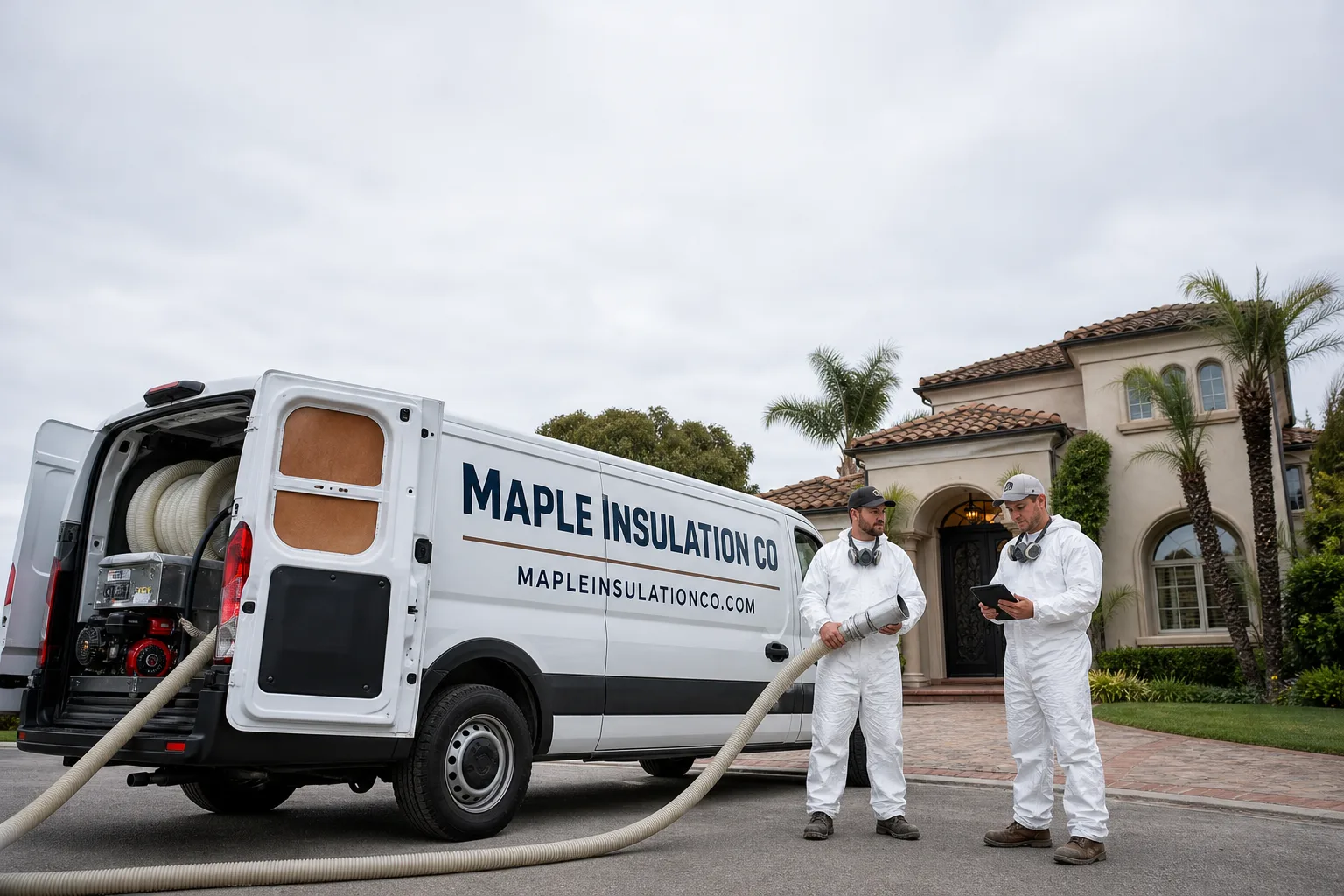
Spray Foam Insulation in Rancho Santa Margarita: What It Costs and Why the Garage Comes First
Spray foam insulation in Rancho Santa Margarita typically runs $1.50 – $3.00 per board foot for open-cell and $2.25 – $4.50 for closed-cell, with most garage ceiling jobs landing between $1,800 and $4,200 depending on square footage. Most homes here are 1980s – 2000s tract builds with unconditioned attics and uninsulated attached garages, so the work almost always starts at the garage ceiling and shared wall, not the attic hatch. If your upstairs rooms won’t hold temperature through a 95°F afternoon, that’s usually where the problem begins. Call (855) 341-6045 and we’ll walk you through what your specific house needs.
Why Maple Insulation Co Is Rancho Santa Margarita’s Preferred Spray Foam Insulation Company
Rancho Santa Margarita isn’t a city where you can copy-paste an insulation approach from coastal Orange County. The inland foothill heat, the concrete tile roofs, the same-era tract housing: all of it shapes how we spec and install foam here. Our crews work across the 92688 ZIP regularly, and we know which neighborhoods to expect compacted original batts in, which attic layouts make scuttle access the only safe route, and where the worst garage-to-living-space heat transfer tends to show up first. Homeowners in RSM call us because we explain why the fix needs to happen where it does, not just what it’ll cost. Noel Castaneda started this company to do exactly that: match the material to the problem, not to whatever’s easiest to sell. When you call (855) 341-6045, you’re talking to a team that actually understands how these houses were built and how they fail.
Crawl Space Spray Foam Insulation in Rancho Santa Margarita
Crawl Space Spray Foam Insulation in Rancho Santa Margarita is one of the most overlooked fixes for homes in the 92688 ZIP, especially on two-story plans where the first-floor rooms sit above a vented crawl instead of a slab. Most RSM tract homes built between the late 1980s and early 2000s got fiberglass batts between floor joists at construction, and after 25 – 35 years of inland heat cycling, that batting has sagged, compacted, or been disturbed by rodents and plumbing work. Closed-cell spray foam applied to the crawl space walls and rim joist area turns that space into a sealed, conditioned zone, which stops cold floors in winter and damp, musty air from rising into the house all summer.
Rim Joist Sealing for RSM Crawls
The rim joist, the band of framing where the floor joists meet the foundation wall, is the single biggest air leak in most Rancho Santa Margarita crawl spaces. Builders in the 1990s rarely sealed these, and in the foothill climate, the daily temperature swing from 60s at night to high 90s in the day pulls air through those gaps constantly. Closed-cell foam on the rim joist kills that air movement and adds structural rigidity in one pass. A typical rim joist job in RSM runs $1,200 – $2,400 depending on linear footage and access clearance.
Vapor Control in Inland Valley Soils
Rancho Santa Margarita sits in the Trabuco Creek drainage, and many crawl spaces here carry ground moisture through the dry season well after the last rain. Open-cell foam breathes, which is great for attics but wrong for crawl walls where vapor drive is the issue. We spec closed-cell Icynene or Demilec in crawls because it acts as its own vapor barrier, something the original fiberglass never did. That matters when you’re trying to keep first-floor humidity below 55% without running a dehumidifier from May through October.
Garage Spray Foam Insulation in Rancho Santa Margarita
Garage Spray Foam Insulation in Rancho Santa Margarita is where we start on nearly every job in this city. RSM’s tract homes were built with attached garages sitting directly under living space, and the original builders didn’t insulate the garage ceiling or the shared wall at all. That means on a 95°F August afternoon, your garage becomes a heat box with a thin layer of drywall separating it from your family room or upstairs bedroooms. Open-cell foam on the garage ceiling and closed-cell on the shared wall breaks that thermal bridge, and in most RSM homes, it’s the single highest-impact insulation dollar you can spend. Expect to pay $1,800 – $4,200 for a standard two-car garage ceiling and shared wall in this area.
Garage as Attic Access Point
Here’s the thing people don’t realize until they live in RSM: your concrete tile roof can’t be walked safely, and most attic scuttles are in a hallway ceiling or closet, which means dragging equipment through the house. Many RSM garage ceilings have a smaller access hatch or a spot where we can safely create one without touching the roof. So the garage isn’t just the insulation job, it’s the path to the attic air-sealing work that most of these homes also need. We’ve done enough of them to know exactly where the joist spacing sits and what the existing builder-grade duct wrap looks like before we even open the ceiling.
Shared Wall and Upstairs Comfort
The shared wall between garage and living space runs vertical along your interior floor plan, often behind a stairwell or a utility room, and heat pours through it from the garage side all afternoon and evening. Closed-cell foam on that wall, usually 2 inches, cuts that heat gain dramatically. It also quiets the garage noise: door openers, dryers, kids working on bikes. For rooms directly above the garage, this is not a nice-to-have; it’s the difference between an AC that cycles normally and one that runs nonstop from 2 p.m. to 8 p.m.
Trusted Brands We Service in Rancho Santa Margarita
We stock and install multiple spray foam lines so the recommendation matches the house, not our inventory. For RSM garages and crawls, we typically reach for Icynene open-cell for ceilings and Demilec closed-cell for rim joists and shared walls. We also work with Owens Corning and Johns Manville batt products when a hybrid approach makes more sense, like pairing spray foam with mineral wool in a sound-sensitive shared wall. Noel Castaneda’s position is simple: eight brands, three methods, one contractor. If a Rockwool detail is the right call for a firewall assembly, we’ll tell you and install it properly. We don’t play favorites with brands; we play favorites with what actually fixes the problem.
Common Spray Foam Insulation Problems We See in Rancho Santa Margarita Homes
- The garage was never insulated, period. Builders in RSM’s 1980s – 2000s boom era treated the garage as outside space and skipped insulation on the ceiling and shared wall entirely, so every July the garage bakes and sends that heat straight into the floor plan above. We fix this with open-cell on the ceiling and closed-cell on the shared wall as a standard package.
- Concrete tile roofs mean no roof-walking access. RSM is almost entirely concrete tile, and those tiles crack under foot and the underlayment below is often fragile after 30 years, so any foam or air-sealing work has to route through the garage or an interior scuttle. A contractor who says they’ll just go over the roof is the contractor who’s going to leave you with a leak.
- 1990s radiant barriers have given up. Many RSM attics have original radiant barriers stapled under the rafters, and after 25 – 35 years of inland foothill heat, that foil has delaminated, torn, or is simply no longer reflecting anything. Spray foam applied without addressing a dead radiant barrier means the attic still holds heat, just with better walls around it.
- Builder-grade duct wrap is end-of-life. The flex ducts and duct insulation in these same-era tract homes were never rated for the heat load they’ve absorbed for three decades. Foam in the attic is great, but if the ducts running through it are still leaking or wrapped in compressed fiberglass, your AC still works harder than it should and your upstairs rooms still won’t hold temp.
Pricing for Spray Foam Insulation in Rancho Santa Margarita, CA
A garage ceiling and shared-wall spray foam job in Rancho Santa Margarita typically lands between $1,800 and $4,200. Rim joist sealing in a crawl space runs $1,200 – $2,400 depending on linear feet and access. Full attic air-sealing plus garage work on a two-story RSM tract home usually falls in the $5,500 – $9,000 range when duct insulation refresh is part of the scope. What moves the number: open-cell versus closed-cell, access clearance in your crawl, whether we’re pulling old batting, and how much duct wrap needs replacing. We give free estimates in writing before any work starts. Call (855) 341-6045 and Noel or one of our estimators will come out to Rancho Santa Margarita, look at your specific house, and give you a number that won’t change unless the scope does.
We Also Serve Cities Near Rancho Santa Margarita
Beyond Spray Foam Insulation in Rancho Santa Margarita, our crews cover Trabuco Canyon, Coto De Caza, Mission Viejo, and Foothill Ranch regularly. The housing stock across these south Orange County foothill communities is similar, so the same concrete tile realities and garage-first approach apply. For full details on our service area, see our Spray Foam Insulation page.
Serving Rancho Santa Margarita, CA — Our Local Coverage Area
We’re based in the Rancho Santa Margarita area and know this community well. Use the map below to see our service coverage — if you’re nearby, we can almost certainly help.
FAQs About Spray Foam Insulation in Rancho Santa Margarita
Because in RSM’s 1980s – 2000s tract homes, the attached garage was built without any insulation on the ceiling or shared wall, so it’s the largest thermal hole in the house, and the concrete tile roof rules out roof access, making the garage the practical entry point for attic and air-sealing work. The garage isn’t a discretionary add-on here; it’s where the job begins. Call (855) 341-6045 and we’ll walk you through what your specific floor plan needs.
Yes, absolutely. We never walk RSM’s concrete tile roofs; the tiles crack and the underlayment below is often already fragile after decades, so we access the attic through the garage or an interior scuttle. For most Rancho Santa Margarita homes, the garage hatch or a hallway scuttle is the only safe route, and that’s part of why our jobsites stage from the garage, not the driveway. If a contractor suggests going over the roof, ask them how they plan to avoid leaving you with cracked tiles.
It usually is part of it. Upstairs rooms in RSM tract homes overheat because heat is coming from three directions: the uninsulated garage below, the unconditioned attic above, and the shared wall in between, plus tired duct wrap and a dead radiant barrier. Spray foam on the garage ceiling and shared wall, plus attic air-sealing and a duct insulation refresh, is the combination that finally lets your AC hold temperature. We see this exact pattern on two-story homes in Trabuco Highlands and around the lake area repeatedly. A 98°F afternoon is the real test; call us at (855) 341-6045 and we’ll schedule a look.
We install Icynene and Demilec spray foam, and we spec them differently: Icynene open-cell for garage ceilings where breathability matters, and Demilec closed-cell for rim joists, shared walls, and crawl spaces where vapor control and structural rigidity matter. We also carry Owens Corning, Johns Manville, and Rockwool batt products when a hybrid detail makes more sense. The brand follows the problem, not the other way around.
Yes, it does. Rancho Santa Margarita routinely swings from low 60s overnight to high 90s during the day in summer, and that wide diurnal range means air moves in and out of attics and crawls every single day, so we lean on closed-cell foam at the rim joist and shared wall where you want an air and vapor seal in one pass, and open-cell above where you want R-value without trapping moisture. The daily swing also means that a degraded 1990s radiant barrier is working against you every afternoon, which changes how we sequence a job. We spec foam around how this specific climate behaves, and we’re happy to explain it on-site.
Written by Noel Castaneda, Owner at Maple Insulation Co, serving Rancho Santa Margarita and the south Orange County foothills. Call (855) 341-6045 for a free estimate.