
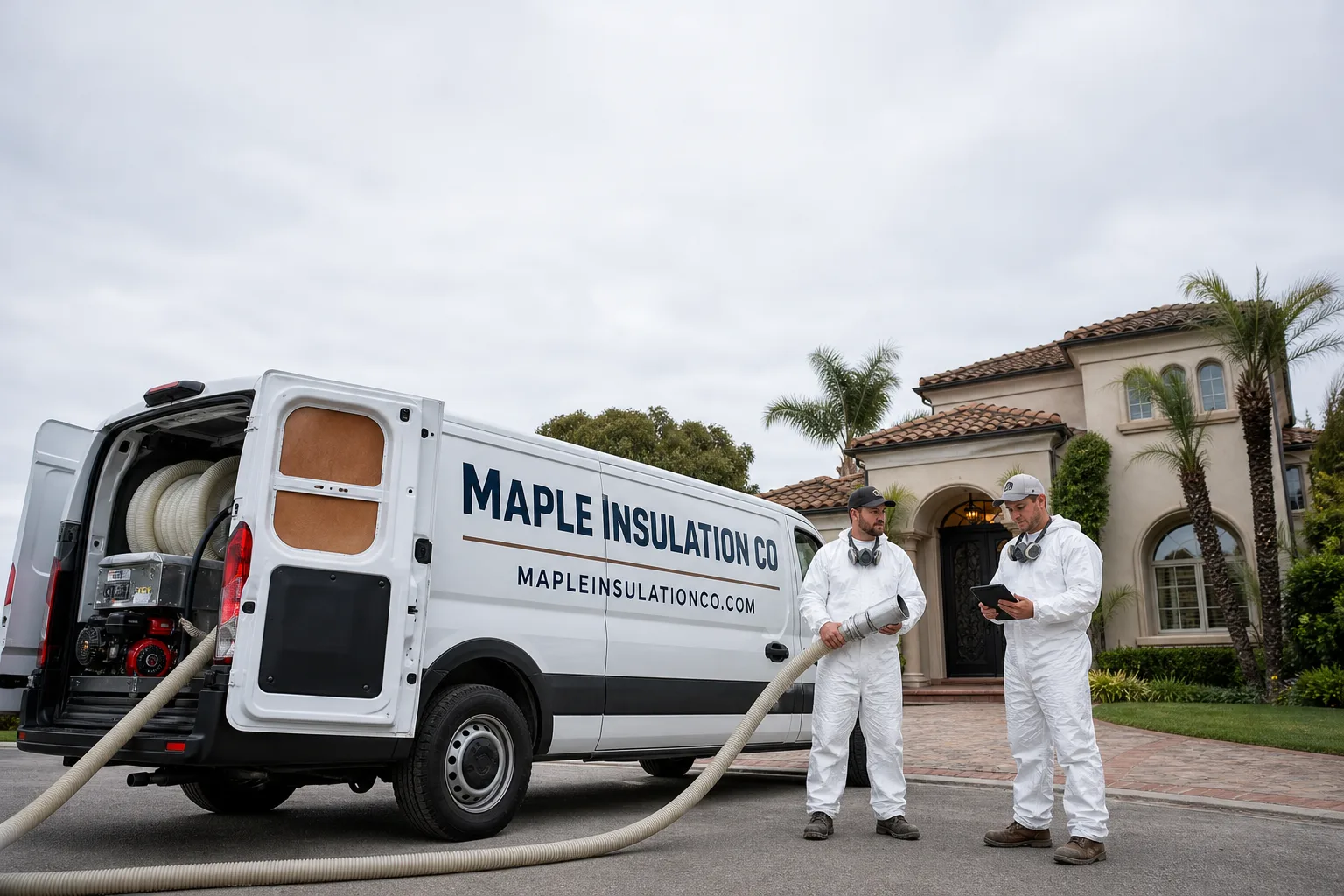
Fast, Reliable Spray Foam Insulation Across Portola Hills
Spray foam insulation in Portola Hills typically costs $2.50 – $6.50 per board foot installed, with most whole-home open-cell projects landing between $5,500 and $12,000 depending on square footage and roof deck access. Our crews reach Portola Hills same-day for estimates and can usually start installs within 3 – 5 business days. If you’re dealing with scorching upstairs rooms during Santa Ana events or suspect your builder-grade insulation was never enough, call (855) 341-6045. Noel Castaneda and our team know these hills, these houses, and what it takes to make them hold temperature properly.
Why Maple Insulation Co Is Portola Hills’s Preferred Spray Foam Insulation Company
Most Portola Hills homes were built between the 1980s and early 2000s, and builders treated insulation as an afterthought. Thin fiberglass batts, unsealed top plates, and attic hatches with zero gasketing. We’ve corrected hundreds of these installations across the 92610 ZIP, from the newer upper-slope homes near the Cleveland National Forest boundary to the original tract sections off Sable Point Drive and Glenn Ranch Road, and we also handle Reflectix repair in Portola Hills when that’s the right fix. Homeowners here don’t just want a lower energy bill. They want a house that stays cool when the Santa Anas push 90-degree air through every gap in the building envelope. That’s the work we do.
Noel Castaneda founded Spray Foam Insulation operations on a simple principle: match the material to the problem, not to whatever we happen to stock most. For Portola Hills specifically, that means open-cell foam on roof decks where heat gain is the enemy, closed-cell where moisture or structural strength matters, and mineral wool where wildfire hardening rises to the top of the priority list. One contractor, three methods, eight brands. You get a straight answer about what your house actually needs.
Open Cell Spray Foam in Portola Hills
Open Cell Spray Foam is the workhorse for Portola Hills attics and roof decks, and for good reason: it expands to fill every cavity, air-seals the entire underside of the roof, and drops attic temperatures by 25 – 40 degrees during summer. For a typical two-story Portola Hills home with a vaulted ceiling and limited attic access, open-cell applied to the roof deck runs $3,500 – $8,500 depending on roof area. It’s the right call when heat gain through the roof is the main problem, which describes most homes here.
How it handles Santa Ana heat
Open-cell foam is an air barrier first and an insulator second. That matters in Portola Hills because Santa Ana winds don’t just heat the attic, they force hot, dry air through every unsealed penetration. Open-cell foam stops that air movement dead.
Roof deck applications
We apply open-cell directly to the underside of the roof deck, turning the attic into a conditioned or semi-conditioned space. This is the standard fix for Portola Hills homes where upstairs bedrooms bake in the afternoon and HVAC ductwork runs through the attic.
Spray Foam Insulation Contractors in Portola Hills
Spray Foam Insulation Contractors who actually understand Portola Hills are rare. This isn’t a flat, coastal Orange County job site. Sloped lots, limited attic access, WUI adjacency, and wind-driven debris intrusion all change how the job gets done. Our team works these hills weekly, and that local familiarity means we plan for ember-resistant venting, debris removal, and proper adhesion on every job, not just the ones where the homeowner asks. A typical spray foam installation in Portola Hills runs $5,500 – $12,000 all-in, with smaller rim joist or garage ceiling jobs starting around $1,800 – $3,200.
Contamination and prep work
Before any foam goes in, we pull wind-driven debris, old contaminated batts, and anything else that would compromise adhesion. You can’t spray over disturbed insulation and expect it to perform. We see this constantly after Santa Ana events and address it before the gun ever comes out.
WUI-adjacent detailing
Homes backing up to Cleveland National Forest open space get a different level of scrutiny. We seal penetrations, verify vent screening, and recommend ember-resistant covers where eave and soffit vents sit exposed. It’s the only way spray foam protects the way it should.
Trusted Brands We Service in Portola Hills
We carry a working inventory across three insulation methods, which gives Portola Hills homeowners real choice instead of a one-brand pitch. On the spray foam side, you’ll find both Icynene and Demilec product lines in our rotation. For projects where mineral wool makes more sense, we stock Rockwool for its fire resistance and sound attenuation. For blown-in jobs, GreenFiber recycled cellulose is on the truck. Portola Hills homeowners often ask whether brand selection really matters. It does when the house sits on a sloped lot with vaulted ceilings and a 40-mph wind event rolling through the canyon. We keep local stock so turnaround stays tight. No waiting on a distributor two counties away.
Common Spray Foam Insulation Problems We See in Portola Hills Homes
- Builder-grade attic hatches left unsealed. We find this in nearly every 1980s – 2000s tract home. Santa Ana winds force hot air and fine dust straight into the attic through the gap, and it degenerates foam performance from day one. Sealing the hatch and pull-down stair is step one.
- Wind-driven debris clogging soffit and eave vents. After a Santa Ana event, we pull leaves, pine needles, and embers out of vent cavities. Clogged vents trap heat against the foam, and in worst cases, debris works its way into the foam itself.
- Foam sprayed over contaminated insulation. Some contractors will spray right over old, disturbed batts. We won’t. Contamination at the surface means poor adhesion, hidden air pockets, and an insulation assembly that quietly fails. We remove first, then spray.
- Missing ember-resistant vent covers in WUI-adjacent homes. For homes near the forest boundary, this is the one detail generic insulation crews skip. Soffit and eave vents are a primary ember entry point. Foam without protected venting is half a job in Portola Hills.
Pricing for Spray Foam Insulation in Portola Hills, CA
Here’s what Portola Hills homeowners can expect to pay, based on the jobs we’re quoting weekly in the 92610 ZIP. Open-cell roof deck applications run $3,500 – $8,500 for a typical two-story. Closed-cell rim joist work lands between $1,800 – $3,200. Garage ceiling spray foam usually comes in at $900 – $1,800. A full-home insulation retrofit that combines spray foam with blown-in or batts in other cavities typically ranges $8,000 – $15,000. What moves the number here: square footage of roof deck, how much debris removal and prep the attic needs, and whether you’re adding ember-resistant vent covers. Estimates are free, on-site, and honest. Call (855) 341-6045 and we’ll get you a real number.
We Also Serve Cities Near Portola Hills
Our trucks run the Saddleback Valley daily. If you’re in Spray Foam Insulation in Portola Hills or one of the surrounding communities like Foothill Ranch, Lake Forest, Mission Viejo, or Trabuco Canyon, same-week scheduling is almost always available. Same crews, same brands, same standard of work across every ZIP we cover.
Serving Portola Hills, CA — Our Local Coverage Area
We’re based in the Portola Hills area and know this community well. Use the map below to see our service coverage — if you’re nearby, we can almost certainly help.
FAQs About Spray Foam Insulation in Portola Hills
Spray foam helps in two ways. First, it air-seals the attic and roofline so wind-driven hot air can’t force its way into your living space. Second, when properly installed alongside ember-resistant vent covers and sealed penetrations, it keeps wind-driven debris from contaminating the insulation assembly. For homes backing up to open canyon land, that second point matters as much as the R-value. Call (855) 341-6045 and we’ll walk your specific roofline with you.
Open-cell foam is recommended for vaulted ceilings in Portola Hills because it expands into the irregular cavity shapes common in 1980s – 2000s master-planned construction, creating a continuous air and thermal barrier without the weight of closed-cell. It also handles the expansion and contraction from Santa Ana heat cycles better than rigid boards. For most upstairs bedroom heat complaints, open-cell on the vaulted ceiling underside solves the problem.
Sometimes yes, sometimes no. If the existing insulation is clean, dry, and properly seated, closed-cell foam can be applied over it in rim joist bays and other accessible cavities. But in Portola Hills, we frequently encounter attic insulation that’s been contaminated by wind-driven debris after Santa Ana events. That material has to come out before new foam goes in. We’ll tell you which situation you have during the estimate.
Look for a contractor who knows the difference between flat Orange County work and hillside WUI-adjacent work. Ask whether they address ember-resistant venting, whether they remove contaminated insulation before spraying, and whether they understand vaulted ceiling detailing. If they don’t bring up Santa Ana winds on a Portola Hills quote, that’s a red flag. Noel Castaneda and our team treat those questions as table stakes, not optional add-ons.
Yes, and it’s specific to this area. After any significant Santa Ana event, you should check soffit and eave vents for wind-driven debris and confirm the ember-resistant covers are seated. Foam itself doesn’t require maintenance, but the venting and penetration seals around it do. We offer post-wind-event inspections for Portola Hills customers because we know these hills get hit harder than the valley floor. Call (855) 341-6045 and we’ll come take a look.
Written by Noel Castaneda, Owner at Maple Insulation Co, serving Portola Hills and the Saddleback Valley with spray foam, blown-in, and attic insulation.