
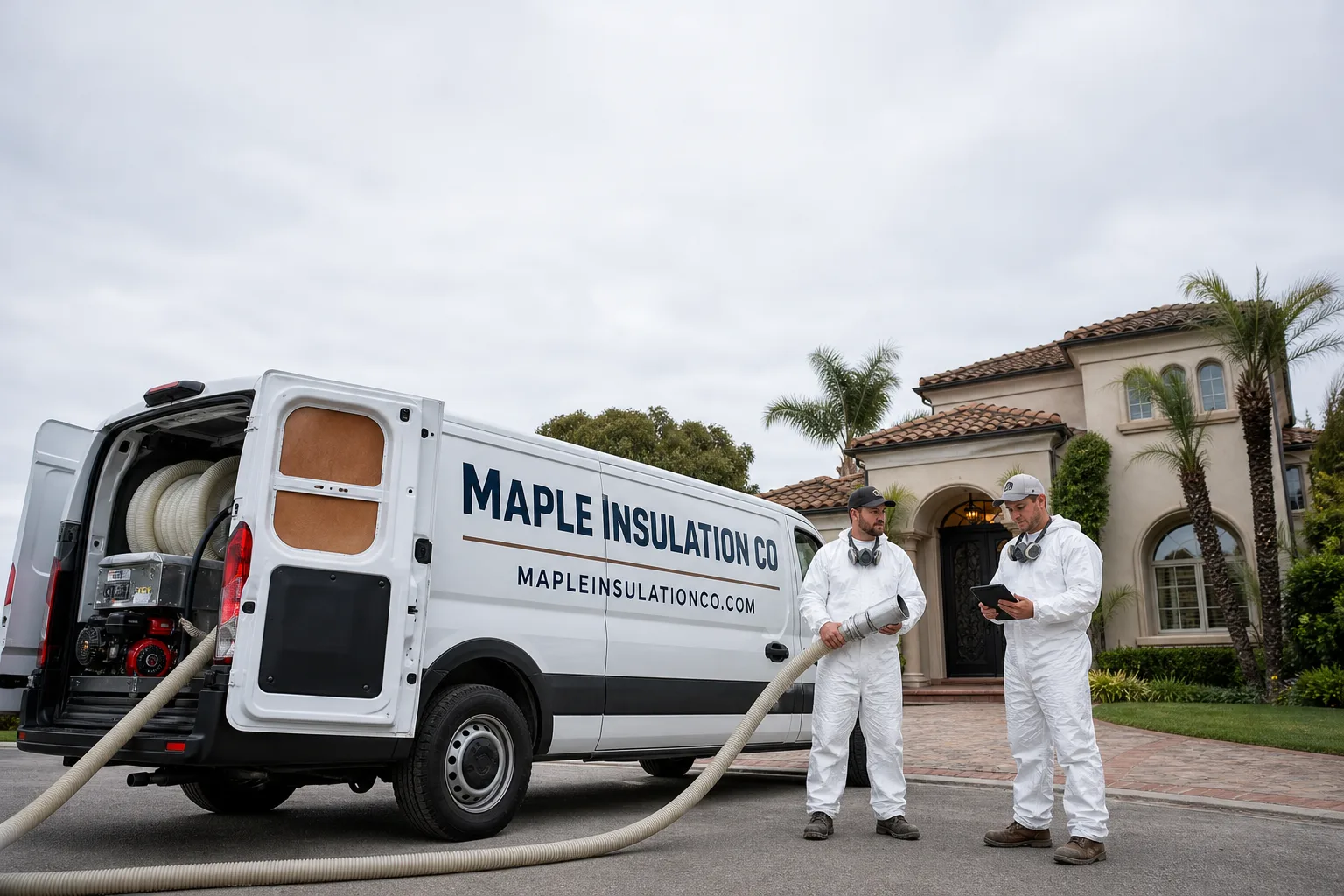
Spray Foam Insulation in Fallbrook, CA: Costs, Options, and Fire-Safe Installation
Spray foam insulation in Fallbrook typically costs $2.50 to $6.50 per square foot installed, with closed-cell foam running $3.50 to $6.50 and open-cell running $1.50 to $3.00. Most Fallbrook homes fall in the 1,800 to 3,200 square foot range, putting full attic spray foam jobs between $4,500 and $14,000 depending on access, existing insulation removal, and WUI code requirements. We’re the team at Spray Foam Insulation that actually works in Fallbrook’s unincorporated county zones, not just passes through. Call (855) 341-6045 for a site-specific number before the next heat wave hits.
Key Takeaways:
- Closed-cell foam adds structural strength and doubles as an air barrier, which matters when Fallbrook’s Santa Ana winds push embers toward your attic vents.
- Open-cell foam works well for interior walls and sound control, but Fallbrook’s 100°F attic temperatures make closed-cell the safer roof deck choice.
- WUI-zone properties in 92028 and 92088 require ember-resistant venting paired with spray foam, not one or the other.
- We remove failed fiberglass and air-seal before spraying. Skipping that step wastes your money in this climate.
Fast, Reliable Spray Foam Insulation Across Fallbrook
Fallbrook’s inland heat is relentless. We’ve measured attic temperatures above 140°F in August on homes near Live Oak Park Road and along the 76 corridor. That radiant load is why spray foam outperforms fiberglass batts here by a wide margin. Fiberglass slows conductive heat. It does nothing for the air movement that carries superheated attic air into your living space. Spray foam stops both.
We run crews into Fallbrook weekly, including the 92028 and 92088 areas. Response time for estimates is usually within 48 hours. Emergency calls, like a failed roof deck or exposed framing after a wind event, get priority scheduling. Call (855) 341-6045 and we’ll tell you straight what we can do and when.
Why Maple Insulation Co Is Fallbrook’s Preferred Spray Foam Insulation Company
Noel Castaneda started Maple Insulation Co with a simple position: match the material to the problem, not to whatever one product line happens to be in the warehouse. That’s why we carry eight brands across fiberglass, mineral wool, open-cell spray foam, closed-cell spray foam, and cellulose. For Fallbrook specifically, we’re recommending closed-cell foam on roof decks and open-cell for interior sound control or rim joist work more often than not.
We know the county’s wildland-urban interface requirements because we work inside them every week. Homes in Fallbrook’s unincorporated zones answer to San Diego County fire code, not a city building department, and that changes what you can install and where. We’ve walked inspectors through foam-and-vent assemblies in Rainbow, De Luz, and along Stage Coach Lane. That experience means fewer callbacks and faster sign-offs. As Noel puts it, if the foam passes inspection the first time, everybody saves money.
We also stock Rockwool mineral wool for Fallbrook customers who want fire resistance in vented assemblies without going full foam. Few crews in the area keep it on hand. We do, because this climate demands options beyond what the big-box stores push.
What Fallbrook Homeowners Tell Us
Consistent feedback from customers off Gird Road and Winterwarm Drive: electric bills drop 20 to 35 percent the first summer after a proper spray foam retrofit. That’s not marketing math. It’s what happens when an attic stops acting like a convection oven and starts behaving like a conditioned space boundary.
Closed Cell Spray Foam Insulation in Fallbrook
Closed Cell Spray Foam Insulation is our most common recommendation for Fallbrook roof decks and WUI-zone exterior walls. It cures into a rigid, dense layer, roughly 2 pounds per cubic foot, that functions as an air barrier, vapor barrier, and thermal insulator in one pass. For Fallbrook’s hot, dry summers and Santa Ana wind exposure, that rigidity matters because it stays adhered to the roof deck when open-cell foam can fail.
Expect to pay $3.50 to $6.50 per square foot for closed-cell in Fallbrook, depending on thickness, access, and prep work. A 2,200 square foot ranch with a vented attic and failing fiberglass might run $8,000 to $12,000 all-in, including removal, air sealing, and ember-resistant vent replacement.
Roof Deck Application in WUI Zones
When we spray closed-cell directly against the roof deck, the attic becomes a semi-conditioned space. That reduces the temperature differential between attic and living space, which cuts cooling load substantially. In Fallbrook’s WUI-designated zones, this approach also creates a continuous thermal barrier that ember-resistant venting can protect. The foam itself is combustible, which is why Fire Marshal approvals typically require an intumescent coating or thermal barrier over the foam when the attic is used for storage or mechanical equipment.
Class A Assembly Integration
A Class A roof assembly requires specific components working together: roof covering, underlayment, and the structural deck. Closed-cell foam applied to the underside of the deck adds stiffness and air sealing, but it does not replace the requirement for ember-resistant vents and non-combustible flashing. We coordinate with the roofing contractor or handle the venting ourselves so the whole assembly passes inspection the first time.
Open Cell Spray Foam in Fallbrook
Open Cell Spray Foam is the right choice for certain Fallbrook applications, primarily interior walls, rim joists, and sound attenuation between rooms. It expands aggressively, fills irregular cavities, and costs $1.50 to $3.00 per square foot. In a 1960s home off South Mission Road with exposed beam ceilings and irregular framing, open-cell fills gaps that closed-cell can’t economically reach.
But open-cell has limits in this climate. Above about 110°F sustained temperature, open-cell foam can lose dimensional stability and off-gas. Fallbrook attics hit that threshold routinely in July and August. We do not recommend open-cell against roof decks or in unvented attic assemblies here. For walls and interior soundproofing, it’s excellent.
Interior Wall and Rim Joist Work
Rim joist sealing stops the stack effect that pulls hot outdoor air into the house through the band board. In Fallbrook’s custom homes, we often find rim joists leaking badly because the original construction predates modern air sealing standards. A few inches of open-cell foam in each bay tightens the envelope noticeably.
Garage Ceiling Applications
Garage ceilings in Fallbrook get brutally hot, especially on west-facing garage doors. If the garage is attached and has living space above, open-cell foam on the garage ceiling helps knock down the heat that bleeds into the floor above. It’s not a roof deck solution, but as an interior application it works.
Trusted Brands We Service in Fallbrook
We install and service spray foam from Icynene and Demilec, two product lines that dominate high-performance building envelopes in Southern California. Both offer closed-cell formulations that meet the fire-resistance and R-value expectations for Fallbrook’s WUI zones. For non-foam applications we stock Owens Corning fiberglass and Rockwool mineral wool, which gives us flexibility when a customer wants fire-rated material in vented attics. We do not claim preferred status with any manufacturer. We do claim experience, and in Fallbrook that means knowing which foam flashes off cleanly in 90-degree weather and which one waits for a 70-degree day.
Common Spray Foam Insulation Problems We See in Fallbrook Homes
- Ember intrusion through standard vents: Homes off Gum Tree Road and Olive Hill Road show the same pattern. Gable and soffit vents pull embers into the attic during Santa Ana events. Those embers then sit on top of fiberglass or degrade exposed foam. We replace standard vents with ember-resistant models rated for WUI zones as part of every foam job.
- Open-cell foam failure on roof decks: Intense inland sun pushes attic temperatures past 110°F. Open-cell foam on roof decks loses adhesion and shrinks within a few years. We remove it and re-spray with closed-cell, which remains stable at these temperatures.
- Uneven foam thickness on low-pitch roofs: Fallbrook has plenty of 1960s-80s ranch homes with low-pitch roofs and limited attic access. Getting a consistent 2-inch pass against the roof deck without leaving thin spots takes experience and sometimes a second crewman with a different spray gun setup. Thin spots are thermal bridges that undermine the entire assembly.
- Collapsed fiberglass under foam work: Before spraying any foam, we find original fiberglass batts that have fallen away from the drywall or deck. Spraying over failed fiberglass is a waste. We remove it, air-seal the framing, and start clean.
Pricing for Spray Foam Insulation in Fallbrook, CA
Here’s what Fallbrook homeowners should budget for full spray foam work, including prep and air sealing:
- Closed-cell roof deck, 1,500 sq ft attic: $5,500 to $9,000
- Closed-cell roof deck, 2,500 sq ft attic: $9,000 to $14,000
- Open-cell interior walls (per wall cavity): $1.50 to $3.00 per sq ft
- Rim joist sealing (average Fallbrook home): $900 to $1,800
- Ember-resistant vent replacement (per vent): $85 to $150 installed
What moves the price: attic access, existing insulation removal, roof pitch, WUI inspection requirements, and whether we’re coordinating with a roofing contractor mid-project. We do not give one-size-fits-all quotes over the phone. Every estimate we write for Fallbrook starts with an attic inspection, because the difference between a $6,000 job and a $12,000 job is often what’s hiding under the old batts. Estimates are free. Call (855) 341-6045.
We Also Serve Cities Near Fallbrook
Our crews work throughout North San Diego County and southern Riverside County. Beyond Fallbrook, we regularly serve Rainbow, Temecula, Murrieta, and Murrieta Hot Springs, with the same county code knowledge we apply here. If you’re just outside Fallbrook, we can still help.
Serving Fallbrook, CA — Our Local Coverage Area
We’re based in the Fallbrook area and know this community well. Use the map below to see our service coverage — if you’re nearby, we can almost certainly help.
FAQs About Spray Foam Insulation in Fallbrook
Spray foam alone will not stop embers. What it does is seal the air gaps that let embers and superheated air move through your attic. But paired with ember-resistant venting and a proper thermal barrier, spray foam makes a real difference. In Fallbrook’s WUI zones, we always couple foam work with vent replacement because standard vents here pull embers during Santa Ana events. If your vents are old, the foam is only half the solution. Call (855) 341-6045 and we’ll check both during the estimate.
Closed-cell works better, and it’s not close. Fallbrook attics exceed 110°F in summer. Open-cell foam can off-gas and lose adhesion at those temperatures. Closed-cell foam remains dimensionally stable and acts as a vapor barrier, which matters in a dry climate where condensation isn’t the concern but radiant heat is. We recommend closed-cell for roof decks and exterior walls in Fallbrook, and open-cell only for interior sound control or rim joist work. If you’re not sure which your home needs, call us at (855) 341-6045 for a straight answer.
Yes, but it takes different equipment and technique. Low-pitch roofs, common on 1960s and 70s ranch homes in Fallbrook, don’t leave much room to maneuver. We use smaller spray guns and sometimes work off planks to reach the full deck surface. The goal is even thickness across the entire roof. Thin spots create thermal bridges that defeat the purpose. We’ve sprayed dozens of tight attics across unincorporated Fallbrook, including homes off South Mission Road and along the 76 corridor.
Spray foam is combustible, so it’s not a fireproofing product. What it does in a proper WUI assembly is seal the attic envelope and reduce airflow that feeds ember ignition. For Fallbrook homes in designated wildfire zones, the full assembly matters more than any single material. We use closed-cell foam with intumescent coatings and ember-resistant vents that meet San Diego County’s Class A requirements. The foam’s job is to keep the assembly tight. The venting’s job is to keep embers out. Both are required.
Almost always yes. On a 1970s ranch home off South Mission Road, we found original fiberglass batts collapsed and soffit vents packed with avocado-leaf debris and ember fragments from previous Santa Anas. We removed the failed batts, air-sealed the top plates with closed-cell foam, and replaced the standard soffit vents with ember-resistant models before spraying 2 inches of closed-cell against the roof deck. The homeowner reported the attic temperature dropped by roughly 20°F during the next heat wave, and the assembly now meets WUI ember-resistance guidelines. That’s the sequence we recommend for every Fallbrook home with old fiberglass: remove, air-seal, vent, then spray.
Written by Noel Castaneda, Owner at Maple Insulation Co, serving Fallbrook and all of North San Diego County.