
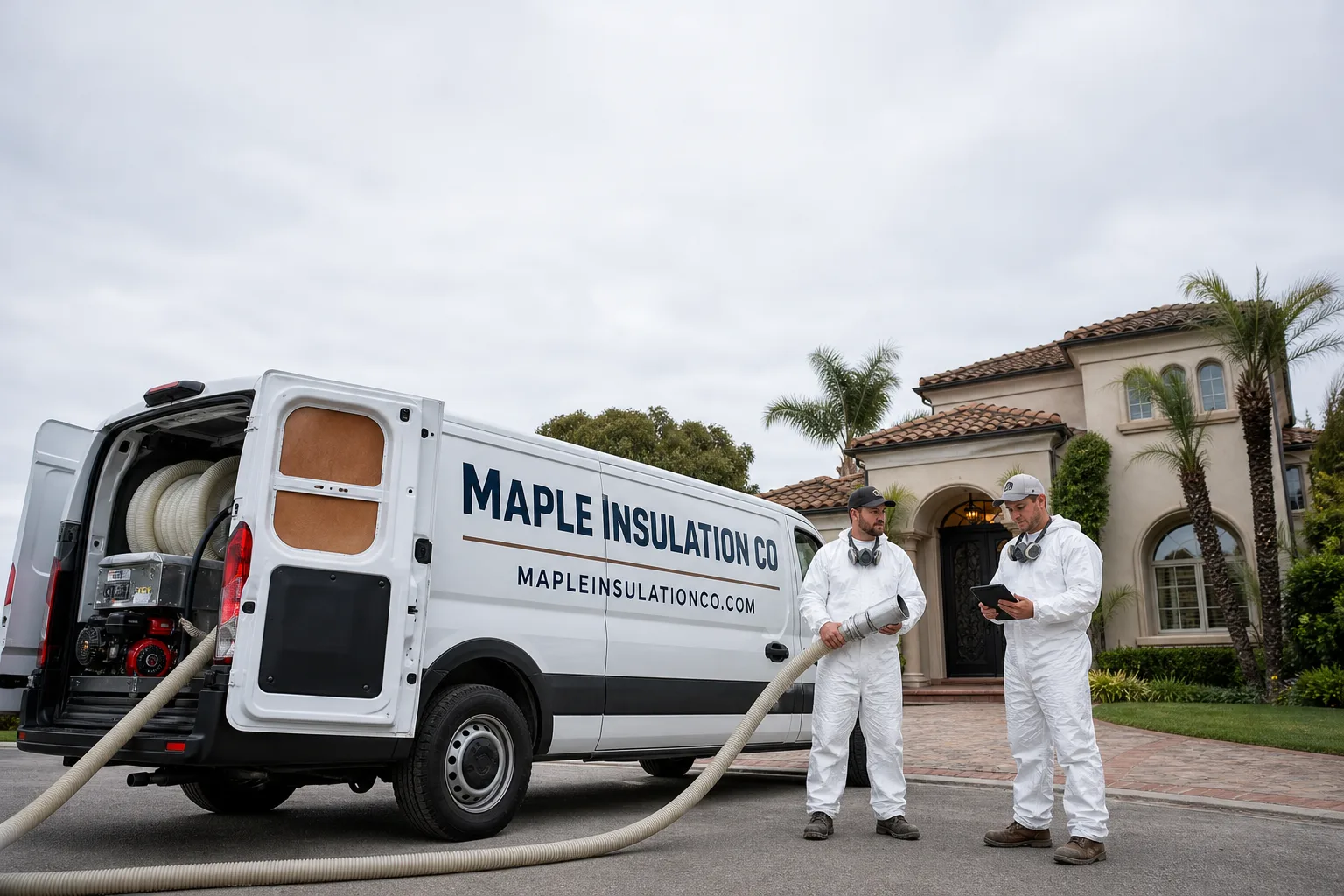
Fast, Reliable Spray Foam Insulation Across Coto De Caza
Spray foam insulation in Coto De Caza typically runs $2.50 to $6.50 per board foot installed, with a full attic retrofit on a large custom home landing between $8,000 and $22,000 depending on foam type, roof complexity, and whether Chapter 7A venting upgrades are required. Most jobs we take in Coto De Caza are retrofits, not new construction. That’s the reality of this community: large custom homes built between the 1980s and early 2000s, many with original batt insulation that’s sagging, shifted, or never did the job in the first place. We know these houses, we know these streets, and we know what a guard-gated canyon-side property requires when the crew shows up. Call (855) 341-6045 and we’ll walk you through what your specific home needs.
Why Maple Insulation Co Is Coto De Caza’s Preferred Spray Foam Insulation Company
Noel Castaneda leads our team with a simple operating rule: match the material to the problem, not to what we happen to stock most. We carry eight insulation brands across every major category, which means when we walk into a Coto De Caza attic and find a ball of poorly sealed top plates, a sagging fiberglass layer, and ductwork running through a 140-degree dead-air zone, we aren’t trying to sell you the one product on our truck. We’re diagnosing your house.
Coto De Caza homeowners have a specific problem profile. The homes are big, architecturally varied, and the original insulation was often code-minimum for the 1980s, which is to say inadequate for the inland foothill summers we get here. We’ve worked the gated communities off Coto de Caza Drive, the canyon-side streets off Vista del Verde, and the custom lots backing up to the Cleveland National Forest boundary. The response time to Coto De Caza from our base is under an hour for most calls, and we schedule free estimates on your timeline. The reviews from this area keep pointing to the same thing: we showed up when we said we would, we explained the options in plain language, and the house is quieter and cheaper to cool. For a complete look at how our Spray Foam Insulation team approaches every project, we break down our material-agnostic philosophy there.
Open Cell Spray Foam in Coto De Caza
Open Cell Spray Foam is the workhorse of most retrofit jobs we do in Coto De Caza, because it expands aggressively into the awkward, hard-to-reach gable bays and cathedral ceiling pockets that dominate these steep-roof custom homes. A full open-cell retrofit in Coto De Caza typically runs $2.50 to $4.00 per board foot, with an average 4,000-square-foot attic landing between $10,000 and $16,000. The foam goes in as a liquid, expands to fill the cavity, and once cured acts as both an air seal and a thermal barrier. Open-cell foam is air-permeable, which means it won’t trap moisture in the wood framing the way a misapplied closed-cell foam can. In the dry foothill climate, that’s the right tradeoff for most roofs.
Air Sealing Before Foam
The single biggest mistake we see in Coto De Caza attics is foam applied over unsealed top plates, recessed can lights, and original duct registers. The foam traps heat around the penetrations and the attic still cooks. On a mid-1980s custom home off a guard-gated canyon-side street, our crew found the original batt insulation sagging away from a complex multi-gable ceiling deck, leaving dead-air pockets above the great room. We air-sealed the top plates and can lights first, then applied Icynene open-cell foam to the underside of the roof deck so the steep gable bays were fully covered. Summer attic heat gain dropped almost immediately, and the ductwork became part of the conditioned envelope for the first time since the house was built.
When Open Cell Beats Closed Cell
For Coto De Caza’s climate profile, open-cell foam handles the primary load: radiant heat from a 150-degree attic baking down through the ceiling. Closed-cell foam adds structural rigidity and moisture resistance, and it’s the right call for rim joists and garage ceilings. But on a steep multi-gable roof deck where access is already brutal, open-cell’s expansion characteristics mean fewer under-sprayed voids. We’ll walk you through the R-value numbers and moisture realities for your specific roof before anyone picks product.
Spray Foam Insulation Contractors in Coto De Caza
Spray Foam Insulation Contractors who actually understand Coto De Caza know that the job isn’t code-minimum new construction. The work here is retrofit-dominant, on homes with steep rooflines, complex gable intersections, and original batt insulation that has failed by any honest standard. A rim joist spray foam job in Coto De Caza, sealing the band joist where the foundation meets the framing, typically runs $1,500 to $3,500 depending on access and the current condition of the joist bays. Most homes built in the 1980s through 2000s have zero rim joist sealing, which is a primary air-infiltration path. The air that leaks in at the rim joist is the same air that makes your bedrooms stuffy in August and your heating bill spike in December.
Retrofit Versus Repair Decisions
The first question we ask a Coto De Caza homeowner: is your existing insulation actually performing, or is it just sitting there? In most 1980s custom homes we assess, the original fiberglass batts have compressed, slid, or been disturbed by decades of attic work and rodent traffic. Repair, meaning patching and fluffing batt insulation, is cheaper in the short term and rarely worth it. Retrofitting with spray foam costs more upfront and solves the actual problem: the thermal bypasses at the ridge, the gable corners, and every unsealed top plate. For sustained energy savings in this type of home, the retrofit wins every time.
Garage Ceiling and Roof Deck Work
Garage ceiling spray foam comes up constantly in Coto De Caza, particularly on homes where the garage sits under a bonus room or master suite. The garage ceiling is a thermal boundary, and in the foothill summer it becomes a heat sink that radiates upward all night. Sealing and foaming the garage ceiling, including the band areas around the door, typically runs $2,000 to $5,000 and transforms a bedroom above the garage from the hottest room in the house to a normal one. Roof deck foam on steep multi-gable structures is more labor-intensive here than in the tract housing of Mission Viejo, precisely because the geometry fights you.
Trusted Brands We Service in Coto De Caza
We carry Icynene and Demilec spray foam lines, Owens Corning fiberglass, Johns Manville batts, and Rockwool mineral wool. That’s four manufacturers among an eight-brand roster, each with a specific job they do best. For Coto De Caza homes with wildfire exposure, Rockwool’s fire-resistant properties are frequently the right recommendation for exterior wall cavities and attic upgrades, while Icynene open-cell handles the roof deck. We keep local parts and common product in stock for Coto De Caza service calls, which means a rim joist or garage ceiling job doesn’t wait on a distributor shipment. The right material is already on the truck.
Common Spray Foam Insulation Problems We See in Coto De Caza Homes
- Steep multi-gable attic bays with under-sprayed cavity ends. The 1980s and 1990s custom homes off Coto de Caza Drive and Vista del Verde have rooflines that create dozens of hard-to-reach gable corners. A contractor without the patience or equipment for confined work leaves thermal bypasses at the ridge, and the homeowner pays for foam that only performs at 70%.
- Foam applied over unsealed can lights and top plates. Recessed lighting is everywhere in Coto De Caza homes, and it’s a penetration straight into the attic. Foaming over an unsealed can light traps heat around the fixture. The fix is air-sealing first, then foam, and it changes the attic’s heat profile dramatically.
- Chapter 7A wildfire venting conflicts during re-insulation. Because Coto De Caza sits in a high fire severity zone under Chapter 7A of the California Building Code, a spray foam retrofit can trigger wildfire-resistant attic venting and exterior component requirements. Applying foam without addressing the venting upgrade first means you might be undoing the work in six months when the county asks questions.
- Original ductwork buried or left in the dead-air zone. Homes built in the 1980s and 1990s ran ductwork through unconditioned attic space, which is a straight line from the AC unit to an 18% to 30% cooling loss in the foothill summer. Spray foam on the roof deck pulls the ducts inside the conditioned envelope, but only if the foam is continuous and the ducts are sealed. Half-measures still cook the attic.
Pricing for Spray Foam Insulation in Coto De Caza, CA
Open-cell spray foam on a Coto De Caza roof deck runs $2.50 to $4.00 per board foot. Closed-cell foam, which we recommend for rim joists and garage ceilings, runs $3.50 to $6.50 per board foot. A full custom-home retrofit with air sealing, attic prep, and foam typically lands between $10,000 and $22,000. The spread reflects three things: roof geometry, the condition of the existing insulation and air barriers, and whether the home is in the Chapter 7A wildfire zone, which can add venting upgrades you wouldn’t need in flat-roof tract housing. Every estimate we give in Coto De Caza is free, and it’s specific to your house, not a square-footage formula. Call (855) 341-6045 and Noel will walk the property with you before anyone quotes a number.
We Also Serve Cities Near Coto De Caza
Our territory covers the south Orange County foothills and the communities around Coto De Caza, including Mission Viejo, Lake Forest, Laguna Hills, and Rancho Santa Margarita. Many of our Coto De Caza clients own rental properties or family homes in neighboring cities, so we handle multi-property insulation work across the Coto De Caza area and the surrounding corridor. Same standards, same material-agnostic approach, same crew.
Serving Coto De Caza, CA — Our Local Coverage Area
We’re based in the Coto De Caza area and know this community well. Use the map below to see our service coverage — if you’re nearby, we can almost certainly help.
FAQs About Spray Foam Insulation in Coto De Caza
Yes, it can. Coto De Caza falls within a high fire severity zone under Chapter 7A of the California Building Code, which means any meaningful roof or attic retrofit, including spray foam applied to the underside of the roof deck, can trigger requirements for wildfire-resistant attic vents, ember-resistant eave details, and specific exterior component standards. The trigger isn’t automatic for every job, but it’s common enough that we check with Orange County building officials before quoting a retrofit. The good news: we’ve done this upgrade path repeatedly in this community, and the venting requirements pair cleanly with a full air-sealed roof deck. Call (855) 341-6045 and we’ll tell you exactly what your specific roof triggers before you spend a dollar.
Yes, and we do it regularly. The steep multi-gable rooflines common in 1980s through 2000s Coto De Caza custom homes create dozens of tight gable bays and ridge intersections that flat-roof tract crews never face. The key is patience, the right access equipment, and an experienced crew that knows how to get the foam into the far corner of every cavity. We’ve foamed gable ends off Coto de Caza Drive, canyon-side custom lots, and homes backing up to the Cleveland National Forest boundary. The difference in the finished product is whether those gable corners get full coverage or under-sprayed thermal bypasses.
For the roof deck, open-cell spray foam is the better recommendation in most Coto De Caza homes. The primary load in this climate is summer attic heat and radiant gain, and open-cell foam expands to fill the irregular gable bays and cathedral ceiling pockets that dominate these rooflines. It air-seals and insulates in one pass, and its air-permeable structure means it won’t trap moisture in wood framing the way closed-cell can if it’s misapplied. Closed-cell is the right tool for rim joists and garage ceilings, where the higher R-value per inch and moisture resistance justify the extra cost. We’ll walk you through both products on your specific roof before any recommendation.
In a Coto De Caza home built in the 1980s or 1990s, retrofit almost always beats repair. The original batt insulation in these houses has compressed, shifted, or been disturbed, and the air leaks at top plates, can lights, and rim joists were never sealed in the first place. Repairing batt insulation patches the symptom; spray foam retrofits address the thermal bypasses, the air infiltration paths, and the radiant heat load as one continuous solution. Repair is cheaper on day one, around $1,500 to $3,500 for a patch job, but the energy savings never materialize. Retrofit costs more and actually lowers the bills. For most homeowners in this community, the math is clear within three to five summers.
Yes, and this is one of the biggest wins for Coto De Caza homes specifically. Homes built in the 1980s through early 2000s ran ductwork through unconditioned attic space, which means the AC is blowing cold air through a 140-degree oven all summer. Spray foam applied to the underside of the roof deck pulls the ducts inside the conditioned envelope, which eliminates the temperature differential and recovers the 18% to 30% cooling loss you’re paying for every month. The ducts need to be sealed first, because foam over leaky ducts just buries the problem. We inspect and seal the duct runs before the foam goes in.
Get Your Free Coto De Caza Spray Foam Estimate
The right spray foam insulation for your Coto De Caza home depends on your roof, your climate zone, and what you’re trying to fix. Whether it’s a full attic retrofit, rim joist sealing, or a garage ceiling that’s cooking the bedroom above it, we’ll walk the property with you and give you a straight answer about what the house actually needs. Call (855) 341-6045 today and schedule a free estimate. Noel Castaneda and the Maple Insulation Co team are already working in Coto De Caza this week.
Written by Noel Castaneda, Owner at Maple Insulation Co, serving Coto De Caza and the surrounding south Orange County foothills.