
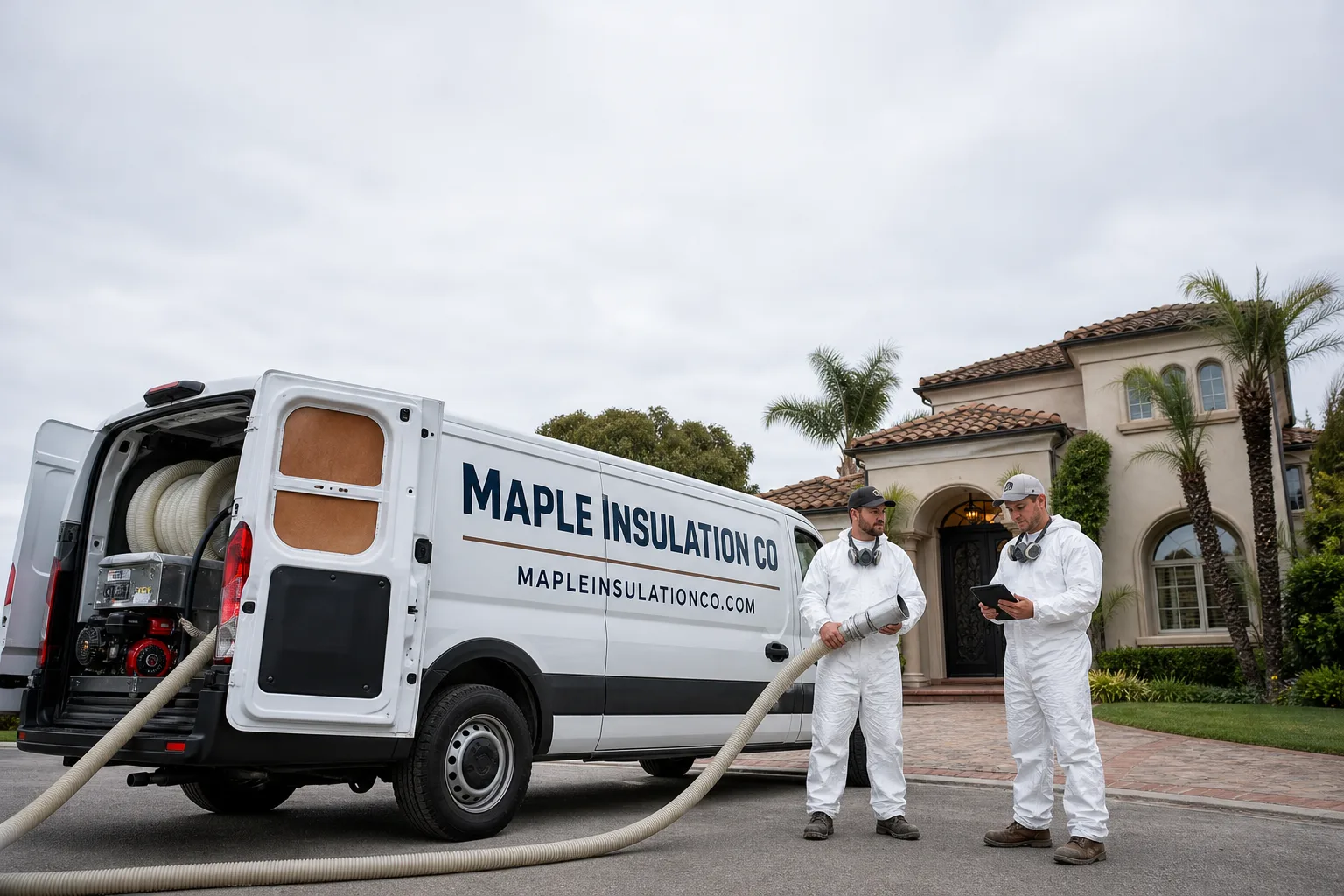
Fast, Reliable Attic Insulation Across Aliso Viejo
Attic insulation in Aliso Viejo runs $1.25 – $2.10 per square foot for blown-in fiberglass, $1.60 – $3.00 for attic batt replacement, and $2.40 – $4.60 for spray foam, with most full retrofits in the city’s two-story stucco tracts landing between $1,900 and $5,400. We’re Maple Insulation Co, and we work these neighborhoods weekly – from Glenwood to Westridge to the canyon-adjacent streets off Wood Canyon Drive – so we know what a 1980s Aliso Viejo attic actually looks like before we open the hatch. Call (855) 341-6045 and we’ll get to you same week, usually within two business days.
Why Maple Insulation Co Is Aliso Viejo’s Preferred Attic Insulation Company
We’ve spent years pulling back attic hatches in Aliso Viejo, and the pattern is consistent: original fiberglass batts from the late 80s and early 90s, settled, compressed by HVAC flex runs, and no longer performing anywhere near their labeled R-value. Homeowners around Pacific Park Drive and Canyon Vistas call us because we don’t pitch a single product line. We match the material to the problem – not to what we happen to stock most.
Noel Castaneda runs our crews, and he’s the one who insisted we stock Rockwool mineral wool and Demilec spray foam alongside the more common Owens Corning and Johns Manville fiberglass. That matters in Aliso Viejo because the marine layer and afternoon ocean breezes create a daily attic temperature swing that punishes underperforming insulation harder than a steady inland climate would. Our crews work the 92656 and 92698 ZIP codes regularly, and we’ve earned our reputation here by fixing what the original builders left behind – and by flagging the salt-air problems other contractors miss.
Attic Mold Removal in Aliso Viejo
Attic mold removal in Aliso Viejo typically runs $900 – $2,300 depending on square footage and how far into the insulation the mold has traveled, and we handle it as a two-part job: containment and removal first, then fixing the moisture source so it doesn’t return. The marine layer that rolls through Aliso Viejo mornings means attics here spend part of every day near dew point, and if the original 1980s insulation is damp or compressed, mold finds a foothold fast. We remove the affected material, treat the framing with an EPA-registered antimicrobial, and identify the exact venting or air-sealing failure that fed it.
Containment and Removal
Mold spores move on air currents, so we set up negative pressure containment and bag the affected batts or blown-in material before it leaves the attic. In Aliso Viejo’s two-story stucco homes, we also check the boxed eaves and can-light penetrations directly above the mold for the air leak that carried moisture upward. Removing mold without fixing the leak is a wasted invoice.
Venting and Air-Sealing After Remediation
Once the mold is gone, we air-seal top plates, wire penetrations, and any attic access hatch, then confirm the existing soffit and ridge vents are moving air. In canyon-adjacent tracts where afternoon breezes pressurize the attic, this step matters as much as the mold removal itself. We’ll tell you what needs to change, why, and what it costs before we touch anything.
Attic Insulation Removal in Aliso Viejo
Attic insulation removal in Aliso Viejo generally costs $1,000 – $2,300 including proper bagging and disposal, and we recommend it whenever the original 1980s fiberglass batts are visibly settled, compressed by HVAC ducting, or contaminated by rodent activity and dust. We remove the old material with a commercial HEPA-filtered vacuum, not by hand-raking it toward the hatch, which keeps your home’s air cleaner during the job. Aliso Viejo attics are tight in the eaves and deep in the field, a combination that makes thorough removal slow work if done right.
When Removal Beats Topping Up
Topping up works when existing insulation is dry, clean, and still at a reasonable depth. When it’s compressed to half its intended depth, or when it’s been soaked by a roof leak or AC overflow, adding new material on top buries the problem instead of solving it. In Aliso Viejo’s older tracts, we remove far more than we top up, because the 30-year-old batts just aren’t doing anything useful anymore.
What Removal Reveals
Every removal we do in Aliso Viejo is also a discovery pass. We find cracked top plates, disconnected bathroom fan ducting, rodent-chewed wiring, and air leaks that the old insulation was hiding. You get a straight report on what we found and what it’ll cost to fix. Call (855) 341-6045 if you suspect your attic is past the point of a simple top-up.
Trusted Brands We Service in Aliso Viejo
We install and service insulation from Owens Corning, Johns Manville, Knauf, and Rockwool, so your Aliso Viejo home gets the material that fits your attic and your budget – not whatever happens to be on our truck that week. For canyon-adjacent homes where fire resistance and sound damping matter, Rockwool mineral wool does things fiberglass can’t. For standard retrofits in 92656, Owens Corning and Johns Manville fiberglass deliver the best cost-to-R-value balance. We keep common batt sizes and blown-in material staged for Aliso Viejo jobs, which trims turnaround time when your attic needs attention fast. All of it is covered under the same careful install standards, regardless of brand.
Common Attic Insulation Problems We See in Aliso Viejo Homes
- Settled and compressed 1980s batts: Original fiberglass batt insulation in Aliso Viejo’s tract homes has typically settled to half its intended depth, and the area where HVAC flex runs cross over the joists is often crushed flat. The attic reads a lower effective R-value than the builder’s label suggests, which is why so many of these attics need removal and replacement rather than a top-up.
- Radiant barrier with missing air sealing: Many Aliso Viejo homes built with radiant barrier sheathing still leak conditioned air at top plates and can-light penetrations. The marine layer-to-afternoon swing pulls that air right through the attic, keeping the radiant barrier from doing its job and driving cooling bills higher.
- Eave gaps that let hot air bypass insulation: Missing or compressed batt coverage at the eaves lets hot afternoon air pour under the insulation, so the attic hits extreme temperatures even when the field of the attic looks adequately covered. We check eave depth on every scope.
- Moisture conditions that feed mold: The morning marine layer raises attic humidity daily, and when fog or drizzle meets a warm attic, condensation forms on nails and ducting. Over months, that’s enough to start mold in the insulation, especially where bathroom fans or dryer vents dump into the attic instead of outside.
Pricing for Attic Insulation in Aliso Viejo, CA
What you’ll pay in Aliso Viejo depends most on attic square footage, ceiling height, and whether we’re removing old material or starting fresh. Blown-in fiberglass retrofits for a standard two-story stucco home are landing between $1,900 and $4,200. Batt replacement runs $2,400 – $5,400, and spray foam – which makes sense for ductwork in unconditioned attics – is $2,900 – $6,800. Add $900 – $2,300 if mold removal is needed first, before new insulation goes in. These ranges reflect the 92656 and 92698 market: smaller than Laguna Hills on average, slightly higher than some Irvine tracts because of access and hatch placement. Call (855) 341-6045 for a free estimate – we measure, inspect, and quote in one visit.
We Also Serve Cities Near Aliso Viejo
Our crews cover the surrounding South Orange County cities, including Laguna Woods, San Joaquin Hills, Laguna Hills, and Irvine. If you’re outside Aliso Viejo but close, visit our Aliso Viejo service area page or see our main Attic Insulation service page for details on what we do across the region.
Serving Aliso Viejo, CA — Our Local Coverage Area
We’re based in the Aliso Viejo area and know this community well. Use the map below to see our service coverage — if you’re nearby, we can almost certainly help.
FAQs About Attic Insulation in Aliso Viejo
Salt-laden marine air moves through Aliso Viejo’s canyon-adjacent tracts daily, and it settles on springs, hinges, rollers, tracks, and opener chains far more aggressively than in inland Orange County cities. The same morning marine layer that swings your attic temperature also accelerates corrosion on any unprotected steel or zinc hardware attached to the structure, so galvanized or coated springs and stainless or nylon hardware are the fix. Our attic scopes include a garage-hardware corrosion check because the two systems sit in the same air. Call (855) 341-6045 and we’ll look at both while we’re up there.
Almost never. Original fiberglass batts in Aliso Viejo’s 1980s tract homes have typically settled, compressed under HVAC flex runs, and lost a significant share of their labeled R-value, meaning your attic is fully insulated in name only. We recommend removal and replacement rather than topping up when the material reads visibly compressed or has been wet. The right move for most of these homes is air sealing and new blown-in or batt insulation, and we’ll show you exactly what we find before any material is ordered.
In Aliso Viejo, the daily marine-layer-to-afternoon-sun swing means radiant barrier performance and air sealing deliver more comfort per dollar than chasing extra R-value alone. Yes, R-value still matters. But if your attic leaks air at top plates and can-light penetrations, and if your radiant barrier is missing or poorly vented, adding R-value on top of that leaks efficiency. We scope the full attic – insulation depth, air leakage, venting, and radiant barrier condition – and then recommend the sequence that gets your afternoon heat gain under control first.
Yes. When original batts settle or compress, they lose loft and create dead air pockets where moisture collects during the morning marine layer, and that moisture feeds mold growth over time. We’ve removed mold from compressed batt insulation in Aliso Viejo homes more times than we can count, and in most cases the fix required both remediation and correcting the air-sealing or venting failure that let moisture sit in the first place. Mold removal runs $900 – $2,300 and should happen before new insulation goes down. Call (855) 341-6045 for a mold-and-insulation scope.
When we air-seal and re-insulate the attic over an attached garage, we also inspect the garage-door springs, hinges, tracks, and opener chain because the same coastal air that cycles through the attic rusts that hardware. In Aliso Viejo, corroding garage-door components are an annual problem, and a stiff hinge or a broken spring can bind the door and stress the framing and drywall that the attic insulation sits against. We flag what we find and recommend coated springs, nylon rollers, or stainless hardware as needed, so the garage and the attic stay in sync.
Written by Noel Castaneda, Owner at Maple Insulation Co, serving Aliso Viejo and the surrounding South Orange County communities.